Food Wars: Shokugeki no Soma
Studio: J. C. Staff
Streamed via Crunchyroll

When I was a teen, I was really into Iron Chef, a competitive Japanese cooking show which might be viewed as the forefather of most of the Food Network’s current lineup. “Food Wars: Shokugeki no Soma” is another descendant. An anime based on manga by Yuto Tsukuda and Shun Saeki, it follows the adventures of teenaged hero Yukihira Soma through Japan’s most prestigious and rigorous cooking school. Soma is the son of a competitive and mysterious diner owner, and he’s been cooking since he was a child. At first, he looks down the other students, who’ve ‘never served a customer before,’ but as the series goes along, he learns a lot about cooking through competing with them.
Shokugeki no Soma falls in line with many of the tropes associated with anime aimed at teenage boys. There are lots of nonsensical rivalries, training, and challenges to overcome while forthrightly contemplating philosophical points. And also plenty of fan service. These are certainly the first chef’s jackets that I’ve ever seen with cleavage. But even the fan service has its own goofy charm. The series is constantly searching for new ways to express culinary language visually. These range from a group of people eating a pork-roast so good their clothes explode to a panel of judges piloting a lobster rocket into space.
The first season of Food Wars: Shokugeki no Soma is currently streaming online at Crunchyroll, and is coming to DVD. While the show ends at a bit of a cliffhanger, and a second season has yet to be announced, this is an excellent series for foodies and anime fans alike. I’d like to give a hat tip to Jason Banks of the Talk Nerdy To Me podcast for the recommendation.
If you enjoyed this article, please share it! For exclusive content and podcasts, sign up for my Patreon feed!
Hugh Likes Anime: Food Wars
October 8, 2015
Hugh Likes Anime anime, cooking, food wars, HLA, Hugh Likes Anime, Japan, review Leave a comment
Hugh Likes Comics: Starve
October 7, 2015
Hugh Likes Comics Brian Wood, Comics, Danjiel Zezelj, Dave Stewart, HLC, Hugh Likes Comics, review, Starve Leave a comment
Starve
Brian Wood, Danijel Zezelj, and Dave Stewart
Published by Image Comics
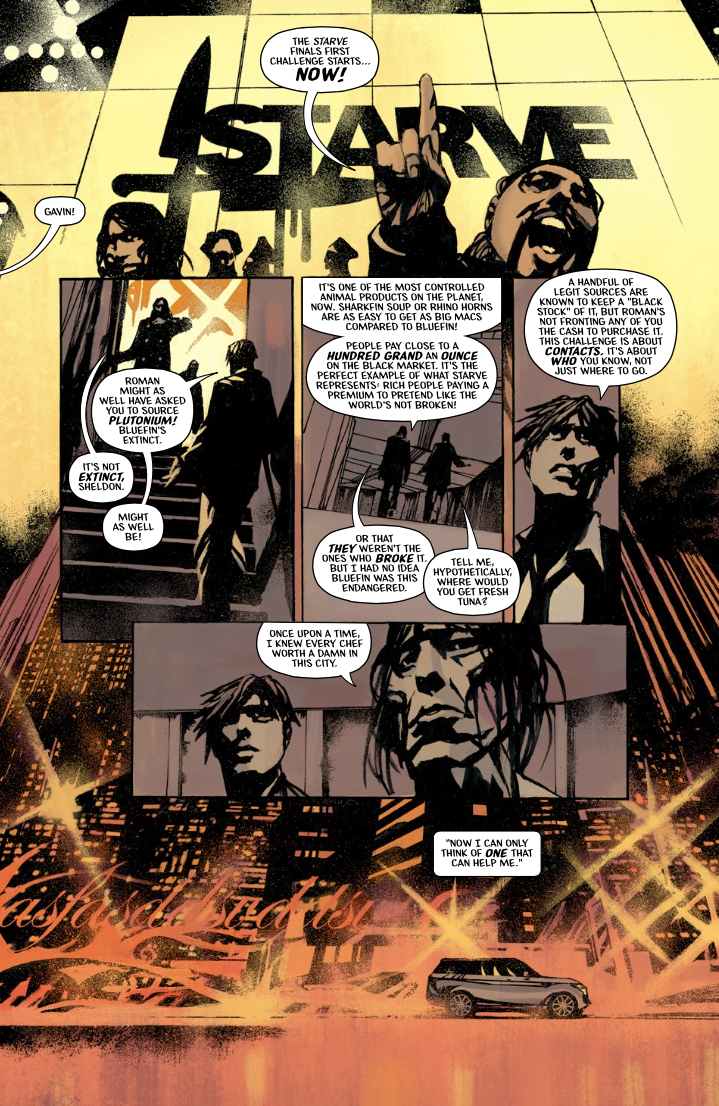
So I’ve been really thinking about cooking lately. Not just how to cook, or where my food comes from, but the whole process, how something goes from a pile of disparate ingredients and becomes something else. I’ve also been reading “Starve” by Brian Wood, Danijel Zezelj, and Dave Stewart. Much like a fine meal, a comic that is more than the sum of its parts.
“Starve” is the story of runaway reality TV Chef Gavin Chruikshank. After the collapse of the global economy and the ruin of his marriage, he disappeared into the wilds of Southeast Asia. Three years later, the network comes looking for him, to force him to fulfill his season contract on a show that is very different than the one he originally began. “Starve” is no longer a travel show, but a competition for the benefit of the 0.1%, still on top despite economic and environmental catastrophe.
Starve is a fun little near future drama, with Gavin fighting for the soul of Chefdom and the love of his daughter against his estranged wife and the rival who stepped into his shoes. It’s politics, aside from F*CK THE 1%, are tough to pin down, but it is a joy to watch anarchic, barbarian chef Chruikshank work his magic. He’s nasty, belligerent, and entirely too much fun. He’s Hunter S. Thompson in a white jacket. While he is a master chef, the comic aims to shock rather than hunger. In the first issue, Gavin is asked to prepare a dog. Rather than being horrified, as is the intention, he carves up a slice, narrating that people all over the world eat dog.
The art is moody and heavily inked, with dark, brooding figures even under blazing stage lights. The washed out color palate further emphasizes the crushing blandness of the excess “Starve” represents.
If I had a complaint, it is I wish they would do more with Gavin’s sexuality. This is hardly a romantic book, but so far, (three issues published at the time of writing) Gavin’s homosexuality has been raised as an important character trait, but never explored. It’s simply treated like another vice, or another thing his ex-wife holds against him. He has had some interaction with his male handler, but almost all of his important relationships are with women.
While it may not whet your appetite, “Starve” is far from slight. Check it out on Comixology or in your local comics shop.
Hungry for more content? Support my Patreon for early and exclusive podcasts and articles!
Hugh Likes Podcasts: The Melting Potcast
October 5, 2015
Hugh Likes Podcasts HLP, Hugh Likes Podcasts, podcasting, review, The Melting Potcast Leave a comment
The Melting Potcast
A F Grapin and Erin Kazmark
TheMeltingPotcast.com
I listen to a lot of writing and fiction podcasts. Most of them try and cultivate a specific audience. The Drabblecast is narrowly focused on weird fiction. Ditch Diggers is specifically about the business side of writing professionally. Specificity is good, usually. But I really enjoy podcasts that go a bit broader. My own podcast, The Way of the Buffalo, is founded on the new, rather than specific genre or even medium. But I can’t think of a podcast that attempts to reach a broader audience that The Melting Potcast.
Billed as ‘a little bit of everything for everyone everywhere,’ they present flash audio fiction based on prompts, longer short stories not constrained by topic, and author interviews, amongst other content. For the sake of full disclosure, I have had one of my own stories appear on the show.
Hosts Erin and A. F. inject humor and passion into their presentations, and the quality is top-knotch. They are accompanied by regular and guest readers. The prompts so far have been clever and interesting, creating a surprising variety of stories that hit on a variety of genre and emotional beats. They’re still fairly new, but their passion for fiction, hard work, and supportive community all shine through. This is definitely a podcast to watch, because it’s only going to get better as it keeps going. Find The Metling Potcast in iTunes, or the podcatcher of your choice.
If you enjoyed this article, please share it, or join my Patreon for more print and audio content.
Hugh Likes Video Games: Castlevania
October 2, 2015
Hugh Likes Video Games Castlevania, Dracula Season, HLV, Hugh Likes Video Games, NES, review Leave a comment
Castlevania
Konami
Nintendo Entertainment System

October is Dracula Season here in the Hugh Likes… HQ, and for my money there is no better modern representation of the character than the Castlevania franchise. The original, produced by Konami in 1987, is a classic example of the old-school challenge of the NES. Tough but never entirely unfair, the player controls Simon Belmont as he fights his way through Dracula’s castle to his showdown with the King of Vampire himself.
The original game has a fun, almost campy sense of atmosphere as Belmont fights his way through a laundry list of B-movie monsters. Famously difficult, the game really conveys the feeling of the environment itself as an adversary. This is a difficult balance to achieve, because it can more often feel like the player is fighting the programmers rather than the game. Like Nintendo’s flagship Super Mario Bros, Castlevania is a sprawling environment that relies on careful exploration, precise timing, and sharp reflexes. Belmont is armed with an upgradable whip and a variety of subweapons that he finds in the castle. While blindly rushing ahead and collecting every subweapon as it drops can result in a series of deaths, a careful strategy, admittedly formed through trial and error, guides the player through each level. A very generous continue system for the time lets the player keep trying for as long as they like.
With the sad news that Konami is scaling back its production to focus on the mobile phone market, we may not see anything new from the series for a while. What better time to dust of a control pad and take your journey through Dracula’s Castle?
Castlevania was originally released for the Nintendo Entertainment System as well as other 8-bit consoles and arcades. It is also available digitally for the Nintendo Virtual Console on Wii, Wii U, and 3DS.
Enjoy Hugh Likes Video Games? Please consider joining my Patreon for more content!
Hugh Likes Video Games: Xeodrifter
September 25, 2015
Hugh Likes Video Games Gaming, HLV, Hugh Likes Video Games, PS Vita, Renegade Kid, Xeodrifter Leave a comment
Xeodrifter
Renegade Kid
PC, PS4, Vita, 3DS, WiiU

Inspired by Metroid, Xeoodrifter is an shooter/platformer/exploration game in the classic style. The player guides their space-suited explorer through the interiors of four maze-like planets while collecting power ups that let him go further. Presented in a “pixel art” style, this Metroid-clone actually has a lot to offer, with deep exploration mechanics, and fun abilities like turning into a rocket or submersible.
This game is a colorful but short Metroid clone. The gained abilities are all fun and challenging without being too complicated, but the boss fights would have benefitted from more variety rather than having the same recolored sprite with slightly upgraded powers and health. The four worlds each have their own unique look, but all feel very similar. The game hints at depth but never really delivers beyond a few hours of gameplay. It is a free game in the Playstation Plus program, though, so it is well worth checking out if you are a member.
Xeodrifter is a fun little explorer that will charm old school gamers for a short time, but leaves nothing behind after the credits roll.
Hugh Likes Comics: Toil and Trouble
September 23, 2015
Hugh Likes Comics Comics, HLC, Hugh Likes Comics, review, Shakespeare, Toil and Trouble Leave a comment
Toil and Trouble #1
Written by Mairghread Scott
Drawn by Kelly and Nichole Matthews
Published by Archaia
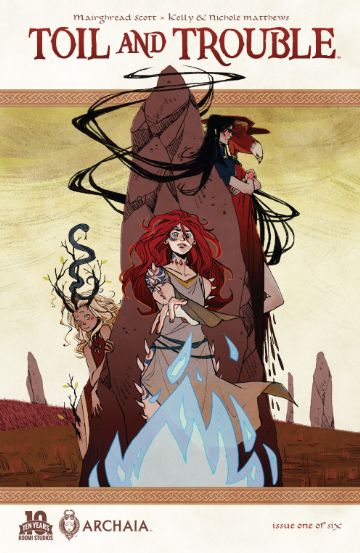
Shakespeare enjoys a peculiar place in the canon of English literature. Both a foundational document and endlessly mutable, it is performed, reenacted, remixed, and endlessly reinterpreted. Romeo and Juliet inspired the musical West Side Story. King Lear was translated into Akira Kurosawa’s opus film Ran. Recently, the tragedy of Hamlet was remixed into the Choose-Your-Own-Adventure style game-book, To Be or Not To Be. Toil and Trouble takes up from Macbeth, focusing not on the Thane, but the Witches.
Structurally, it resembles the Tom Stoppard Play “Rosencrantz and Guildenstern Are Dead,” which follows the two titular henchmen from before their introduction and up to their bumbling, offstage demise. (Spoiler alert for a four-hundred and a fifty year old play, respectively.) The comic follows Smertae, one of the three witches, returning to Scotland after being banished. The reason for her banishment is unclear, but seems to involve Macbeth. Like the Stoppard play, the action of the original Shakespeare drifts around and through the dialog of the comic. In this first issue, the reader sees an expanded version of the opening scene.
In Scott’s version of events, the witches are agents of Fate, tasked with ensuring the continuity of Scottish royalty. To accomplish this, they mean to strike down Macbeth in order to give Prince Malcolm a trial to ready him for the throne. Smertae is against the plan, but reluctantly agrees. We then follow the witches in their work cursing Macbeth’s camp, and in the battle the next day, where Smertae makes a decision that goes against fate.
I was drawn to this comic because I am a huge fan of the Scottish Play. The plot is an interesting take, and I’m excited to see how it interacts with the original. The writing is actually quite solid, and the dips into 17th Century language feel natural with the rest of the dialog. The world building is the biggest break from the original, but I’m a sucker for the concept of a fading magical world, struggling in the face of onrushing modernity, and Scott absolutely nails this fantasy milieu.
What surprised me is the exceptional quality of the art. The Matthewses style is absolutely gorgeous, and the designs, particularly of the three witches, are immediately eye-grabbing and carry a lot of the story’s weight. The three represent Sea, Earth, and Sky. Smertae has crab-like spikes jutting from her body, and her sisters equally expressive of their elements. The ‘acting’ of the characters is also very well done. The meeting scene is wonderfully emotional without relying too heavily on the dialog to convey meaning, for example. The art is helped by bright and detailed coloring and inventive layouts, such as the climactic battle splash page, which features small circular insets showing the effects of the witches curses in the epic clash.
“Toil and Trouble” is the first part of a series I can’t wait to read more of. Find it on Comixolgy, or in the rack at your local comics shop.
Hugh Likes Podcasts: The Voice of Free Planet X
September 21, 2015
Hugh Likes Podcasts HLP, Hugh Likes Podcasts, Jared Axelrod, podcasting, The Voice of Free Planet X Leave a comment
HLP-The Voice of Free Planet X
Produced and hosted by Jared Axelrod

Over the course of over one-hundred and seventy-five episodes, Jared Axelrod has hosted a variety of projects on his podcast, The Voice of Free Planet X. It began as a presentation of his short fiction. It has also served as a platform for his sci-fi puppetry project, “Aliens You WIll Meet.” It featured the serialized steampunk adventure “Fables of the Flying City,” which is where I jumped on board. But the latest, recently begun project revives the original title, and is an outstanding podcast production.
Ostensibly published by GPR (Galactic Public Radio) The Voice of Free Planet X is This American Life for a fantasy world, a Radio Lab of the impossible. Jared interviews stranded aliens and out-of-the-casket vampires. He talks to AI musicians and post-apocalyptic road warriors.
It is a clever response to the post-Serial podcast landscape, and the production values are top-notch. It takes a discerning ear to determine the show was made in a home studio with actors, and not on the board of a WBEZ mobile truck. But the real strength lays in Axelrod’s writing, and the performances of his interview subjects. He’s managed to take spec-fic cliches, such as vampires as metaphors for sexual deviancy, and breathe new, and interesting, human life into them. The format does an end run around suspension of disbelief, but the voice, if you will, is what sells it. These interviews aren’t pulse-pounding adventure stories. They are the best sort of feature story for people that never existed. And like the best of this flavor of fiction, it bleeds into the way we see the real world. Because you never know when that youtuber will turn out to be an incarcerated computer intelligence.
Hugh Likes Video Games: Final Fantasy Adventure
September 18, 2015
Hugh Likes Video Games Final Fantasy Adventure, Game Boy, Gaming, HLV, Hugh Likes Video Games, RPG, Squaresoft, Video game 1 Comment
Final Fantasy Adventure
Game Boy
Square/Sun Soft


Today we’re traveling back in time for a classic edition of Hugh Likes Video Games. Final Fantasy Adventure is a action RPG originally released for the Game Boy by Square. Released in Japan as Seiken Densetsu, western fans may be more familiar with its blockbuster sequel, Super Nintendo’s “Secret of Mana.” The game follows a escaped gladiatorial slave as he fights against the forces of the evil Glaive empire to protect a mysterious girl who may be the key to an ancient power.
A top-down action role playing game, Final Fantasy Adventure feels more like the Legend of Zelda than its command-based namesake. In fact, the name was changed for the U.S. market to tie-in to the popular NES and SNES titles. Over the course of the game, the hero, who the player names themselves, equips a variety of weapons, armor and magic, travels through a world that is surprisingly vast for the little handheld, and befriends a number of allies to help in his adventure.
Having recently replayed Final Fantasy Adventure, I can say that it holds up in some ways and not others. The combat is solid fun, and the story is spare but enjoyable. The repetitive dungeons and occasionally frustrating puzzles, which occasionally rely on luck rather than skill, are not. Also aggravating are the town NPCs, who have completely idiotic pathfinding, and give long speeches whenever you touch them. Getting out of town can occasionally be more of a hassle than the dungeon you just left.
Despite the antiquated elements of the game, Final Fantasy Adventure remains a hidden gem from the dawn of handheld gaming. It is not yet available in the Nintendo Virtual Console store, but there was a rather bland remake for the game boy color called “Sword of Mana.” Unfortunately, it didn’t hold up to the original. If you have an old Game Boy or GBA laying around, pick up this one if you get the chance.
Drabble-The Alien Message
September 17, 2015
Free Fiction Drabble, Fiction, Sci-Fi Leave a comment
The message was short, and at first, puzzling. It boomed in every local language from anything with a power source and a speaker. There should have been a mothership, a miles long modern sculpture hanging over a major metropolitan center. That was the alien invasion Hollywood promised us. But the skies were clear. All we got was the message, delivered in a smooth, emotionless baritone.
“The test begins now. You have eight minutes. Good luck.” At first, this contact was met with confusion. We only understood it when the sun went out.
And by then, it was far too late.
Hugh Likes Comics: Wayward
September 16, 2015
Hugh Likes Comics Comics, HLC, Hugh Likes Comics, Image, Japan, Jim Zub, Steve Cummings, Urban Fantasy, Wayward Leave a comment
Wayward Vol. 1: String Theory
Written by Jim Zub
Drawn by Steve Cummings
Published by Image Comics

Rori Lane isn’t your typical teenager. The daughter of an Irish engineer and a Japanese seamstress, she moves to Japan to live with her mom after her dad ‘didn’t work out.’ Before she can settle in, she begins to have visions of glowing red thread, and is soon drawn in to the dangerous hidden world of the Yokai, or Japanese monsters. But she isn’t on her own. She makes friends with other mythological denizens: An energetic cat girl, a classmate laboring under a curse, and a mysterious homeless boy with untapped powers.
Cummings’s art is gorgeous, and dispenses with pop-culture cuteness. The Yokai in this book are by turns tough, terrifying, and absolutely disgusting. There are no fuzzy-wuzzy kitsune mascots, and the kappa have a taste for human flesh, not cucumbers. The gore is a little brutal at times, but the grown-up monster designs do a great job of just how deep and dark the well they they’ve stumbled into is.
The detail in the art is quite appealing as well. Having worked as a English as a Second Language teacher in Japan, I noticed lots of little details in the background art that made the Tokyo of the book come alive.
“Wayward” is one of those odd little books that is too adult for YA based on the fact that the teenaged characters act a little too realistically. Rori is foul-mouthed and psychologically damaged in ways that would make Katness Everdeen crap her pants. Her mother is loving, but busy and at times distant. Rori’s real teenage problems fitting in to a new environment are a nice parallel to her supernatural adventures. While too much for youngsters, this is an excellent, but serious fantasy adventure for older teens. Parental discretion advised, of course.