Home

Hugh Likes Comics: Ms. Mavel

Leave a comment

Ms. Marvel
Written by G. Willow Wilson
Drawn by Adrian Alphona, and others.
Published by Marvel Comics
Saturday-1st-Ms-Marvel-Kamala-Khan-2

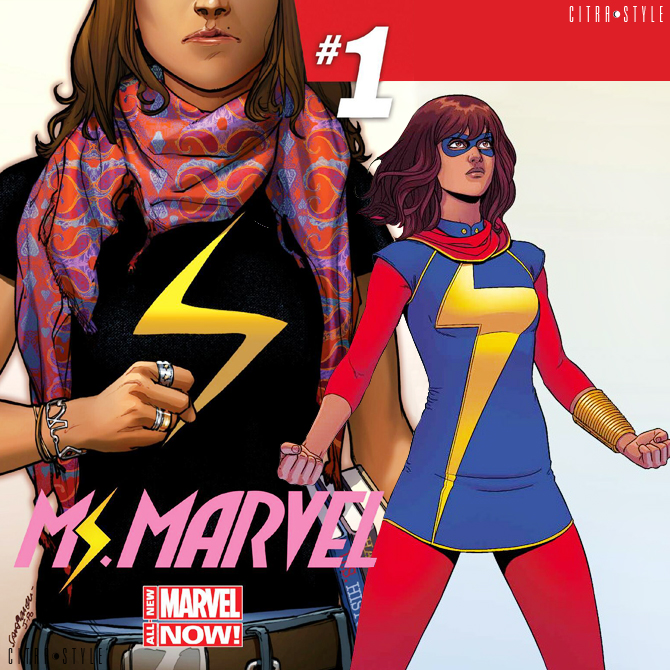
Spider-Man was the quintessential teen superhero. When he was introduced in the early sixties, teens in comics were either sidekicks like Robin, or less genre characters like Archie. But Peter Parker both fought villains and managed the travails of family and high school. Marvel has attempted to replicate this formula many times since, with varying levels of success. The most recent, and possibly most successful attempt, is “Ms. Marvel” by G. Willow Wilson and drawn by Adrian Alphona.
Kamala Khan is a Pakistani-American Girl living in Jersey City. When a supernatural event gives her superpowers, she has to figure out how to navigate being a costumed heroine like her idols, Captain Marvel and the Avengers, while also dealing with her daily life.
“Ms. Marvel” is great because it is authentic where most most pulp fiction goes over the top. That isn’t to say that this isn’t a comic full of super-heroic action and giant robots, because it totally is. But WIlson has taken great care in not only creating deep characters, but also presenting a broad range of characters within the community of Jersey City. Identity is the central theme of this story, and the level of nuance she brings to the topic is stunning for a funny-book.
In a marked contrast to Stan Lee’s throwing a mountain of slang against the wall and seeing what sticks, WIlson starts off her book talking about concern trolling. In a media landscape where the Muslim community is so often reduced to images of terrorism and privation, this is a huge deal.
Kamala’s rebelliousness and her struggle with her own identity plays out nicely against her shapeshifting powers. When she gains them, she says she would like to be her hero, Captain Marvel, ‘in the classic, politically incorrect costume, and kick butt in giant wedge heels.’ but when she turns into that, she finds it is entirely wrong for her. She’s at her most powerful when she uses her powers to stretch or heal herself. Basically, she’s a shapeshifter who turns into herself, which is a really clever concept, especially in a teenage book.
Alphona’s art is great as well. His style is sketchier here than it was in previous cult-hit teen comic “Runaways,” but he still shows that he really gets how to draw teenagers, who all too often in comics come out looking like slightly shorter adults.
While the directness of this comic might be a bit off putting to adults, this is a perfect comic for teens of all kinds. And the reveal of the bad guy, The Inventor, is so much perfect comics fun, that I won’t spoil it here. But is well worth checking out for that moment alone.
Ms. Marvel is available from Comixology, The Marvel Unlimited App, or your local comics shop.
If you enjoyed this article, please share it! And consider supporting my Patreon for early and exclusive content!
Hugh Likes Podcasts: The Fantasticast

Leave a comment

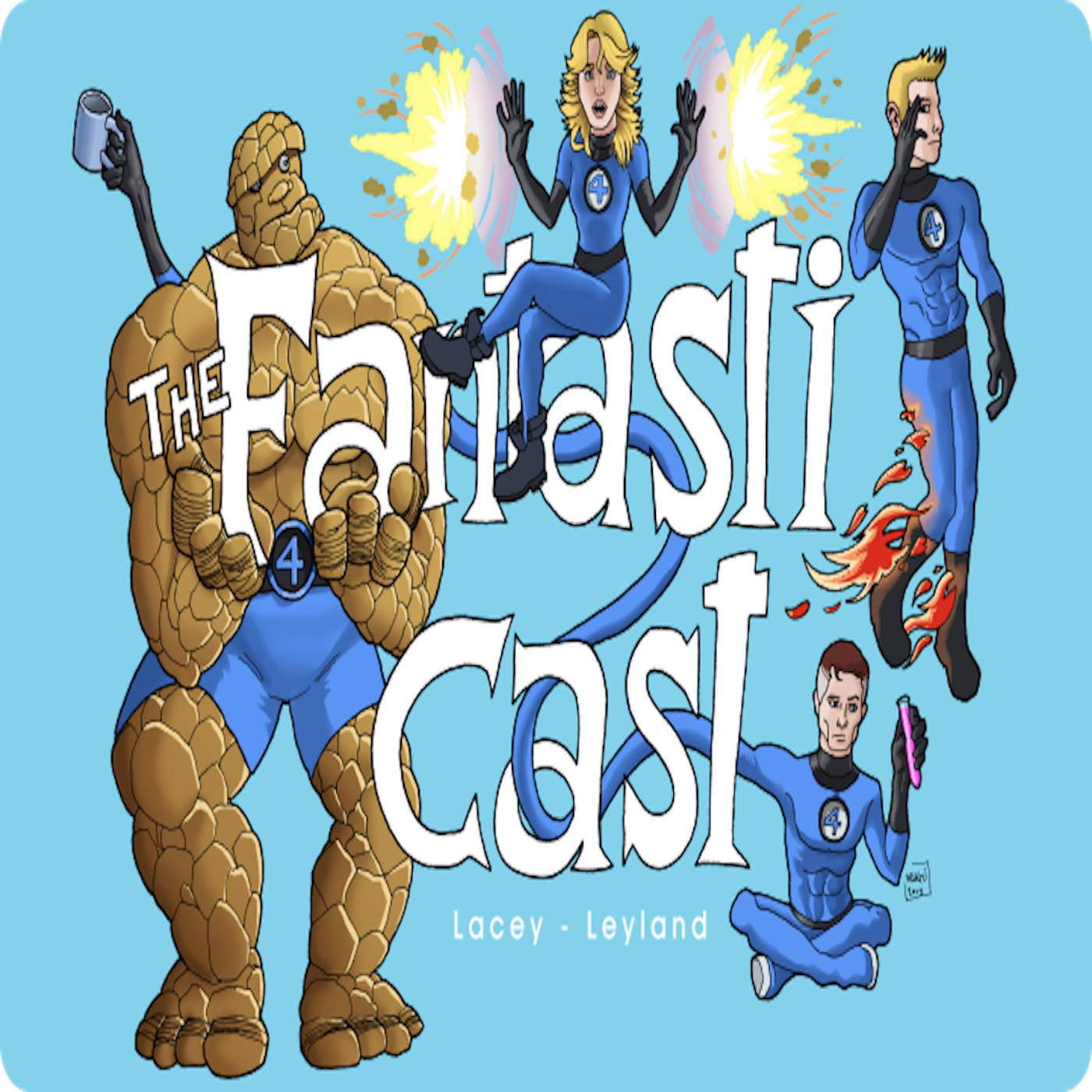
The Fantasticast
Stephen Lacey and Andrew Leyland
https://fantasticflameon.wordpress.com/
11722235_980705178658790_1244561183689926273_o
One of the advantages of digital comics is that issues that were once collectors items are easily available for modern readers.  Wether through reprinted omnibuses, black and white ‘essential editions,’ DVD editions, or online stores, there are more ways to read comics than ever before.  Which in turn means that issues that might have been lost to time can be reexamined, enjoyed, and picked apart.  Which is just what the Fantasticast does.
A team-up of two veteran comics podcasters, Steve Lacey of “Twenty Minute Long Box,” and Andrew Leyland of “Hey Kids, Comics!” The Fantasticast sets out to summarize, celebrate, and take the piss out of every issue and appearance of “The Fantastic Four,” in order.  With well over six-hundred issues and innumerable guest appearances, this is no small task.  After 100-and-something episodes, they’ve just gone from their original appearance in 1961 to the early seventies.
I’ve been listening along issue-by-issue using the Marvel Unlimited app, and it is great fun.  Andrew and Steve have a great rapport, and it is interesting to hear the perspective of British fans to so American a medium as silver-age Marvel comics.  The show is a lot of fun, and balances humor, reverence for the subject matter, and intelligent perspective quite well.  Their synopses are entertaining and complete, and listeners don’t need a long box handy to follow along.
The Fantasticast is certainly a by-fans-for-fans presentation, and I don’t know if it would hold much interest for listeners who aren’t interested in the origins of the Marvel universe, or the Fantastic Four in particular, but it is well done and worth a listen for the comics geek who wants a bit of light perspective along with their heroism.

If you liked this article, please share it, or consider supporting me on Patreon for more articles and audio content.

Hugh Likes Video Games: Castlevania Aria of Sorrow

Leave a comment

Hugh Likes Video Games: Castlevania: Aria of Sorrow
Castlevania: Aria of Sorrow
Konami
Game Boy Advance, 2003
250px-AriaofSorrowCover hqdefault
Today we’re skipping ahead a few years to look at “Aria of Sorrow,” the last of the ‘Metrovania’-style Castlevania games for the Game Boy Advance.  This means that rather than consisting of numbered platforming stages that the player must complete in order, the game is instead one large 2-D map, with the player gaining access to new areas through the use of special abilities.  For example, once the player gets the ability jump in mid-air, they can reach higher platforms and thus reach corridors they couldn’t previously.  In the Castlevania series, this format started properly in Symphony of the Night for the Sega Saturn and Sony Playstaion.
Aria of Sorrow breaks with tradition in that rather than being set in the middle ages or 19th Century, this game takes place in the future.  The game is set in 2035, but the future date doesn’t play much into it, except that you can score a sweet laser rifle later in the game.  But at that point, your other options include powerful holy weapons, so it’s not really an upgrade.  No cybernetic werewolves or anything.
The main character is Soma Cruz, an American teenager living in Japan.  When he goes to watch a solar eclipse at a shrine operated by a childhood friend, he passes out.  When he wakes up, he finds himself in Dracula’s Castle, and in possession of inexplicable power.  As Soma makes his way through the castle in search of answers, he meets sinister missionaries, amnesiac exorcists, and other mysterious people.
Aria of Sorrow pushes the GBA to its limit with absolutely gorgeous graphics and a sprawling castle filled with monsters.  Soma’s powers are a neat twist of the Castlevania formula, and encourage exploration in search of new souls to win and try out.  It would be nice if they weren’t quite so rare, and packed a bit more of a punch, though.  Especially early in the game, they don’t have the same heft to them as the classic subweapons.  While this does give a sense of progress to the game as the player collects stronger and stronger abilities, it can be a grind to collect them.
Overall, “Aria of Sorrow” is a definite hit in the Castlevania score sheet, and not to be missed.  If you can’t find a used copy of the cartridge, it is also available as a download from the WiiU store.

If you enjoyed this article, please share it, or support me on Patreon for early and exclusive podcasts and articles.

Hugh Likes Anime: Food Wars

Leave a comment

Food Wars: Shokugeki no Soma
Studio: J. C. Staff
Streamed via Crunchyroll
food-wars
When I was a teen, I was really into Iron Chef, a competitive Japanese cooking show which might be viewed as the forefather of most of the Food Network’s current lineup.  “Food Wars: Shokugeki no Soma” is another descendant.  An anime based on manga by Yuto Tsukuda and Shun Saeki, it follows the adventures of teenaged hero Yukihira Soma through Japan’s most prestigious and rigorous cooking school.  Soma is the son of a competitive and mysterious diner owner, and he’s been cooking since he was a child.  At first, he looks down the other students, who’ve ‘never served a customer before,’ but as the series goes along, he learns a lot about cooking through competing with them.
Shokugeki no Soma falls in line with many of the tropes associated with anime aimed at teenage boys.  There are lots of nonsensical rivalries, training, and challenges to overcome while forthrightly contemplating philosophical points.  And also plenty of fan service.  These are certainly the first chef’s jackets that I’ve ever seen with cleavage.  But even the fan service has its own goofy charm.  The series is constantly searching for new ways to express culinary language visually.  These range from a group of people eating a pork-roast so good their clothes explode to a panel of judges piloting a lobster rocket into space.
The first season of Food Wars: Shokugeki no Soma is currently streaming online at Crunchyroll, and is coming to DVD.  While the show ends at a bit of a cliffhanger, and a second season has yet to be announced, this is an excellent series for foodies and anime fans alike.  I’d like to give a hat tip to Jason Banks of the Talk Nerdy To Me podcast for the recommendation.
If you enjoyed this article, please share it!  For exclusive content and podcasts, sign up for my Patreon feed!

Hugh Likes Comics: Starve

Leave a comment

Starve
Brian Wood, Danijel Zezelj, and Dave Stewart
Published by Image Comics
starve-2-135200
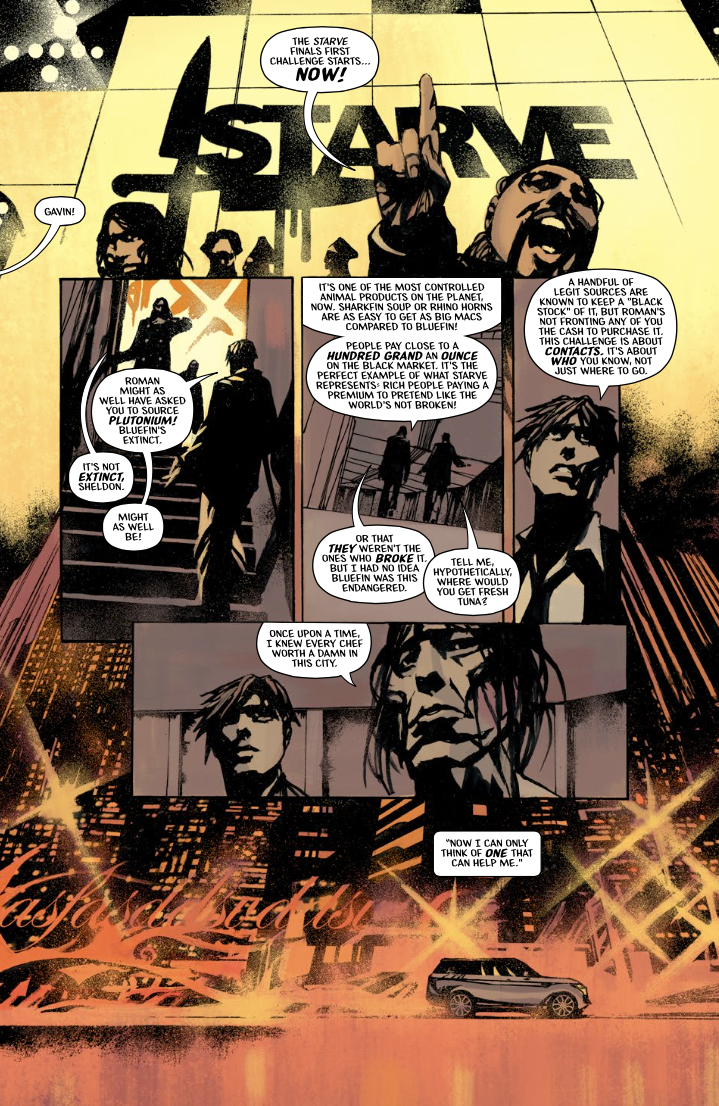
So I’ve been really thinking about cooking lately.  Not just how to cook, or where my food comes from, but the whole process, how something goes from a pile of disparate ingredients and becomes something else.  I’ve also been reading “Starve” by Brian Wood, Danijel Zezelj, and Dave Stewart.  Much like a fine meal, a comic that is more than the sum of its parts.
“Starve” is the story of runaway reality TV Chef Gavin Chruikshank.  After the collapse of the global economy and the ruin of his marriage, he disappeared into the wilds of Southeast Asia.  Three years later, the network comes looking for him, to force him to fulfill his season contract on a show that is very different than the one he originally began.  “Starve” is no longer a travel show, but a competition for the benefit of the 0.1%, still on top despite economic and environmental catastrophe.
Starve is a fun little near future drama, with Gavin fighting for the soul of Chefdom and the love of his daughter against his estranged wife and the rival who stepped into his shoes.  It’s politics, aside from F*CK THE 1%, are tough to pin down, but it is a joy to watch anarchic, barbarian chef Chruikshank work his magic.  He’s nasty, belligerent, and entirely too much fun.  He’s Hunter S. Thompson in a white jacket.  While he is a master chef, the comic aims to shock rather than hunger.  In the first issue, Gavin is asked to prepare a dog.  Rather than being horrified, as is the intention, he carves up a slice, narrating that people all over the world eat dog.
The art is moody and heavily inked, with dark, brooding figures even under blazing stage lights.  The washed out color palate further emphasizes the crushing blandness of the excess “Starve” represents.
If I had a complaint, it is I wish they would do more with Gavin’s sexuality.  This is hardly a romantic book, but so far, (three issues published at the time of writing) Gavin’s homosexuality has been raised as an important character trait, but never explored.  It’s simply treated like another vice, or another thing his ex-wife holds against him.  He has had some interaction with his male handler, but almost all of his important relationships are with women.
While it may not whet your appetite, “Starve” is far from slight.  Check it out on Comixology or in your local comics shop.

Hungry for more content?  Support my Patreon for early and exclusive podcasts and articles!

Hugh Likes Podcasts: The Melting Potcast

Leave a comment

The Melting Potcast
A F Grapin and Erin Kazmark
TheMeltingPotcast.com
I listen to a lot of writing and fiction podcasts.  Most of them try and cultivate a specific audience.  The Drabblecast is narrowly focused on weird fiction.  Ditch Diggers is specifically about the business side of writing professionally.  Specificity is good, usually.  But I really enjoy podcasts that go a bit broader.  My own podcast, The Way of the Buffalo, is founded on the new, rather than specific genre or even medium.  But I can’t think of a podcast that attempts to reach a broader audience that The Melting Potcast.
Billed as ‘a little bit of everything for everyone everywhere,’ they present flash audio fiction based on prompts, longer short stories not constrained by topic, and author interviews, amongst other content.  For the sake of full disclosure, I have had one of my own stories appear on the show.
Hosts Erin and A. F. inject humor and passion into their presentations, and the quality is top-knotch.  They are accompanied by regular and guest readers.  The prompts so far have been clever and interesting, creating a surprising variety of stories that hit on a variety of genre and emotional beats.  They’re still fairly new, but their passion for fiction, hard work, and supportive community all shine through.  This is definitely a podcast to watch, because it’s only going to get better as it keeps going.  Find The Metling Potcast in iTunes, or the podcatcher of your choice.
If you enjoyed this article, please share it, or join my Patreon for more print and audio content.

Hugh Likes Video Games: Castlevania

Leave a comment

Castlevania
Konami
Nintendo Entertainment System
250px-Castlevania_NES_box_art
October is Dracula Season here in the Hugh Likes… HQ, and for my money there is no better modern representation of the character than the Castlevania franchise.  The original, produced by Konami in 1987, is a classic example of the old-school challenge of the NES.  Tough but never entirely unfair, the player controls Simon Belmont as he fights his way through Dracula’s castle to his showdown with the King of Vampire himself.
The original game has a fun, almost campy sense of atmosphere as Belmont fights his way through a laundry list of B-movie monsters.  Famously difficult, the game really conveys the feeling of the environment itself as an adversary.  This is a difficult balance to achieve, because it can more often feel like the player is fighting the programmers rather than the game.  Like Nintendo’s flagship Super Mario Bros, Castlevania is a sprawling environment that relies on careful exploration, precise timing, and sharp reflexes.  Belmont is armed with an upgradable whip and a variety of subweapons that he finds in the castle.  While blindly rushing ahead and collecting every subweapon as it drops can result in a series of deaths, a careful strategy, admittedly formed through trial and error, guides the player through each level.  A very generous continue system for the time lets the player keep trying for as long as they like.
With the sad news that Konami is scaling back its production to focus on the mobile phone market, we may not see anything new from the series for a while.  What better time to dust of a control pad and take your journey through Dracula’s Castle?
Castlevania was originally released for the Nintendo Entertainment System as well as other 8-bit consoles and arcades.  It is also available digitally for the Nintendo Virtual Console on Wii, Wii U, and 3DS.

Enjoy Hugh Likes Video Games?  Please consider joining my Patreon for more content!

Hugh Likes Comics: Toil and Trouble

Leave a comment

Toil and Trouble #1
Written by Mairghread Scott
Drawn by Kelly and Nichole Matthews
Published by Archaia
Toil&Trouble
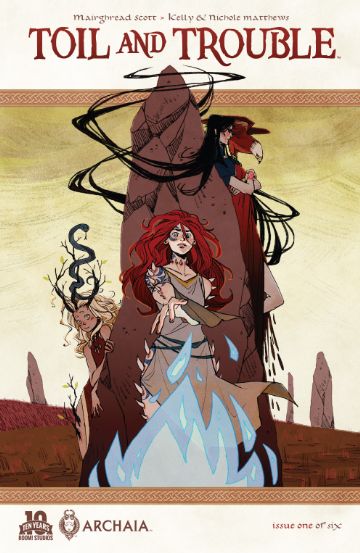
Shakespeare enjoys a peculiar place in the canon of English literature.  Both a foundational document and endlessly mutable, it is performed, reenacted, remixed, and endlessly reinterpreted.  Romeo and Juliet inspired the musical West Side Story.  King Lear was translated into Akira Kurosawa’s opus film Ran.  Recently, the tragedy of Hamlet was remixed into the Choose-Your-Own-Adventure style game-book, To Be or Not To Be.  Toil and Trouble takes up from Macbeth, focusing not on the Thane, but the Witches.
Structurally, it resembles the Tom Stoppard Play “Rosencrantz and Guildenstern Are Dead,” which follows the two titular henchmen from before their introduction and up to their bumbling, offstage demise. (Spoiler alert for a four-hundred and a fifty year old play, respectively.)  The comic follows Smertae, one of the three witches, returning to Scotland after being banished.  The reason for her banishment is unclear, but seems to involve Macbeth.  Like the Stoppard play, the action of the original Shakespeare drifts around and through the dialog of the comic. In this first issue, the reader sees an expanded version of the opening scene.
In Scott’s version of events, the witches are agents of Fate, tasked with ensuring the continuity of Scottish royalty.  To accomplish this, they mean to strike down Macbeth in order to give Prince Malcolm a trial to ready him for the throne.  Smertae is against the plan, but reluctantly agrees.  We then follow the witches in their work cursing Macbeth’s camp, and in the battle the next day, where Smertae makes a decision that goes against fate.
I was drawn to this comic because I am a huge fan of the Scottish Play.  The plot is an interesting take, and I’m excited to see how it interacts with the original.  The writing is actually quite solid, and the dips into 17th Century language feel natural with the rest of the dialog.  The world building is the biggest break from the original, but I’m a sucker for the concept of a fading magical world, struggling in the face of onrushing modernity, and Scott absolutely nails this fantasy milieu.
What surprised me is the exceptional quality of the art.  The Matthewses style is absolutely gorgeous, and the designs, particularly of the three witches, are immediately eye-grabbing and carry a lot of the story’s weight.  The three represent Sea, Earth, and Sky. Smertae has crab-like spikes jutting from her body, and her sisters equally expressive of their elements.  The ‘acting’ of the characters is also very well done.  The meeting scene is wonderfully emotional without relying too heavily on the dialog to convey meaning, for example.  The art is helped by bright and detailed coloring and inventive layouts, such as the climactic battle splash page, which features small circular insets showing the effects of the witches curses in the epic clash.
“Toil and Trouble” is the first part of a series I can’t wait to read more of.  Find it on Comixolgy, or in the rack at your local comics shop.

Hugh Likes Fiction: Star Wars Aftermath

Leave a comment

Hugh Likes Fiction: Star Wars Aftermath

Written by Chuck Wendig

Published by Del Ray Books

aftermath

“Star Wars” isn’t about war.  The movies are adventures, with thrilling chases, dazzling special effects, and last-minute rescues.  Throw in a few cute aliens and droids for comic relief, and cinema history is born.

This isn’t to say I don’t like Star Wars. They are (at least three) of my favorite films.  But there was always a feeling of slight-of-hand about the consequences.  We watch the destruction of Alderaan from the bridge of the Death Star, not the surface.  We hear a lot about Jabba’s grip on the Outer Rim, but what we see is the pleasure barge.  There is a lot of grungy corners in the Star Wars universe, but the movies focus on the brightness of the lightsabers.  Valuing plot over character, and spectacle over consequence, the films, particularly the prequels, are fun, but never quite mature.

With Star Wars Aftermath, the first novel set after “Return of the Jedi” since Disney did away with the previous ‘extended universe,’ Chuck Wendig has certainly pushed the property towards adulthood.  That isn’t to say the book is ‘mature’ in the sense of gore and sex, although both skirt the edges.  Like the title implies, this is a novel about what happens when the battle ends, and examines whether they ever really do.

Wendig takes the bold step of delivering a Star Wars tie-in that has almost no beloved characters in it.  Luke is nowhere to be seen, and Han and Chewy show up for a brief two-page interlude.  Instead, our heroine is Norra Wexley, Rebel pilot and survivor of the Battle of Endor.  After following Wedge Antilles through the second Death Star, she’s returned to her home planet of Akiva to collect her teenaged son and start a new life for themselves.  But their reunion is complicated.  The remnants of the Empire are gathering on Akiva for a summit.  Her remote, Outer Rim world is blockaded.  She evades it, but Wedge, in the area on a routine scouting mission, isn’t so lucky.  And then there is the fact that her son Temmen, a technical genius and junker, has gotten himself in deep trouble with a local crime lord.  He’d rather stay and fight it out with the criminals than leave the planet with his absentee mother.

While Wendig’s present tense style is a bit to get used to, and this particular entry could have used another editing pass in parts, he does a great job of delivering these characters and fleshing them out.  Also excellent are the interludes, which take the reader across the galaxy and into the lives of anyone from newly named Chancellor Mon Mothma to a back-world farmer trying to keep his sons, each having chosen a faction, from killing each other.  These feel like the complex, emotional scenes George Lucas left out.  The characters are not just a monolithic band of evil facing off against a team of scrappy yet hopeful rag-tag heroes.  Wendig shows us once-idealistic people  on both sides, ground down by years of violence.  It’s a brave and striking move, but I think it pays off, while still delivering a solid adventure story.

Speaking of brave moves and what Lucas left out, this next bit will be a bit spoilery, but needs to be addressed.  Wendig has included not one, but three queer characters in the story, and has been getting a lot of flack for it.  This is unwarranted, and the reveal for one of them is certainly something I had spoiled for me.  The other two are minor characters mostly uninvolved with the action, Norra’s sister and her wife.  That’s right, Wendig also brought gay marriage to the Galaxy, and good for him.

Often, telling a story with diverse characters isn’t lauded, but greeted as something that simply should be done.  And the disincentive to include these characters is strong.  The novel has come under a hail of one star Amazon reviews for forcing the issue ‘down our throats,’ as one reviewer so eloquently put it.

I think this is a big deal, and we should be noting it.  And then continuing to support Wendig’s approach, in which diversity is not something to be overcome or avoided, but a facet of his deeply rich and interesting characters.  Our fantasy worlds are reflections of our own ideals, the landscapes of our collective imaginations.  The original trilogy had a handful of women, only three of whom had speaking roles.  It had a few aliens, Lando Calrissian, and an entire cast of young, white, and canonically speaking, straight men.  Chuck Wendig’s view of the Galaxy is a bit more complicated, but it’s the Star Wars I’d rather see going forward.  If this is the face of the new Expanded Universe, I’m ready for a lot more stories in a galaxy far, far away.

Hugh Likes Podcasts: Coxwood History Fun Cast

Leave a comment

Coxwood History Fun Cast
Written and Produced by K. T. Bryski
https://coxwoodhistoryfunpark.wordpress.com/
chfplogotentacle-mitchell
Those that don’t learn from history, are doomed.
This is the motto, nay, the mission statement of The Coxwood History Fun Cast, a full-cast audio horror comedy set in the world’s most evil living history museum.  If you liked “Welcome To Night Vale,” but wish it had more hoop skirts and opium dens, this is the podcast for you.
The story centers on the park’s social media rep, Katherine Sinclair.  Ms. Sinclair has it tough.  Her office is a broom closet, her boss is demonically possessed, and the interpreters all make fun of her.  But when disaster strikes, from witches to bloodthirsty groundhog armies, to, worst of all, fundraising, it’s up to her to save the day.  And get a quick podcast recording done as well.
While Coxwood’s production isn’t quite as polished as “Nightvale,” it has just as much humor, wit, and heart.  The oddball characters and farcical situations are brought to life by excellent voice acting, particularly P. C. Herring as one of the opium girls.  The characters have a perfect mix of strangeness and likability that makes this podcast a treat.  Writer and producer K. T. Bryski, (who also voices Katherine,) really knows her stuff, and pours her love of historical interpretation and podcasting into the work.  I especially enjoyed the character of Old Mabel, whose youth and sanity were taken by her own full-cast podcast.  And also moonshine.
The Coxwood History Fun Cast just completed its first season, and at the moment their is no word on a second, but I hope that we get another chance to visit the park, see the ballroom, complete with giant pulsing ball of evil energy, and have tea and authentic 19th century biscuits with the unspeakable horror.  No raisins please, they’re the food of the devil.
You can find the RSS feed HERE, or join the Facebook fan page.

Older Entries Newer Entries