Home

Hugh Likes Video Games: Wordle

Leave a comment

Wordle
 Created by Josh Wardle
 https://www.powerlanguage.co.uk/wordle/

⬜🟨🟨⬜🟨
🟩🟩🟩🟩🟩

The Skinny: You probably already played it today.

By this point, Wordle is a game that needs no introduction. But I am still coming across friends and relations puzzled by the towers of green and yellow blocks on their feeds. So I will make a brief introduction. Wordle began in 2019 as a sort of gift by Josh Wardle for his partner. Wardle, the designer of The Button and Place for Reddit, is known for his parasocial games. But Wordle is almost paradoxically enticing in its simplicity. There are no loot boxes to grind for. Nothing to subscribe to, no gatcha mechanic. Just a new five-letter word every day, and six guesses. The game didn’t even allow sharing until the feature was implemented towards the end of last year.
 But perhaps it is its simplicity that draws attention in 2022. It’s an echo of a simpler electronic age when the idea of meeting people in faraway places through a screen seemed like magic. In its way, Wordle is punk rock. It doesn’t need to be downloaded from an app store (although certainly, clones have popped up on all of them in the past few weeks.) It doesn’t have microtransactions and ads for the game don’t play 24/7 on YouTube. It’s just a quick little word game you can play every day and share your results.
 Wordle is a shared experience, and I think that’s key to its success. Having only one word a day, and knowing that everybody else posting their score had the same word, creates a feeling of connection, communication, and competition. That word took you six tries? You had that many correct letters on the first guess? The content is sharable and gets people talking. I like to look at people’s posted patterns and try and guess what words they use. Other users place a great value in getting the word in as few guesses as possible. Wordle is as much a game of deduction as wordplay. 
 With the New York Times’ Announcement that they have purchased Wordle in a seven-figure deal, the future of this little-game-that-could is uncertain. For now, the game is still hosted at the same site and is still free to play. But only time will tell if the paper’s acquisition will mark an end to the fad or elevate Wordle to the same level of cultural cachet as the crossword.

Hugh Likes Comics: We Ride Titans

Leave a comment

We Ride Titans #1
Written by Tres Dean
Drawn by Sebastian Piriz
Colored by Dee Cunniffe
Lettered by Jim Campbell
Published by Vault Comics

We Ride Titans #1

The Skinny:  Evangelion meets Dynasty.

Kit Hobbs doesn’t get along with her family. So when her brother has a breakdown and Kit is called back home, she’s upset. But as much as she hates her family, she’s still willing to step into his shoes to pilot the family giant robot and protect the city of New Hyperion from monster attacks.
We Ride Titans #1 is one of those comics that fits squarely into my wheelhouse. Queer angst and messy family drama set against giant robot vs. daikaiju action? Sign me up. So I had a feeling this book would be an easy sell for me. And while the first issue doesn’t do much more than limn the characters and the setting and set up their relationships, it’s still an appealing introduction to the story and the setting.
Dean’s writing and dialog are as sharp as a monster’s claws, as we get a contrast of Nexus Command’s outward presentation versus the mess they are struggling to keep in. Giant monsters are a fun metaphor for this sort of chaos, and Kit being completely unable to handle it is very human. Her shaky relationship with her partner Jen is also interesting, as we see her consistently trying to do right, but just not having the tools. And when Kit’s mom shows up to bring her back after her brother fails, we get a clean, crisp look at her world falling apart. These sorts of stories really only work when the story outside of the SF elements is compelling in its own right, but so far, We Ride Titans delivers.
Piriz and Cunniffe also deliver on the art. The backgrounds all have a very sharp, angular, and modern feel to them. Everything feels like it was just rebuilt on the cheap yesterday. We see lots of struts and exposed brick. The world doesn’t feel lived-in so much as hastily rebuilt. Cunniffe’s colors are warm but not pleasant, they’re muted and bruise-like. The book exudes a feeling of papered over trauma, shakily standing but ready to collapse or explode at any moment, just like the characters.
One detail I loved was a page of Kit driving through the desert. She passes a city in the middle of nowhere, and we see a battle being fought in the background. A robot being helicoptered in, a shot of two massive figures battling amid towers that must always be under construction. Kit just adjusts her mirror and keeps on driving through the night.
We Ride Titans #1 is the setup to something that I think is going to be something special. It is available now from Comixology and Your Local Comics Shop!

Hugh Likes Video Games: Toem

Leave a comment

Toem
Developed by Something We Made
Played on Nintendo Switch

The Skinny: A delightful little adventure about photography and community
Toem is a little gem of an indie adventure game about photography and perspective. This comforting little puzzle box is full of puzzles to solve, characters to help, and tiny locations to visit.
 Created by Swedish indie studio Something We Made, Toem only takes a few hours to play but is all about relaxation and comfort. Designed to be played in short bursts, it is the perfect game to wind down with at the end of the day or de-stress to over a coffee break as you take missions tracking down singing goats and finding the perfect spot to photograph a forest hotel.
 The game sets you in the shoes of a young photographer on an adventure to find the Toem, with no further explanation given. The tools at your disposal are your trusty camera and a very unusual public transit system that rewards public service with free rides. The game is divided into five zones, and at the start of each one, you’re given a public service card. As you explore a forest, a city, a seaside resort, and a mountain, you are given puzzles to solve in the form of requests of each area’s inhabitants. These can range from the simple, such as taking a photo of a requested subject, to the obtuse, such as recovering lost items or even restoring a power plant. After each puzzle, you are rewarded with a stamp on your card. Collect the requisite number of stamps, and you’re free to move along to the next area. But completionists will still have plenty of challenges to complete, animals to photograph, and hidden secrets to uncover beyond the game’s forgiving requirements.
 With one notable exception, Toem is presented in a charming black and white art style, and the small, isometric levels have a diorama-like quality. The characters are quirky, and a few of the puzzles are fiendishly clever, but I never felt stuck.
 Toem is a short and cozy experience that is perfect for unwinding by a roaring fire or relaxing with a hot cup of cocoa. If you’re looking for something to chill with at the end of the year, give this game a shot. Toem is available on PC from Steam and Epic, Nintendo Switch, and PS5.

Hugh Likes Video Games: Metroid Dread

Leave a comment

Metroid Dread
Developed by Mercury Steam
Published by Nintendo
Played on Nintendo Switch

The Skinny: Samus Aran is back, baby!

My life-long love of the Metroid series began with Metroid II on the clunky, grayscale Game Boy. It was the first video game I bought with my own money, or close enough. I had won a gift card to the mall in a school raffle. I’ve had a soft spot for the taciturn and mysterious bounty hunter ever since. But after the series pivoted into Metroid Prime, I had all but given up hope of seeing a brand-new 2D Metroid. I expected the four games in the series to remain relics of the past, fondly remembered and imitated by indie devs, but a part of history.
I was pleasantly surprised by the announcement of Metroid Dread if a little skeptical. I needn’t have worried, and perhaps should have seen it coming. Created by Mercury Steam, the studio which created the 2017 remake Metroid II: Samus Returns, the fifth game in the series is a return to form.
The gameplay feels much more modern, but still in line with older games. Samus moves with more fluidity and grace than her previous entries, the melee counter returns in a much more satisfying form, and her new slide move is fun to use. She has an agility that feels more akin to her movement in Smash Bros. than Super Metroid. But it works, and it makes exploring this huge new planet a delight. That momentum is also very important for the game’s other new enhancement: Stealth sequences!
Metroid Fusion toyed with the idea of stealth by introducing SA-X, a powerful enemy with all of Samus’s abilities that the player must avoid and hide from in scripted sequences. In Dread, Samus faces off against the E.M.M.I, nigh-indestructible scientific robots out of Boston Dynamics’ worst nightmares. They each have a specific area they patrol, and Samus must avoid and run from them until she can find a way to stop them. Overall, these sequences are a lot of fun but require a level of precision that leads to frustration at times.
This demand for precision also extends to the boss encounters. Bosses are varied and wonderfully gross in their designs. An early encounter has you fighting a big mutant scorpion thing standing on jutting rib bones. Each encounter requires not only precise timing but a keen eye. Each boss has patterns and weaknesses more akin to Zelda’s bosses than Metroid, and each has a melee vulnerability that leads to a sort of quick-time event where they are vulnerable. While these sequences are cool and surprising, the bosses are very tough, and by the time I was facing them over and over again, I was sick of them. It is frustrating when you’re running through a boss for the fifth time because you haven’t fought it in the exact steps the game demands. Earlier game bosses were more tests of the player’s ability to explore and find hidden resources like missiles and energy tanks. Metroid Dread has a much softer focus on exploration.
The game’s zones are wonderfully designed, but the game is filled with one-way doors, drops that Samus can’t go back through without late-game upgrades and hidden pits. I felt a bit herded at times, and discouraged from really exploring at my own pace. While this preserves the game’s momentum and ensures you don’t get too lost, it loses the thrill of exploration for a more guided experience, and this lack of options extends to the game’s controls.
While Metroid Dread gives players a lot of tools to work with, there’s no way to adjust or experiment with your layout. Y shoots, ZL slides, and holding in the left joystick activates the speed boost. When it works, such as with the slide, movement and combat feel fluid and dynamic. When it doesn’t, and with the speed booster in particular, movement becomes a frustrating, emersion-breaking chore. Allowing players to map their buttons, or implementing any sort of accessibility options would have gone a long way to improving the game. The graphics were also gorgeous but occasionally a stumbling block for me. Metroid Dread looks fantastic, but it was designed with the OLED Switch in mind. I played it in handheld mode on my original Switch, and while it still looked great, there were a few sections where I wasn’t quite sure what was a foreground element and what was part of the background. I ran into a few literal walls that way, which is just embarrassing for a bounty hunter of Samus’s caliber. 
 Overall, Metroid Dread is a glorious return to 2D form for the series. It still innovates in all the right ways and brings back enough of the classic feel that it gets my hearty recommendation. While I wish it would get out of its own way at some points, it’s Samus’s biggest 2D adventure yet. While it doesn’t quite replace Super Metroid in my heart, this is still a brilliant entry in a series that doesn’t get enough love from Nintendo. This game is a Switch essential.

Hugh Likes Fiction: Comfort Me With Apples

Leave a comment

Comfort Me With Apples
Written By Catherynne M Valente
Read By Karis Campbell
Published by Tordotcom and Dreamscape Media LLC

The Skinny – This puzzle box of a novella about a woman living in an exclusive gated community is a suspenseful, surprising little treat.


Sophia’s life is a paradise. She keeps her husband’s house in the Arcadia Gardens, the ultimate gated community, and even though he is away with work much of the time, he’s the perfect husband, who has given her the perfect life. She was made for him, and everything is perfect. But she begins notices cracks in the veneer of her supposedly perfect life. She finds a hairbrush that isn’t her’s and her neighbors seem just a bit too eager when they ask her if she’s happy. And then there’s the basement, which she is forbidden to enter. When Sophia’s perfect life begin to unravel, and the temptation to destroy the illusion becomes overpowering.
Giving much more of a description to this fast-paced and engaging novella would give away the game, but Valente’s luscious prose unfolds like a puzzle box, with Sophia’s narrative interposed with her contract from the unseen but all-powerful Arcadia Gardens Home Owners’ Association. It’s a clever trick that works beautifully. The story is a perfect novella length, giving just enough clues to resolve the mystery while keeping a sharp and suspenseful pace.
Karis Campbell’s narration is spot on, making this quick but engaging audiobook well worth the full credit, even if it only clocks in at a couple of hours of listening time. Each character is unique and distinct, and her read of their narration is subtle. She doesn’t give the game away, but still highlights all the incongruous and unsettling bits of Valente’s story.
Comfort Me With Apples was an unexpected and gripping little story that is well wroth your time, and works best if you go in not knowing the twist. It’s available in print, ebook and audiobook from all the usual retailers.

Hugh Likes Video Games: Castlevania Advance Collection

Leave a comment

Castlevania Advance Collection
Developed by M2
Published by Konami
Played on Nintendo Switch

The Skinny: Dracula Season is back, baby!

Just in time for Halloween, M2 has released a new collection of Castlevania titles from the Gameboy Advance, and these 32-bit classics have never looked or played better.
The collection includes Circle of the Moon, Harmony of Dissonance, and Aria of Sorrow, all of which were originally released on the GBA, Super Nintendo’s Dracula X, and a nice horde of extras. Players can choose from the North American, Japanese, and European releases of each game, along with an art gallery, manuals, music players, and encyclopedias. Each game also includes a ‘gadget,’ a special tool added to help manage collectables that can be turned on or off.
The three GBA Castlevanias were all side-scrolling exploratory RPGs in the style of PS1’s Symphony of the Night. While not as beloved as that cult hit, the three games are each a gem, and being able to play them on major consoles or PC in one package is a nice bonus.
Circle of the Moon was a GBA launch title, and while it was impressive, the dark, intricate sprites were hard to see on the unlit screen, and progression relied on random item drops for the game’s card-based magic system. This is the game that benefits the most from this collection. The visuals look great on the Switch handheld screen, and the encyclopedia and added gadget make collecting card and health drops a much less frustrating process. While it’s no longer considered canon in the Castlevania series, CotM is still one of my favorites, and I’m glad it’s included here.
2002’s Harmony of Dissonance is a much more straightforward follow up to Symphony of the Night featuring a castle more reminiscent of the PS1 game, and a nimble, Alucard-like protagonist in Juste Belmont. This game had its visuals tuned for the darker, smaller screen, and the very complicated, labyrinthine double castle is trickier to navigate, but this was still a delight to return to, even if this is the game that gets the least out of the included extras and form factor.
Aria of Sorrow, the last GBA Castlevania game, is probably the star of the show here. Released later in the GBA’s life, Iga and his team at Konami created an incredibly atmospheric castle that doesn’t feel too big or too cramped, while delivering the most interesting story in the series by setting it in the far-off future date of 2035. Soma is a joy to play as, and his ability to collect and absorb the souls and abilities of enemies gives the game a lot of replay value. There’s just so much variety in what he can do that I really went digging to find all the souls I could.
Also included is Castlevania: Dracula X, a Super Nintendo not-quite-port of the Turbo Graphic CD game Rondo of Blood. Infamous for its extreme difficulty and removing most of Rondo’s innovations, cutscenes, and voice work, it’s technically a part of the collection, but mostly exists as an afterthought here. But it is included for completionists who want to butt their heads against quite possibly the most difficult final boos fight in the whole series.
Castlevania Advance Collection brings together three hand-held classics that hold up today. These were some of my favorite games on the GBA, and I’m thrilled to be able to still bring them with me on the Switch twenty years later. If you never tried these sprawling adventures back in the day, or if you’re just in the mood for something thematically appropriate but not too intense this Halloween, pick up for PC through Steam, or your modern console of choice.

Hugh Likes Comics: Cable Reloaded

Leave a comment

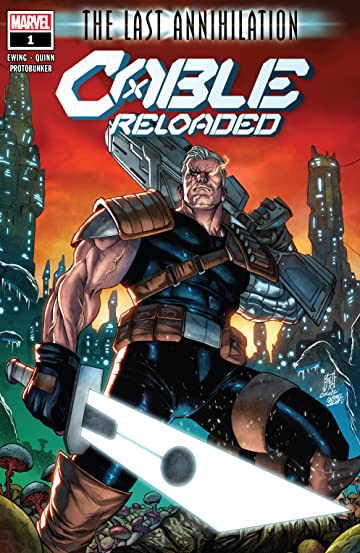
Cable Reloaded #1
Written by Al Ewing
Drawn by Bob Quinn
Colored by Java Tartaglia
Lettered by VC’s Joe Sabino
Design by Tom Muller
Published by Marvel Comics

The Skinny: Maybe the real Time-Traveling Cyborg Super Soldier was Friendship all along.

Cable has never been one of my favorite Marvel characters. In a lot of ways, the cybernetic super-soldier from the future represents a lot of the problems that crept into 90’s Marvel Comics. His backstory is a complicated mess, his design is unpleasant, and his plots center around the hyper-masculine dourness that dominated the comics industry at the time. In short, I think he’s just not a lot of fun.
 Cable recently returned to his status quo after he was murdered and replaced by a teenage version of himself because Comics and this solo one-shot integrates him back into the Marvel Universe. Since I didn’t read Teen Cable’s solo series, I would’ve given this issue a pass if it weren’t written by one of my favorite writers, Al Ewing. I’m glad I didn’t skip it because it turns out, this is a great single issue.
Cable Reloaded is also a tie-in to Al’s Last Annihilation storyline going on right now in Guardians of the Galaxy and S.W.O.R.D. Fortunately, you don’t need to know much about either book to be brought up to speed. Cable’s new mission is to infiltrate the infamous Breakworld, previously seen in Astonishing X-Men. But again, that’s not anything you need to know because this is actually a comic about Cable reestablishing his connections and friendships after being gone. Because he’s a time traveler, it’s been a lifetime for him since he’s been in this era, but only a month in everyone else’s time, including the reader.
Cable gets a few nice moments with Cannonball and Boom-Boom, his mentees from when he was leading X-Force, as well as with the staff of S.W.O.R.D, where his younger self was working as Security Chief. 
We also see a fair bit of Cable’s internal monologue throughout the issue, and it is an interesting peek into the thoughts of a normally taciturn and laconic character. One of the fun things you can do with a character like Cable in the context of a crossover is to use him to build up the importance of an event or put over another character. There’s a fun scene in which Cable meets Guardian of the Galaxy Rocket, and is awed by meeting such a famous and brilliant historical tactician. Rocket is clearly one of Ewing’s favorite characters, but it’s still a nice scene.
Bob Quinn’s art is also very good in this issue. He evokes a 90’s aesthetic without falling into the failings of the era, and he is a steady hand at making complex action easily understandable. The issue’s page layouts have a particularly nice flow to them. java Tartaglia’s colors are warm and glossy, also evoking Cable’s origins while remaining easy on the eyes.
I picked up this issue not knowing what to expect, but I’m glad that I did. Cable Reloaded #1 is a self-aware and oddly sweet return to form for the character, and I wouldn’t mind seeing more of this creative time and this character in the future. Cable is a character of excess in a lot of ways, but this issue hits all its points without overindulging. If you’re at all curious about Cable, S.W.O.R.D., or The Last Annihilation, do yourself a favor and pick this issue up from Comixology or your Local Comic Shop.

Hugh Likes Video Games: Cozy Grove

1 Comment

Cozy Grove
Developed by Spry Fox
Published by Quantum Theory Games
Played on Nintendo Switch

The Skinny – What if Tom Nook was dead the whole time?

Cozy Grove is a chill game in the style of Animal Crossing and Stardew Valley that can best be described as a ‘chore simulator’ but that’s hardly a bad thing. Players are put in the boots of a novice Spirit Scout, sent to Cozy Grove to hone her skills and put the many ghosts haunting the island to rest. Also, the ghosts are anthropomorphic bears, because why not.
As you meet each ghost and learn a bit about their story, they will task you with quests, most of which involve gathering either specific items hidden on the island, or resources earned from fishing, mining, and other activities. Players can also commission and place decorations and raise plants and animals.
While this all will sound very familiar to players of the genre, the systems are well executed, and the hand-drawn art is charming. The island is rendered in muted black and white tones, but as ghosts have their daily needs fulfilled, the areas around them fill with color. These areas can be expanded using decoration in the game, making the game easier to see and giving it a real sense of progress.
Cozy Grove does require a great deal of patience, even for a game of this type. Items the characters need to complete the next part of their stories are often locked behind quests for other characters, or require high amounts of limited resources. Characters don’t give story missions every day, either. It can be frustrating to wait for a character to give you what you need for another part of the story. Especially if multiple other characters need something from them.
I played on the Nintendo Switch, but Cozy Grove feels like it was designed with tablets in mind. While the button controls are by no means bad, the game has a bit of trouble with targeting, and often selects the wrong object to interact with when using button controls. There is a ‘swap target’ that occasionally appears if the game is unsure where you are pointing, which somewhat resolves the issue, but it isn’t always there.
These are minor quibbles in what is an excellent, heartfelt, and charming little chill-out game. Cozy Grove is a perfect game to wake up with over coffee or unwind to after a long day The game is available on mobile, PC, and major consoles. If you have the time and inclination, it is a cozy goth delight.

Hugh Likes Video Games: Dragon Quest II

Leave a comment

Dragon Quest II: Luminaries of the Legendary Line
Published by Square Enix
Played on Nintendo Switch

The Skinny – A flawed but still-fun classic

Last week, Dragon Quest celebrated its 35th-anniversary last week, and I have been playing through the second entry in the venerable series to celebrate. While the game has a lot of rough edges, the Switch port still largely holds up.
Originally released in 1987 in Japan and 1990 in North America, Dragon Quest II is a continuation and expansion of the original Japanese role-playing game. In the first adventure, a lone knight, who is the descendant of a great hero, saves a kingdom from an evil wizard, who is also a dragon. The sequel picks up the story a century later, with three of that hero’s descendants picking up the family trade and taking out Hargon, a malevolent priest bringing about the end of the world. While this is still a primitive example of a console RPG, it does mark some notable firsts for the genre. The player starts out controlling a single hero, but picks up two companions along the way, making it the first JRPG with a party. Your party doesn’t quite have defined classes per sei, but each character plays a little different, with the Prince of Midenhall playing the role of a warrior with high attack and defense, but no access to magic, while the Princess of Moonbrook can cast powerful spells but can’t wield swords or wear heavy armor. The Prince of Cannock is a bit in the middle, with some access to both.
You also get a boat to explore a wider world, which includes a simplified and smaller version of the world map from Dragon Quest! While there is a pretty big (for the time) world to explore full of towns to visit and dungeons to delve into, the story isn’t very complex by today’s standards. There are plenty of clever secrets and things to uncover, such as a hidden slot machine minigame, but the plot is your basic quest to go find the big bad and put your sword through him.
The Switch port carries on from a long line of ports and remakes that have incrementally improved the game over the years, from the Super Famicom to Game Boy to Wii and up through mobile phones. This is definitely a game that is in no danger of ever going ‘out of print.’ Naturally, the graphics and sound have been upgraded, and the game looks fabulous, with highly detailed and colorful sprites, although there isn’t much animation in the game, with battle scenes still being fought against still images. But even if they don’t animate, Akira Toriyama’s designs really pop in HD. And Koichi Sugiyama’s orchestral score sounds great.
The gameplay is pretty relaxing, with turn-based combat and simple puzzles that are usually resolved by finding the right NPC or using the correct item based on their clues. You don’t always have full control over actions in battle, as enemies appear in groups and you can’t select individual monsters if they’re in a crowd. But the AI has been improved over the years, and the game tends to deal out damage in an optimal way for the player. While the monsters are fun to look at, combat can get pretty repetitive, though. Developers hadn’t quite worked out the curve for adding bosses, and you won’t see very many until the last castle.
The only thing that hasn’t been improved from the original, and is still the biggest drawback, are the dungeons. The towers and caves in the game are long and very maze-like, with lots of frustrating traps that just serve to prolong the game without being much fun. The cave that leads to the final dungeon, in particular, has a set of very nasty trap floors that force you to begin again from the entrance, with random encounters hitting you every few steps. It’s not the most engaging design, and I had to put the game down a couple of times and play something else.
With those drawbacks aside, Dragon Quest II: Luminaries of the Legendary Line is a classic that further defined an emerging genre. Plus, it is on sale right now as a part of Dragon Quest’s anniversary, so curious gamers can experience this historic gem for cheap on the Nintendo Switch eshop or IOS and Android app stores.

Hugh Likes Video Games: The Legend of Zelda – Link’s Awakening

Leave a comment

The Legend of Zelda: Link’s Awakening
Published by Nintendo
Developed by GREZZO
Played on Nintendo Switch

The Skinny – This reoccurring Zelda classic still plays like a dream.

Originally released for the Game Boy in 1993, The Legend of Zelda, Link’s Awakening may be the most revisited game in Nintendo’s catalog. But that isn’t without good reason. in 1998 it received an upgrade for the Game Boy Color, with a bonus dungeon and new functionality for the Game Boy Printer peripheral. A little over twenty years later, a new version for the Nintendo Switch has brought it back again with bright and colorful HD graphics. But how does a Game Boy game hold up over twenty-five years later?
 Pretty well, as it turns out. The story and gameplay are nearly untouched, with the only tweak being the inclusion of dedicated buttons for Link’s sword and shield, with two buttons for selectable tools, which makes better use of the Switch’s controls. The combat is familiar and satisfying. This game plays just as well as it did in the original.
A few new items were added to the game, including a set of Amiibo-like collectibles and bottles, which allow the player to recover inside dungeons. There is also an expert difficulty added for returning players which bulks up enemies and removes heart drops from the game. This more than balances out the difficulty, and made the game a nice challenge.
The added GB Printer sections have been removed, which is disappointing because even if the printer wasn’t available, the cutscenes for obtaining them were still fun to discover in the GB Color version. In its place is a new minigame that allows players to make and complete their own dungeons based on chambers in the game. This is a fun little diversion, but without the ability to design chambers yourself, it feels a little insubstantial. The minigames from the original GB release, a fishing minigame, a raft obstacle course, and a UFO catcher, have been expanded and improved. I usually skip the fishing in Zelda games, but this one was a lot of fun.
Link’s Awakening has always been one of the stranger games in the series, with the titular hero washing up on a mysterious island and being thrust into its mysteries. The remake keeps the story intact, while also give a shiny toy-like aesthetic to the graphics. The game preserves the aspect of the original game with the update, which means that the action is a bit more zoomed out, giving a preview of what would be on the next ‘screen’ in the original version. Overall, I feel this is a good choice, and it helps reinforce the new diorama-like feel of the world.
The Legend of Zelda: Link’s Awakening is a definitive edition of a stone-cold classic. Switch owners shouldn’t sleep on this bite-sized adventure.

Older Entries Newer Entries