Home

Hugh Likes Video Games: Metroid Dread

Leave a comment

Metroid Dread
Developed by Mercury Steam
Published by Nintendo
Played on Nintendo Switch

The Skinny: Samus Aran is back, baby!

My life-long love of the Metroid series began with Metroid II on the clunky, grayscale Game Boy. It was the first video game I bought with my own money, or close enough. I had won a gift card to the mall in a school raffle. I’ve had a soft spot for the taciturn and mysterious bounty hunter ever since. But after the series pivoted into Metroid Prime, I had all but given up hope of seeing a brand-new 2D Metroid. I expected the four games in the series to remain relics of the past, fondly remembered and imitated by indie devs, but a part of history.
I was pleasantly surprised by the announcement of Metroid Dread if a little skeptical. I needn’t have worried, and perhaps should have seen it coming. Created by Mercury Steam, the studio which created the 2017 remake Metroid II: Samus Returns, the fifth game in the series is a return to form.
The gameplay feels much more modern, but still in line with older games. Samus moves with more fluidity and grace than her previous entries, the melee counter returns in a much more satisfying form, and her new slide move is fun to use. She has an agility that feels more akin to her movement in Smash Bros. than Super Metroid. But it works, and it makes exploring this huge new planet a delight. That momentum is also very important for the game’s other new enhancement: Stealth sequences!
Metroid Fusion toyed with the idea of stealth by introducing SA-X, a powerful enemy with all of Samus’s abilities that the player must avoid and hide from in scripted sequences. In Dread, Samus faces off against the E.M.M.I, nigh-indestructible scientific robots out of Boston Dynamics’ worst nightmares. They each have a specific area they patrol, and Samus must avoid and run from them until she can find a way to stop them. Overall, these sequences are a lot of fun but require a level of precision that leads to frustration at times.
This demand for precision also extends to the boss encounters. Bosses are varied and wonderfully gross in their designs. An early encounter has you fighting a big mutant scorpion thing standing on jutting rib bones. Each encounter requires not only precise timing but a keen eye. Each boss has patterns and weaknesses more akin to Zelda’s bosses than Metroid, and each has a melee vulnerability that leads to a sort of quick-time event where they are vulnerable. While these sequences are cool and surprising, the bosses are very tough, and by the time I was facing them over and over again, I was sick of them. It is frustrating when you’re running through a boss for the fifth time because you haven’t fought it in the exact steps the game demands. Earlier game bosses were more tests of the player’s ability to explore and find hidden resources like missiles and energy tanks. Metroid Dread has a much softer focus on exploration.
The game’s zones are wonderfully designed, but the game is filled with one-way doors, drops that Samus can’t go back through without late-game upgrades and hidden pits. I felt a bit herded at times, and discouraged from really exploring at my own pace. While this preserves the game’s momentum and ensures you don’t get too lost, it loses the thrill of exploration for a more guided experience, and this lack of options extends to the game’s controls.
While Metroid Dread gives players a lot of tools to work with, there’s no way to adjust or experiment with your layout. Y shoots, ZL slides, and holding in the left joystick activates the speed boost. When it works, such as with the slide, movement and combat feel fluid and dynamic. When it doesn’t, and with the speed booster in particular, movement becomes a frustrating, emersion-breaking chore. Allowing players to map their buttons, or implementing any sort of accessibility options would have gone a long way to improving the game. The graphics were also gorgeous but occasionally a stumbling block for me. Metroid Dread looks fantastic, but it was designed with the OLED Switch in mind. I played it in handheld mode on my original Switch, and while it still looked great, there were a few sections where I wasn’t quite sure what was a foreground element and what was part of the background. I ran into a few literal walls that way, which is just embarrassing for a bounty hunter of Samus’s caliber. 
 Overall, Metroid Dread is a glorious return to 2D form for the series. It still innovates in all the right ways and brings back enough of the classic feel that it gets my hearty recommendation. While I wish it would get out of its own way at some points, it’s Samus’s biggest 2D adventure yet. While it doesn’t quite replace Super Metroid in my heart, this is still a brilliant entry in a series that doesn’t get enough love from Nintendo. This game is a Switch essential.

Hugh Likes Video Games: Metroid: Samus Returns

1 Comment

Metroid: Samus Returns
Developed by MercurySteam and Nintendo EPD
Published by Nintendo
Played on New 3DS

The Skinny: Nintendo resurrects another classic with a gorgeous coat of 3D paint, tricky new puzzles, and intuitive new abilities.

Metroid: Samus Returns is the gold standard of remaking a classic video game. A retelling of the original game boy adventure Metroid II, it follows bounty hunter Samus Aran through the underground passages of planet SR388 as she attempts to eradicate the metroids, living bioweapons designed by a nearly lost alien civilization.
While the original game pushed the monochrome game boy to its technological limits, Metroid II doesn’t hold up well when separated from the gauzy veneer of nostalgia. The resolution brings the camera in very close, making the caves of SR388 claustrophobic and difficult to navigate, and the designs have an almost-cute goggle-eyed quality to them. This remake uses the advantages of the 3DS hardware to deliver huge chambers in high resolution polygons. The action is fast and responsive, and everything looks and sounds amazing. 2D Metroid fans have had to wait over 13 years since Zero Mission for another entry in the series, but Samus Returns certainly delivers.
Developed by MercurySteam, whose previous credits include the 3DS Castlevania entry Mirror of Fate, the game pays tribute to the original and updates it in fun and innovative ways. The most notable is the addition of a melee attack, which can usually only be used as a counter to charging enemies. The move stuns enemies and allows Samus to lock on for a quick kill. It’s a nice ability early in the game, when Samus’s arm cannon isn’t quite up to full power yet. She also picks up extra Aeon abilities over the course of the game, which are fun to use but require extra power. A scanning abilities takes the place of Super Metroid’s map room, and the ability to slow time replaces dash boots. Expanded Chozo technology like Warp points and Statues that control the level of the ‘radioactive acid’ from the original are welcome updates as well.
More so than any other Nintendo property, Metroid is a series that uses the design and atmosphere of the environment to tell a story, and MercurySteam does a great job continuing that tradition. Their version of SR388 is huge, and their ruins all feel unique and purposeful. The player gets a better feel for the abandoned ruins and machinery as they are slowly reclaimed by the wild. Daisuke Matsuoka’s music does an excellent job of updating and calling back to Metroid II’s 8-bit soundtrack as well.
Metroid Return of Samus takes the starting point of the original and blows it up to a huge modern adventure while still recalling the feel for the of the original. You can find it for the 3DS as a cartridge or digital download, and I highly recommend it.

Hugh Likes Video Games: Metroid II

Leave a comment

Hugh Likes Video Games-Metroid II
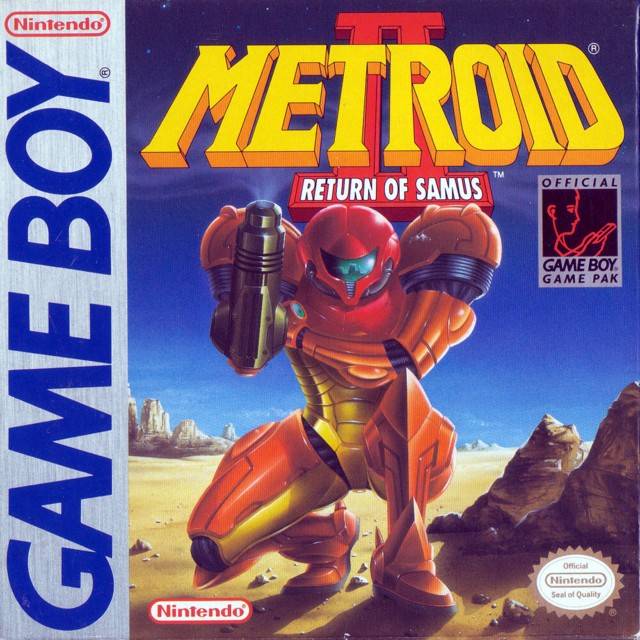
Metroid II: Return of Samus
Nintendo Game Boy
Published 1991
Metroid_II_US_boxart
The Nintendo Game Boy was a little system that could.  Propelled to success by its classic version of Tetris, the monochrome game system boasted a wide variety of games despite its low resolution and hunger for batteries.  Being a child of the 80’s and 90’s with a limited budget, most of my gaming nostalgia goes back to the original, which still holds a place of pride on my display of gaming systems that have since gone to pasture.
One of my favorite games of the era was Metroid II: Return of Samus.  This handheld sequel to the original NES game follows space bounty hunter Samus Aran as she traverses the caverns of an alien world to destroy weaponized aliens called Metroids.
While not narratively complex, the Metroid series offers plenty of exploration, tricky platforming, and the most badass woman in all of gaming as a protagonist.  II is a bit shrunk down and more linear than its 8-bit predecessor, but the thrill of actively hunting rather than simply exploring is an improvement on the original.
The maze-like interior of planet SR388 is divided into sections, each with a number of metroids.  Each section is cut off by ‘boiling acid’ which conveniently recedes when the required number of metroids have been killed.  This replaces the standard Metroid mechanic of requiring upgrades to proceed, although the game is still littered with toys for Samus to collect.  But the metroids Samus encounters aren’t simply the jellyfish-like floating aliens encountered in Metroid.  On their home planet they havea multi-stage life cycle, and become larger and more difficult as the game progresses.
While the game is a bit linear, and, if you collect everything, easier than other Metroid games, it is still a standout of the original Game Boy library.  You can find it fairly easily in used game stores, or digitally in the 3DS eshop.

Thanks for reading this article.  If you enjoyed it, please share it!  You can also support me on Patreon for exclusive and early access to writing, podcasts, and more!