Home

Hugh Likes Comics: Bandette #1

Leave a comment

Bandette #1 written by Paul Tobin, art by Colleen Coover published by Monkey Brain Comics and available via Comixology.


Disclaimer: I recently interviewed Ms. Coover and Mr. Tobin on The Way of the Buffalo Podcast. They were delightful.

Also: For the month of November, Monkey Brain Comics will be donating its portion of sales to The Hero Initiative.

Bandette” is my kind of comic: a fun, light, bite of adventure and atmosphere available at a discount price as a digital download. One of the launch titles for Chris Roberson’s Monkey Brain line of creator-owned digital comics, “Bandette” is the story of a faux-french thief whose exploits occasionally put her on the right side of the law. In the opening pages, she explains her dubious legal philosophies to a puppy she meets in the mansion of one of the ‘bad guys’ she steals from. “This is called justice. Or larceny, one of the two.”

Bandette” is refreshingly light hearted, with beautiful ink washed art and cartoonish character designs that reinforce the timeless, child-like frivolity of the comic. It feels both modernly hip, with a heroine who is smart, resourceful, and just a touch immoral, but with the delightfully retro style of “The Pink Panther” and “Lupin III.”

Coming in with a scant 13 pages of story, issue one is a quick jaunt of a tale, both quaintly familiar and unique. In a comics market where the major publishers are rushing to embrace grim and gritty, the charm and wit of Bandette #1 makes a perfect remise en bouche.

Hugh Likes Comics: Atomic Robo & the Flying She-Devils of the Pacific #4

Leave a comment

So here’s a new little use for this blog: A new, short digital comic review every so often. I like comics, and love the Comixology app, so hopefully this will be something I can keep up with. And of course, spoilers to follow.

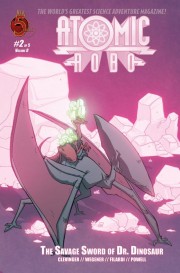
I’ve never really hidden my love for Brian Clevenger and Scott Wegener’s Atomic Robo comics, and I’m enjoying their latest effort: Atomic Robo and the Flying She-Devils of the Pacific # 4.

Brian and Scott have been deconstructing the issues on Nerdy Show, so go have a listen if you want to hear them discuss it in their own words.

Being the penultimate issue for the series, and man, has that word been coming up a lot around here lately, this is the big reveal of our bad guys, Chokaiten. The reader has been getting hints of their story as Japanese WWII survivors, but now we get their whole master plan. They are a weird science division of the Imperial Japanese army that, rather than surrender, went dark and is now staging a revenge attack which might destroy the western United States, unless of course Robo and the Flying She-Devils, a crew of all-female air pirates with jet packs, can stop them.

I have really been enjoying this volume of Atomic Robo just as a pulpy adventure tale. I love the aesthetics of the She-devils, all of whom are based on real indie comics creators. Their base and tech really had the feel of being held together by twine and hope, but also had the feeling of that technical leap that WWII enabled.

The Japanese villains, however, go a bit to far and becomes a bit silly. For story purposes, I can accept the idea that their country surrendered but they didn’t. But, the idea that the Japanese government forgot where all their best scientists and pilots were hidden doesn’t make much sense. The very existence of this kind of secret project being conducted by the notoriously cash-strapped Japanese forces without getting cannibalized strikes me as unrealistic, and that’s all before the UFO fighters and their earthquake bomb.

“Flying She-Devils” is a lot of fun, but it isn’t as smart as the other Action Science adventures. I recommend a read, but don’t look too deeply. This one’s just for fun.

Review: Wrayth by Philippa Ballantine

Leave a comment

Disclaimer: I have met Ms. Ballantine several times, and we are acquainted through social media. She has appeared twice as a guest on the Way of the Buffalo podcast. A review copy of Wrayth was provided by the publisher.

Wraith is the third of four books in Phillipa Ballantine’s “Books of the Order” series, and continues the spirit hunting adventures of Deacons Sorcha Farris and Merrick Chambers, along with the possessed prince-turned pirate Raed Rossin. The novel contains all of the fantasy action, cool ghost-centric magic, and dark political rumblings that fans of the series have come to expect. It moves the plot along in some very cool ways, introducing the reader to new Geistlords, spirits with immense power and subtle plans. One is the titular Wrayth, a sort of vampiric hive mind with plans of conquest. Another is the Fensena, a Coyote spirit who seems just as much the trickster as his mythological counter-part.

The Books of the Order are a fun, high-concept series full of all kinds of twists and turns, and I can’t wait for book four to bring everything to the suitably epic conclusion. Wrayth is an enjoyable entry that reveals lots of new details for our main characters, and arranges all the pieces on the board for the cataclysmic finale, but it suffers from the same problems that many penultimate series entries do: It saves a bit too much for the last book.

Overall, the novel feels a little too pared down. The pace is very fast, and rewards a careful read, but all the adventure passes by in a blur. The series focuses mainly on the three leads, with some major revelations about Sorcha’s origins, and Raed’s connection to the Rossin, the leonine geistlord that rides him. Aside from a few notable exceptions, the supporting characters feel more like extras. Raed’s crew members and the other deacons don’t really get much page space to shine. In a few places, I had to go back to the earlier entries to recall who some of the characters were. Some plot threads were snipped a bit too suddenly and cleanly, and the reader didn’t nearly get as much of a chance to steep in the wonderfully gothic atmosphere of Arkaym as in previous books. I would have loved to have seen this novel spread out over two books, or even given another hundred pages or so to breathe. Ms. Ballantine’s tales are a fine vintage, well worth sipping and savoring. Even the quick shots offered in Wrayth are fine, but I hope that the final book gives us more time to enjoy the world and characters Ms. Ballantine has created.

Support The Way of the Gun on Kickstarter!

2 Comments

You know what’s cool?  Samurai.  You know what else is cool?  Westerns.  That’s why you should go support Scott Roche’s Way of the Gun anthology on Kickstarter!

Scott is making an anthology of cool crossover Samurai westerns and he’s bringing in some really cool authors to help him out.  I’m not directly involved in this collection, but I want it to succeed, very badly.  So I’m not just putting my money where my mouth is, I’m putting up my own ebooks for backers.

Kick in $5, and I’ll send you a double pack of ebook short stories:  “The Brisingamen” and “The Crash.”  Donate $10, and I’ll send you two more:  “Moving Mountains” and the as-yet unavailable in print “Lou’s Journey.”  But if you want to get these ebook collections, you have to go support The Way of the Gun.  Already donated?  Just increase your pledge by $5 or $10 and you’ll still get the ebooks.

Can’t afford $5?  Spread the word.  Scott’s kickstarter is approaching its last week, and I’d hate to lose out on this totally awesome story collection.  Tweet, reblog, and share this post or just follow the link back to Scott’s kickstarter video and share it on Youtube.  You can help bring an incredibly awesome project to life.

Final Fantasy II: The One With The Evil Empire

Leave a comment

Original Release Date: 1988

System: Nintendo Famicom

Final Fantasy II is a game that is that feels both very different from its predecessor and very similar to its sequels. It is perhaps the strangest and most frustrating installment, but at the same time laid the foundation for many of the themes and plot elements that would become series standards.

First of all, this is a difficult game. Its learning curve is a bit steeper than the first game, and it doesn’t wait around for you to get warmed up. After the brief introductory text screen, the player is brought straight into… COMBAT! What’s more, this is a battle that your four starting characters have no hope of winning. You are completely outclassed, and MIGHT have the chance to attack once. You won’t do any damage. Rather than getting a game over screen, the characters wake up to find that they have been rescued, for the moment. Unfortunately, it’s just the three of them. One of them wasn’t found.

This missing crewman is a nice touch because it works for both the story and the gameplay, the holy duology of game writing. Leon’s disappearance personalizes and escalates the tension of the war. Having only three permanent characters leaves a slot open for new characters to join or leave the party as the game progresses, adding variety. This is a narrative trick that is commonplace later in the series, sticking characters together both for dramatic effect and to allow the player to experience multiple play styles.

While finding your missing companion is somewhat a goal of the game, the characters quickly become swept up in a rebellion against the evil empire attempting to wipe them all out. Rather than commanding a host of military units, your three characters go on supply runs, rescue missions, and commando raids to help turn the tide. This mission structure allowed FF2 to tell a much deeper story than FF1, with standout moments of betrayal, sacrifice, and triumph. The more rounded characters and personal story elevate the plot of Final Fantasy II above the comparatively retrieval quest of the first game. The thematic elements of a small band struggling against a powerful, omnipresent imperial force became a series staple.

Gameplay was also refined in the second game. Final Fantasy II completely ditched the experience points found in other games in favor of a more organic system of advancement. Instead of gaining levels by obtaining experience points, your characters’ actions determined their progress. You increased your strength by attacking, your magic by casting, and your hit points and defense by getting attacked. Weapon skills and magic worked the same way. This meant that your three characters were extremely customizable. It also meant that in order to keep gaining in power, you had to fight enemies that were more powerful than you, unless you cheated. There was a bug in the original versions of the game that allowed you to gain hit points and strength more quickly by attacking yourself. This led to some pretty unique leveling up. However, it does contribute to the game’s thematic elements. Rather than simply ticking off rungs on a latter, if feels like your characters really are developing organically.

Another unique feature to FF2 was the password system. During certain dialogues with NPC characters, the player had the chance to choose a phrase that the character had memorized, much like the dialogue trees in later Bioware RPGs. These choices usually just provided clues to the player about where they had to go next, or brought up some humorous bit of extra text. The player wasn’t able to significantly change the story by using them. It was a very basic system, but an interesting development for the time.

Despite the game’s many positive points, there are quite a few problems. The most glaring issue is the advancement system. As I stated above, the game doesn’t tell you when you gain experience, so it is VERY difficult to tell if you are making real progress. Also, because the magic system works the same way as all of the other advancement systems, your spells start out very weak. This is even true for the powerful magic you obtain late in the game. This pads out the game into a bit of a grind as the player has to fight enough random monsters so that the ultimate magic actually does a fair amount of damage.

The other major problem the game his is the hardware limitations of the 8-bit Nintendo Famicom (NES) system. FF2 has a lot of standout story moments, but many of the key plot points happen while the player is far away, searching for some macguffin in the depths of a cave on the other side of the map. Coming back to find the whole town died in the Empire’s latest attack gets old after the first couple times. Unfortunately, the 8-bit cartridge just didn’t have the power to tell the kind of story later games in the series could.

Final Fantasy II was never officially released internationally until 2003, so there is a bit less nostalgia for the game than others in the series. The game introduced some of the most enduring themes and story elements of the series, but in many ways it remains the black sheep of the Final Fantasy family.

Next up: Final Fantasy III, the point where the series began cultivating class.

I’ve got a Youtube channel now!

Leave a comment


As a part of doing Dragon*Can’t this year, Google required me to set up a Youtube channel to use hangout-on-air.  So far, you can see a couple of my readings, one from Dragon*Can’t and the other a test of the system.  They’re unedited, but there will be more polished content coming soon.  Check it out!

Click HERE!

#dragoncant

Leave a comment

For geeks with tight budgets, Labor Day weekend can be tough.  It seems like everywhere you look, friends are having fun at the biggest conventions of the summer.  From Pax in Seattle, to Chicon in Chicago, to Dragon*Con in Atlanta.  Everywhere you look, tweets, pics, and posts are going up in celebration of the end of the con season.  But the solution isn’t to turn off the computer and hide from the stream.  Come to Dragon*Can’t instead!

Dragon Can’t is an UnCon, devised by S. V. Allie, Brand Gamblin, and Nathan Lowell, this is a virtual con held in social media, chats, hangouts, and video conferences.  It’s all the fun panels, readings, and socializing from cons, but without the long lines, expensive food, and con funk.  You should definitely check it out at dragoncant.com.

I’ll be doing a live reading over G+ Hangout on air at 8PM Est on Saturday, Sept. 1st as part of Dragon*Can’t.  I’ll be reading from a new Novella coming soon, announcing a project for January 2013, and doing Q and A.  You should totally come!

Final Fantasy: This is what happens after we save the princess.

Leave a comment

Release Date: 1987

Original System: Nintendo Famicom/Nintendo Entertainment System

This is the first in a series of blog essays examining the games in the Final Fantasy Series. We’ll be considering plot, mechanics, design and other aspects of each game, and how they work together as an experience. As a far bit of warning, these essays are going to be chock full of spoilers.

This is the one that started it all, and it did something cool right out of the gate. At first glance, Final Fantasy doesn’t have much of a story or plot. A slowly crawling text screen, almost an 8-bit equivalent of the “Star Wars” opening text crawl reveals that the world is ending, and only four brave youths, each carrying an orb, aim to stop it. Next, you choose the names and jobs of your characters, making them fighters or mages. This is the only game in the series where you choose your characters’ jobs at the beginning and have to stick with your decision. Once you’ve picked out your favorite team of Fighters and Mages, the game unceremoniously deposits your party on the map screen, in a forest ringing a huge castle town.

“Final Fantasy” and the other well known Japanese RPG of the era “Dragon Quest” both stick very close to the mold of computerized Dungeons and Dragons clones. Although there are some interesting twists in the first installment, and later games create more of an identity for themselves. The first game was chock full of giants, hordes of D & D style undead, and even beholders! And much like the style of tabletop RPGs at the time, Final Fantasy did not hold your hand or give much in the way of hints, aside from pointing you in the direction of evil and demanding that you ‘Rekindle the Orbs.’

At the start of the game, the major problem is that Garland, a formerly gallant knight, has kidnapped Princess Sara and is hiding out in the creepy ruined shrine to the north. No one in the kingdom is a match for him, so it’s up to you to go knock him down. So your characters march through the goblin-haunted forest, fighting monsters and hopefully leveling up a bit before meeting your heroic destiny and saving the princess. At the time, of course, saving the princess or other damsel in distress was so common that just about every game (except for Metroid, Samus Aran is a self-rescuing princess.) featured an end goal of freeing some captive lady from a dastardly villain who set a few hours of obstacles in your path and waited patiently on the last screen. But here’s where “Final Fantasy” does things a little differently.

Slaying Garland and rescuing Sara isn’t the end goal of your long and perilous quest. It’s just your first step on a much wider and grander adventure. This may not seem like much today, but from the mindset of 1987, it was huge. Final Fantasy didn’t just present a challenge, it creates an arc.

This is a common literary device, and I wish games used it more often. Like the opening sequence to a summer blockbuster, the audience is given a compact introduction based on action rather than exposition. In the 8-bit era, the story for a game was something often left for the instruction booklet. Final Fantasy embraces a more literary aspect, while at the same time creating a ‘newbie area’ for the player to learn the gameplay without wandering into a fight they aren’t ready for.

The reason this really works is that the player doesn’t even know this until they return the princess, collect their reward, a lute that seems to be important, but has no known purpose, and leaves town.

When the player reaches the new bridge, filled with a new purpose to discover what is ill in the world, something very different happens. Credits roll. Final Fantasy might be the first game to include credits at the front of the game, much like a film.

Things get more difficult for the player on the other side of that bridge, but the game has a pretty balanced difficulty curve. Final Fantasy is essentially a huge map, and the player is invited to explore more and more of it as he overcomes challenges. These are not merely physical challenges in terms of having stronger enemies in new areas, either. The narrative functions extremely well here. As with the bridge at the beginning of the game, new methods of exploration become available and obstacles are removed from your path as you complete the story. In some cases this could feel artificial or illogical, but Final Fantasy is rather elegant about it.

The player helps a blind seer recover her crystal ball, and receives vital information about the quest. The player frees a harbor town from invading pirates, and takes their boat as a reward. The player feeds a hungry monster and opens the path it blocked. This not only progresses the story and keeps the player invested, but it gives the player a sense of agency in the game world.

Focusing on challenge and exploration does come at a cost, however. While NPC’s are are interactive and change to some degree as the story goes on, the player is piloting a barber shop quartet of tabula-rasas across the game. The Light Warriors themselves don’t have any personality at all, and their accomplishments nest very simply on the shoulders of the player. The game is much more a power fantasy than an epic.

The plot still has the ability to surprise the player, however. Late in the game, after saving the world from three arch-fiends, and firmly entrenching the world of swords and magic, the plot throws a spanner in the works.

Late in the game, something falls to earth and is buried in a cave. The player explores the cave full of monsters and discovers… a robot. It seems the last archfiend has hidden herself in the last remnants of an advanced civilization’s technology, and you’ll have to go up into space to fight her. This isn’t a medieval fantasy, it’s a post-apocalyptic one. This is a really cool twist, and one of the mainstays of the series. It is reinforced in the final dungeon, when all four now lit orbs are brought back to the Chaos Shrine from the start of the game. The real plot of the game’s villains is to use the orbs to create a time-loop which makes them immortal, at the expense of the rest of the world, and the agent responsible is of course the original princess-kidnapping knight, Garland.

Final Fantasy’s plot is bare bones, but it presents the player as an agent of change, and the antagonists as bringers of a terrible status quo. This is a refreshing standout in a medium where heroes usually served as Princess retrieval services. Final Fantasy is a game about breaking out of damaging patterns and changing the world for the better, and it certainly changed the face of electronic entertainment.

Next up: Final Fantasy II, the black sheep of the family.

Hugh supports Gaymercon and rants a bit

1 Comment

I just supported a kickstarter for Gaymercon.  I doubt that I will be able to make it to the actual event next year, but I am amazed by the courage and awesomeness of the organizers. This is an incredible idea, an incredible convention. It is something that makes me proud to be a geek. And there are people who are complaining about it. They are complaining that it is being EXCLUSIVE and FRACTURING THE GAMING COMMUNITY NEEDLESSLY. I’ll let you read those big old capslock letters again. Welcome to privilege town, ladies and gentlemen.

I am a gamer. Two months ago, I married my wonderful partner of eleven years. We wore matching red and blue waistcoats, and we exited the ceremony to a version of the Final Fantasy Prelude. I was very happy that I could include gaming in our wedding, because we finally got our good ending.

I have never set foot in X-box live, and I steer clear of gamin message boards. Some of the hate spewed in those places is ignorance, some is childishness, and some is a tactic. But it lessens my experience. It reminds me that I’m different. That I’m unwelcome. Gaymercon is an event that is going to bring the gaming community together, to support our identities and our hobbies, and to say that the two are not mutually exclusive. I’ll be damned if some hetero-normative bully is going to tell me to sit down and shut up about it. Gaymercon is important and it is necessary because of this, and this, and let’s not forget this.  Gay, lesbian, transgender, hell, even FEMALE and NON-WHITE gamers have had to fight for their seat at the table in this community.

There is a lot of support for diversity in the gaming community, but there is a lot of hate, too. And that hate has one hell of a large bullhorn. Things are changing, if slowly for the LGBTQA community in gaming. Gaymer con is going to be a great step in making gaming a safe place for everyone. I’m supporting them, and if you feel the same way I do, regardless of your gender identity or sexual orientation, I urge you to do the same.

Final Fantasy Origin

Leave a comment

This year is the 25th anniversary of Final Fantasy, which is to say that Final Fantasy was originally released in Japan in 1987.  I learned of the series ten years later, as an awkward high school student.  My best friend gave me a 3.5 floppy disc (kids, ask your parents) with a DOS NES emulator and a rom of Final Fantasy.  This was the same time when Final Fantasy 7, with its CGI videos and polygonal graphics was tearing up the PlayStation, but I didn’t care.  It was something amazing.  It was a game that changed my whole outlook.

Playing Final Fantasy games brought be back to fantasy and science fiction as a reader.  They were genres I had abandoned in favor of horror and thriller paperbacks.  But these games brought me back to them, and showed me that there was something great in those stories.  And I fell in love with fantasy so hard that I started writing it myself.  It’s funny to think that a video game could be the reason I became a writer, but it’s true.

In the fifteen years since I made my first party (Lugh, Bobo, Bill and Maev) the series has had its ups and downs, sequels, spin-offs, mergers and MMOs.  I’ve traveled and journeyed as well, from school to the working world, to living overseas and coming home, and getting married.  And I’ve been playing and loving Final Fantasy throughout everything.  A lot of writers, myself included, have literary heroes they admire and seek to emulate.  For me, Hironobu Sakaguchi, the designer of Final Fantasy is just as much in my pantheon of legends.

Each Final Fantasy game is different, and each one has its own flaws and strengths.  And each one has something to teach about its design, even to writers.  I am going to spend a few weeks looking at the story and plot of each Final Fantasy, to see what makes it tick, and why the game works, or doesn’t.  It’s going to be quite a ride, and I hope you stick with me on it.

Older Entries Newer Entries