Home

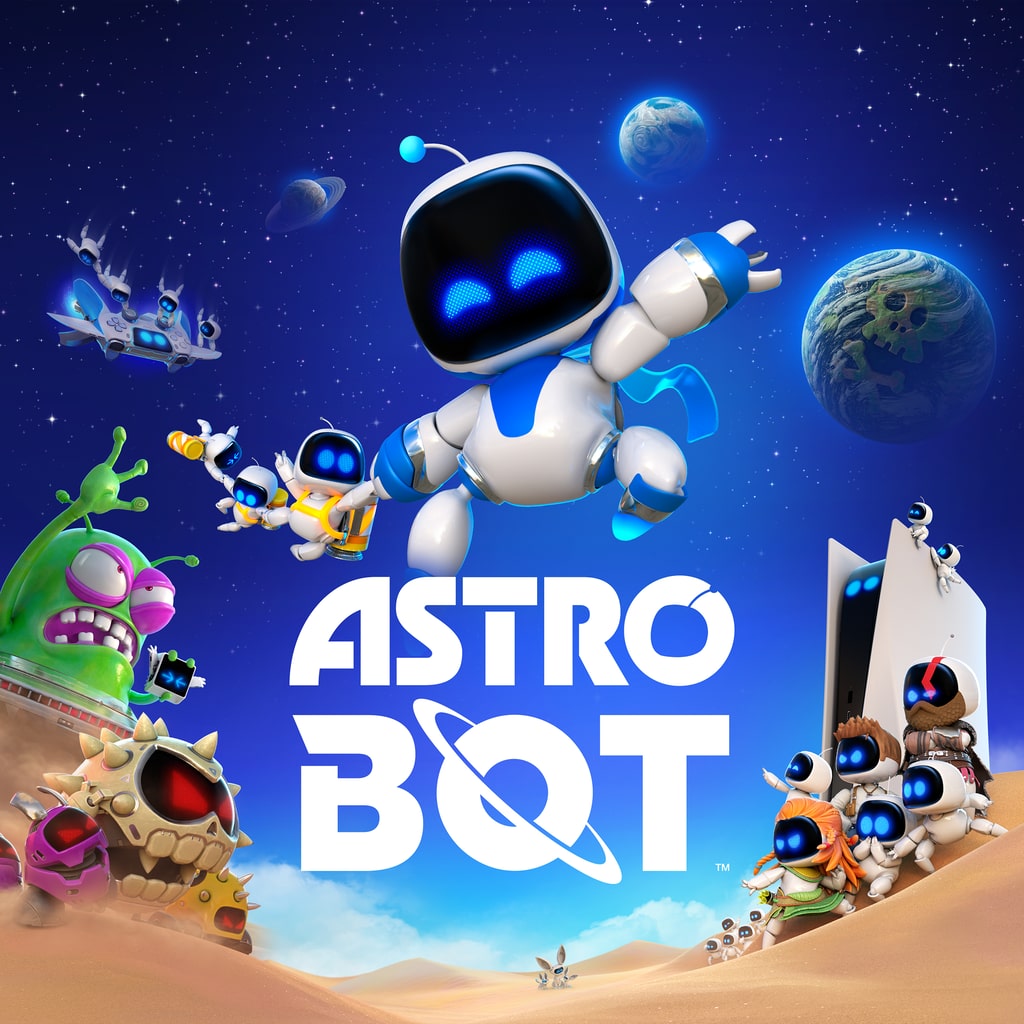
Hugh Likes Video Games: Grindstone

Leave a comment

Grindstone
Developed by Capybara Games

Published by Apple

Played on Mac via Apple Arcade

The Skinny: Rise and grind in this monster-hunting, loot-collecting puzzle adventure!

For some people, hunting monsters is an adventure, but for Jorj, it’s a nine to five.
Grindstone is a delightful mix of puzzle and RPG with a whimsical hand-drawn art style. Think of Puyo-Puyo but with more barbarians. Jorj is a Stonegrinder. He mines precious, magical grindstones from the hordes of monsters infesting Grindstone Mountain, hoping to someday save up enough to take his family on vacation somewhere warm. Monsters appear in a grid, and Jorj can chain through monsters of the same color. Long-enough chains generate grindstones, which land on the map and allow Jorj to change colors, thus extending his chain and generating more grindstones. It’s a fun and addictive loop, and after each level, Jorj can return to the inn at the base of the mountain to refill his hearts, or use the grindstones and other loot that he gathers to upgrade gear such as swords, armor, and potions, which provide buffs or bonuses during levels.
The game is structured into well over 200 different levels, with side areas, and different sections of the mountain with their own unique enemies, hazards, and puzzle elements. There are also a variety of daily challenge modes. There’s plenty to do, and the loop of playing a few levels, returning to the inn to stock back up or unlock new gear, and head back out is effective and addicting. The game’s vapor-wave soundtrack is surprisingly relaxing, as well. I played the game on my Mac via Apple arcade and found that the touch controls using the trackpad were intuitive, and the game also had simple keyboard shortcuts. Grindstone also has controller support, but I found it to be less precise. Grindstone feels best with touch controls.
I played Grindstone on my Mac Pro as a part of Apple Arcade, and that version is also available for iPad and iPhone. The game is also available for purchase from the Steam and Epic stores, as well as consoles. This is one grind that is worth the time.

Hugh Likes Video Games: Katamari Damacy Rolling Live

Leave a comment

Katamari Damacy Rolling Live

Published by Bandai Namco

Released in Apple Arcade
Played on Macbook Pro

The Skinny: The Skinny: Still rolling along.

Released exclusively for phones, tablets, and Mac via Apple Arcade, Katamari Damacy Rolling Live brings back The King of All Cosmos, who is dismayed to find that time has moved on from his heights of popularity in the early 2000s. In order to regain the hearts of the people, he hatches a plan to become a hugely popular streamer. And by streamer, he means streaming the Prince taking on missions rolling up everything in his path.

Structurally, Katamari Damacy Rolling Live works in much the same way as every Kamari sequel since 2005’s We Love Katamarii. A line of fans will each give the King a request, which results in a level or a challenge for the Prince. In addition to the traditional challenges of growing to a certain size or within a given time limit, levels include trying to spend as much as possible in a convenience store, rolling up as many people as possible at an amusement park, and using the katamari to clean a bath house. As the game has been optimized for play on phones (with use of a wireless controller or backbone,) the challenges tend to be a little shorter and the levels are a bit cramped. But the game shares the same low poly aesthetic and jazzy electric J-Pop soundtrack that you remember. As the levels grow in complexity, you can go from rolling around a living room, to a shopping mall, to rolling up the whole world. There isn’t a ‘house’ to explore, but the levels, if a little small, are interesting. New levels unlock based on the number of ‘views’ your performance earns. Most levels will unlock eventually, but a better score unlocks them faster.

The game plays a bit too far into nostalgia. The central joke, the King becoming a streamer because nobody is paying attention to him, doesn’t really land. The joke’s fangs are blunted, mostly because the game doesn’t want to really say anything too mean about streamers, whom Bandai Namco presumably wants to push and market the game for them. So the story just kind of falls flat as a gimmick, and the satire feels toothless.
The Soundtrack is another standout, full of peppy, dancy, and occasionally downright weird J-Pop Jazz to roll along to. “Midnight Tryst,” “Parallel Damacy,” and “Starry Night Fever” are standout tracks for me. You can also spend Candy, the game’s in-game currency on unlocking extra cousins, personalizing your channel logo, and unlocking classic songs from previous games like Katamari on the Swing. As a part of Apple Arcade, there aren’t any cash micro-transactions so the unlocking experience doesn’t feel at all predatory.
Katamri Damacy Rolling Live is presented as a part of Apple Arcade, so it’s free with a subscription to the service, which makes it well worth your time if you liked the PS2 classics. Take it for a spin on iPhone, iPad, or Mac If you aren’t a part of the Apple grid, you can wait for Once Upon a Katamari when it launches for Steam and consoles later this week.

Hugh Likes Video Games: Sword of the Sea

Leave a comment

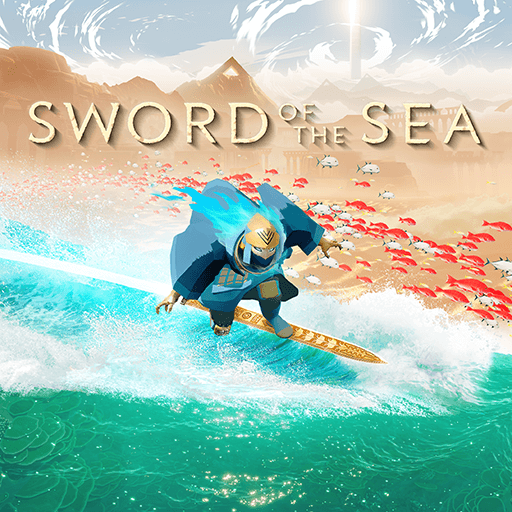
Sword of the Sea

Developed by: Giant Squid

Published by: Giant Squid

Played on Playstation 5 as a part of PS Plus Extra

The Skinny: Restore life to a desert necropolis with the power of sweet kick flips!

The latest game from the creators of The Pathless and ABZU, Sword of the Sea is as much a vibe as a game. A low-stakes, exploratory game that puts you in the shoes of The Wraith as they seek to restore life to a desert necropolis after a devastating war between the forces of the spirits of Fire and Water.
And it’s also a snowboarding game, sort of.
You navigate the world on the titular sword, a sort of magical hoverboard that allows you to zoom over the dunes and waves as you restore the sea and life to the desert. Whereas other boarding games may attempt to bring a sense of realism to the sport, this is all about the feeling of speed as you navigate vast wastelands and grind down cyclopean monuments. It is less about skill than it is about joy, although you can discover skate park-like challenge rooms and upgrade your arsenal of tricks by collecting gems scattered throughout the areas.
Much like Giant Squid’s previous games, The Sword of the Sea is short and light on challenge, but creates a beautiful, joyous world that you will want to linger in and explore, without the threat of a timer or hostile enemies. The game can be completed in an evening, but it is well worth savoring.
Along the way, you will discover ancient mosaics and plinths with lore depicting the state of the world, but they are less important than the labyrinths of geometry and haunting soundtrack. This game is a vibe, first and foremost.
Short and sweet, with a narrative expressed entirely without dialog while encapsulating a rush of speed that even the clumsiest newbie can achieve, The Sword of the Sea is, much like Journey, an experience not to be missed.
Sword of the Sea is available for PS5 and PC via Steam. I highly recommend it. And for PS Plus Extra subscribers, the game is included in the library, so there’s no reason not to pick it up. 

Hugh Likes Non-Fiction: Queer As Folklore

Leave a comment

Queer As Folklore: The Hidden Queer History of Myths and Monsters
Written by Sacha Coward

Narrated by Will Watt

Published by Tantor Media

Listened to via Audible

The Skinny: A reimagining of legends and mythological creatures with a Queer lens.

Queer As Folklore examines the icons of myth and legend, and their hidden, and sometimes not so hidden connections to Queer iconography, history, and culture. Coward describes folklore as a living document, the stories that a culture tells. He presents both ancient and modern interpretations of archetypes, from the ancient to the modern. Everything from unicorns to UFOs get touched on.  Dealing largely with historical records, a lot of the history presented in this book is obscure, and depressing. So much of Queer history, particularly in Europe and America in the 18th, 19th, and 20th centuries was written in grave stones and police records, and Coward is a good anthropologist who doesn’t stray too far from his sources, even when he admits the temptation.

Each chapter focuses on a different mythological, supernatural, or pop-culture figure, presenting their mythological and historical context alongside their Queer signifiers, interpretations, and reinterpretations, along with associated Queer history and figures. Coward discusses, for example, Mermaids in their various classical and modern incarnations, and particularly focuses on The Little Mermaid author Hans Christian Andersen’s letters and tangled romantic history. He traces arguments through history, from the classical to the romantic to the modern.

The audiobook narration, delivered impeccably by Will Watt, is also charming and lively, keeping the listener engaged and not becoming a waterfall of facts and dates. I would listen to Watt read the phone book, but finding him here was a surprise and a delight, and he delivers the material well.

While a high-level overview of a number of different myths, legends, and historical figures, Queer as Folklore is a great place to start looking and reexamining these stories, and an excellent jumping off point for interested burgeoning scholars of mythology, culture, or Queer history. There is sure to be something fascinating that you haven’t heard before. I highly recommend it.

Hugh Likes Podcasts: DC Action News

Leave a comment

DC Action News
Hosted by Alex Jaffe

Produced by Esper Quinn

The Skinny – “Reporting Bravely and Boldly every Wednesday as the news breaks from the center of the Multiverse.”

DC Action News is a great little podcast that sets out to do what it does, and is quick and clever. Formatted as a newscast, DC Comics loremaster Alex Jaffe essentially recaps the events of the current week’s DC comics. And if you just want a recap of this week’s comics issues, it’s great.
But the real joy in the show is the clever twists he takes with the format, presenting the over-the-top comic book stories as serious real events. This ten-minute weekly mini-podcast is all about delivery. It’s the difference between a super-fan telling you about how a terrorist group lead by a super-intelligent psychic gorilla tired to steal the Moon and getting that story from Walter Cronkite.
The show mostly focuses on the ‘prime’ Earth, the one that the comics usually take place in, but also features segments from ‘Absolute’ Alex Jaffe and other versions of the host from the various alternate realities that crop up in comics, and occasionally features additional interviews and cameos.
The most recent episode, which lampshades the ‘Fifth Wednesday Phenomenon,’ in which for some reason almost no terrible events happen in the world on the fifth Wednesday of each month, is my favorite so far.  Since the ‘news’ was light, the majority of the episode was dedicated to a Reporter on the Street segment which featured a bunch of delightful podcaster cameos answering the question: Does ACAB include Batman?
DC Action News is published weekly. You can subscribe or listen to episodes at DCActionNews.com or through your podcatcher of choice. I highly recommend giving it a listen.

Hugh Likes Comics: What Did You Eat Yesterday?

Leave a comment

What Did You Eat Yesterday?

Written and Drawn by Fumi Yoshinaga

Published by Vertical, Inc.

The Skinny: A Gay slice-of-life cooking manga that has more romaine than romance.

Shiro and Kenji are a Gay couple in their 40s living together in Tokyo. Closeted lawyer Shiro fends off the questions about his girlfriend, while boisterous barber Kenji is much more relaxed and free-spirited. But every day Shiro cooks an amazing meal for his partner at the end of the day.

Equal parts slice-of-life and cooking manga, What Did You Eat Yesterday? has very little plot to speak of, just the day to day lives of the protagonists and their emotions. Shiro is a fussy and vain, but he demonstrates the depths of his emotions in his cooking for Kenji, who can be jealous. I wish the book were a bit more, well, it has all the spice level of a cup of milk, to be frank. But for as little physical affection as the characters show, the book is a look into the daily lives of people who usually don’t get a spotlight in either manga or western comics.

Yoshinaga’s art style is easy to read and balances a fashion plate-like style for the characters with gorgeous, detailed renderings for the food. It also includes clear recipes that, while being originally intended for the Japanese market, are easy to follow and recreate in the kitchen of a Western reader. The comic follows Shiro from the grocery store to plating and serving the dish for Kenji, often involving the math and planning stages, interwoven into the story. Do I wish that Shiro’s parents were more open and accepting of their son, yes. But did you see that amazing drawing of fried tofu?

What Did You Eat Yesterday? also received its own live-action television series, consisting of two seasons and a movie. It also has its own accompanying fan-fiction series, which includes all of the adult content the comic doesn’t cover. I am glad that the translation includes the frank discussion of everyday life of these characters and their relationships, something that we haven’t always gotten, particularly for queer characters in larger franchises. Stares in ‘They’re Cousins’ This is a serious manga for adults, but if you are looking for spice, you’re going to find more on the plate than in the sheets.

What Did You Eat Yesterday? is available in print and digital editions from the usual online retailers, or in print from your local bookstore or comics shop. You may be able to find it or ask for it at your local library!

Hugh Likes Video Games: Tiny Terry’s Turbo Trip

Leave a comment

Tiny Terry’s Turbo Trip

Published by Super Rare Originals

Developed by Snekflat

Played on Nintendo Switch

The Skinny: A weird little sandbox game about driving to space.

Tiny Terry’s Turbo Trip is a truly weird but highly enjoyable sandbox game about driving to space. Terry, a child living in the entirely law-free city of Spranklewater, wants to drive to space. To accomplish his goal, he’s gotten a job as a taxi driver, with a tiny car, and which he absolutely will not do. You will, at no point in this game, give anyone a ride anywhere. What you will do is collect a lot of junk and money to upgrade your car, complete quests, and interact with the charming and bizarre town and its citizens before making your fateful trip.
Tiny Terry isn’t a long game, perhaps 6-8 hours if you try and do everything, and a slim 2-3 if you just focus on accomplishing the main quest. Terry can’t be injured and there is no lose condition, although he’ll lose money if he runs into a cactus or otherwise comes to harm. This is a very casual and kid-friendly game where you explore the town, play mini-games, dig up random piles of dirt, and trade in the junk you find to upgrade your car to one day drive all the way up the side of the town’s tallest building and eventually slip the surly bonds of gravity.
The game itself isn’t very challenging, but the hook lays in its charm. The graphics have a blocky, Gamecube-like quality to them, and the little town is packed full of quirky characters and hidden secrets. You can play soccer with the kids you’re supposed to be going to summer school with, collect bugs to help a beachside snack bar stay in business, and commit Grand Theft Auto and other crimes. The humor in the game feels like it’s a draw for the pre-teen crowd, with weird characters, eating bugs, and a guy so sunburned he catches on fire. There’s a lot packed into this tiny game, and every minute is a delight.
While it’s a bit too slight to be truly great, Tiny Terry’s Turbo Trip is a little indie gem that will get you through a relaxing weekend or a long plane ride. It was previously available from Steam and is now on consoles. It’s well worth checking out!

Hugh Likes Fiction: The City in Glass

Leave a comment

The City in Glass
Written by Nghi Vo

Published by TOR

The Skinny: Good Omens meets Sim City

Azril is a city known for its universities and its brothels, its festivals and its observatory, its merchants and its anchoresses. It is home to the demon Vitrine, who has built and shaped the city as she pleases for centuries. She is pleased with her project, until a quartet of angels come and destroy it in a single night. Left with nothing but the book of names in her heart, she curses them as the leave, leaving a piece of herself lodged in the last angel’s chest. And then they are left to consider what to do next.
The City in Glass is a book about recovery and revenge. It is a book about trauma and it is a book about love. Vo’s poetic, tightly worded prose brings a dead city to life as Vitrine wanders the ruins of her home, propelling the reader backwards and forwards in time with an immortal’s perspective as she sifts through the rubble and slowly rebuilds. Her sparring, circling affair with the angel who brought it all down is set against her memories of the city that was, with anecdotes of the artists, pirates, and refugees who had called the city home.
A novel written during the Pandemic Lockdown, Vo has poured grief, frustration, and a strange wicked fondness into her characters and her broken garnet of a city. While many of us were making our Animal Crossing: New Horizons islands, Vo created her own bustling port city only to tear it down with holy fire and start again. The story captures and personalizes the god’s eye view of a simulation city builder as Vitrine goes from changing the course of rivers and cleaning up bodies to planting flowers to choosing which citizens to favor and which to spurn. But Vitrine and the Angel are such fascinating characters and the city they are building is so vibrant that I never felt like I was watching someone else’s play-through. Vo pulled me in completely.
The City in Glass is a bloody jewel of a novel. It constantly surprised me with its capricious demon building and planning her wonder of a city as she danced through the streets and whirled closer and farther from the distraught Angel that pursued her. You can find it in print or ebook from the usual online sources, or from your local independent bookshop. Or, as Vitrine might suggest, your can get it at your local library. I highly recommend it.

Hugh Likes Comics: The Drops of God

Leave a comment

The Drops of God Vol. 1

Written by Tadashi Agi

Drawn by Shu Okimoto

Translation by Vertical, Inc.

Published by Kodansha Comics

The Skinny: A Martial Arts Manga about Wine Tasting.

When legendary wine critic Yutaka Kanzaki dies, he leaves only his estranged son Shizuku to inherit his estate and his priceless cellars. Due to his demanding upbringing, Shizuku has no interest in wine, and still resents that his father spent years training him. In fact, he has never even drank wine, out of resentment to his father. But shortly after his death, a second heir appears.
A week before his death, Kanzaki formally adopts young, talented wine critic Issei Tomine and creates a new will. The two will have to compete in tasting a dozen different wines, as well as identify one mythical bottle, the so-called ‘Drops of God’ in a winner-take-all competition for Kanzaki’s estate and collection.
Even with his latent skills developed by his father’s rigorous training, Shizuku will need help to figure out a path to gain control of his father’s estate. His only hope is apprentice sommelier Miyabi, who agrees to help him beat the unstoppable critic.
With drama like a martial-arts manga, The Drops of God is a unique comic that mixes the aesthetics and over-the-top posture of manga and anime with a deep understanding of wine making and tasting. It is a more grown-up taste for fans that have grown up on One Piece and Dragonball. This risky mix that doesn’t always work, but the terroir of serious adult drama and stakes with shonen sensibility is a delightful romp. Watching our heroic couple (even if they don’t know it yet) hunt through Ginza for a hidden wine that can match a hundred-thousand dollar vintage is a delight. Meanwhile his nefarious rival completes trains by tasting row after row of wine, and pours strange, black-hued vintages down the naked back of a corporate executive who looks like the model from the cover of Duran Duran’s Rio.
The characters are both archetypal and over-the-top and also grounded in a way that is interesting. The art is clear and solid, with more grown-up visual style, although cuter aesthetic touches surface here and there.
The Drops of God is a mature vintage of manga for a discerning palate. It is available in print and digitally from online and other retailers.

Hugh Likes Comics: Star Trek Lower Decks: Warp Your Own Way

Leave a comment

Star Trek Lower Decks: Warp Your Own Way

Written by Ryan North

Drawn by Chris Fenoglio

Colored by Charlie Kerchoff

Lettered by Jeff Eckleberry

Published by IDW

The Skinny: A Choosable Path Adventure that feels like a great stand-alone episode of Star Trek.

Star Trek Lower Decks: Warp Your Own Way is a ‘choosable path adventure’ set somewhere in the continuity of Star Trek: Lower Decks, by the creative team that has been killing it recently with a recent ongoing series, delightful one-shots, and surprising minis. While I have read a little of their previous work, I haven’t seen more than the first couple of episodes of the show. But I greatly enjoyed this graphic novel as a bit of a taste of what the show is like, written by a writer squarely in his wheelhouse and drawn by an artist who knows exactly what they are doing.
North is no stranger to ‘Choosable Path’ stories, having writing the wonderful and surprising To Be or Not To Be and Romeo and/or Juliet, a pair of prose Shakespeare choosable path adventures that are somewhat a bit more complex than this entry, but share a similar tone and excitement for the genre. The graphic novel format has its own advantages in conveying the compact information more quickly, and drawing the eye in ways that a prose page cannot. North and Fegoglio also captures the magic of Star Trek’s more daring and experimental episodes, directly referencing some of the highlights of the franchise as well including some wilder easter eggs. Depending on the choices the reader makes, series main character Mariner and the crew of the Cerritos could fight off an invasion by Borg, a hostile attack from Khan himself, or a visit from a hard-partying space god. But as each story branch reaches its conclusion, readers will notice a pattern emerging.  This is the point where the book goes from referential game to something much more interesting and special.
North has a gift for understanding and manipulating the structure of media he’s working in. Warp Your Own Way isn’t simply a riff on the “Choose Your Own Adventure” novel format with a Star Trek: Lower Decks license. North and Fenoglio understand the assignment on a deeper level, and use the structure of a graphic novel and choosable path format to tell a Star Trek story in a way that only they could pull off.
My favorite episodes of Star Trek are the ones where they break away from the usual structures and plots and do something strange and different; like the Star Trek: TNG episode “Cause and Effect,” which was essentially a repeat of the same period of time due to the ship being caught in a time loop. This book ultimately has some of that energy.
Fenoglio’s art is pleasing and easy to follow, which works well in a few sequences that break not only the story structure but the page itself in a fun way. Kerchoff’s colors are bright and eye-catching and just what you expect for a book like this. It matches what I’ve seen of the show, but I’m not an expert there.
If there is a flaw it is that this book feels somewhat detached from the source material of Lower Decks itself. There are some sequences that establish the characters, but there is a broadness to the story that feels like it could be pulled from any Star Trek series, swapping the crew of the Cerritos for the Enterprise or Voyager and still come through relatively unchanged. Having seen very little of Lower Decks, I can’t really be sure here, and this wasn’t a detriment to me as a new reader coming in. New readers won’t have to catch up to enjoy the story.
Star Trek Lower Decks: Warp Your Own Way is available now in print from Your Local Comics Shop or digitally wherever you buy books or comics.

Older Entries