Home

Hugh Likes Video Games: Grindstone

Leave a comment

Grindstone
Developed by Capybara Games

Published by Apple

Played on Mac via Apple Arcade

The Skinny: Rise and grind in this monster-hunting, loot-collecting puzzle adventure!

For some people, hunting monsters is an adventure, but for Jorj, it’s a nine to five.
Grindstone is a delightful mix of puzzle and RPG with a whimsical hand-drawn art style. Think of Puyo-Puyo but with more barbarians. Jorj is a Stonegrinder. He mines precious, magical grindstones from the hordes of monsters infesting Grindstone Mountain, hoping to someday save up enough to take his family on vacation somewhere warm. Monsters appear in a grid, and Jorj can chain through monsters of the same color. Long-enough chains generate grindstones, which land on the map and allow Jorj to change colors, thus extending his chain and generating more grindstones. It’s a fun and addictive loop, and after each level, Jorj can return to the inn at the base of the mountain to refill his hearts, or use the grindstones and other loot that he gathers to upgrade gear such as swords, armor, and potions, which provide buffs or bonuses during levels.
The game is structured into well over 200 different levels, with side areas, and different sections of the mountain with their own unique enemies, hazards, and puzzle elements. There are also a variety of daily challenge modes. There’s plenty to do, and the loop of playing a few levels, returning to the inn to stock back up or unlock new gear, and head back out is effective and addicting. The game’s vapor-wave soundtrack is surprisingly relaxing, as well. I played the game on my Mac via Apple arcade and found that the touch controls using the trackpad were intuitive, and the game also had simple keyboard shortcuts. Grindstone also has controller support, but I found it to be less precise. Grindstone feels best with touch controls.
I played Grindstone on my Mac Pro as a part of Apple Arcade, and that version is also available for iPad and iPhone. The game is also available for purchase from the Steam and Epic stores, as well as consoles. This is one grind that is worth the time.

Hugh Likes Video Games: Katamari Damacy Rolling Live

Leave a comment

Katamari Damacy Rolling Live

Published by Bandai Namco

Released in Apple Arcade
Played on Macbook Pro

The Skinny: The Skinny: Still rolling along.

Released exclusively for phones, tablets, and Mac via Apple Arcade, Katamari Damacy Rolling Live brings back The King of All Cosmos, who is dismayed to find that time has moved on from his heights of popularity in the early 2000s. In order to regain the hearts of the people, he hatches a plan to become a hugely popular streamer. And by streamer, he means streaming the Prince taking on missions rolling up everything in his path.

Structurally, Katamari Damacy Rolling Live works in much the same way as every Kamari sequel since 2005’s We Love Katamarii. A line of fans will each give the King a request, which results in a level or a challenge for the Prince. In addition to the traditional challenges of growing to a certain size or within a given time limit, levels include trying to spend as much as possible in a convenience store, rolling up as many people as possible at an amusement park, and using the katamari to clean a bath house. As the game has been optimized for play on phones (with use of a wireless controller or backbone,) the challenges tend to be a little shorter and the levels are a bit cramped. But the game shares the same low poly aesthetic and jazzy electric J-Pop soundtrack that you remember. As the levels grow in complexity, you can go from rolling around a living room, to a shopping mall, to rolling up the whole world. There isn’t a ‘house’ to explore, but the levels, if a little small, are interesting. New levels unlock based on the number of ‘views’ your performance earns. Most levels will unlock eventually, but a better score unlocks them faster.

The game plays a bit too far into nostalgia. The central joke, the King becoming a streamer because nobody is paying attention to him, doesn’t really land. The joke’s fangs are blunted, mostly because the game doesn’t want to really say anything too mean about streamers, whom Bandai Namco presumably wants to push and market the game for them. So the story just kind of falls flat as a gimmick, and the satire feels toothless.
The Soundtrack is another standout, full of peppy, dancy, and occasionally downright weird J-Pop Jazz to roll along to. “Midnight Tryst,” “Parallel Damacy,” and “Starry Night Fever” are standout tracks for me. You can also spend Candy, the game’s in-game currency on unlocking extra cousins, personalizing your channel logo, and unlocking classic songs from previous games like Katamari on the Swing. As a part of Apple Arcade, there aren’t any cash micro-transactions so the unlocking experience doesn’t feel at all predatory.
Katamri Damacy Rolling Live is presented as a part of Apple Arcade, so it’s free with a subscription to the service, which makes it well worth your time if you liked the PS2 classics. Take it for a spin on iPhone, iPad, or Mac If you aren’t a part of the Apple grid, you can wait for Once Upon a Katamari when it launches for Steam and consoles later this week.

Hugh Likes Video Games: Sword of the Sea

Leave a comment

Sword of the Sea

Developed by: Giant Squid

Published by: Giant Squid

Played on Playstation 5 as a part of PS Plus Extra

The Skinny: Restore life to a desert necropolis with the power of sweet kick flips!

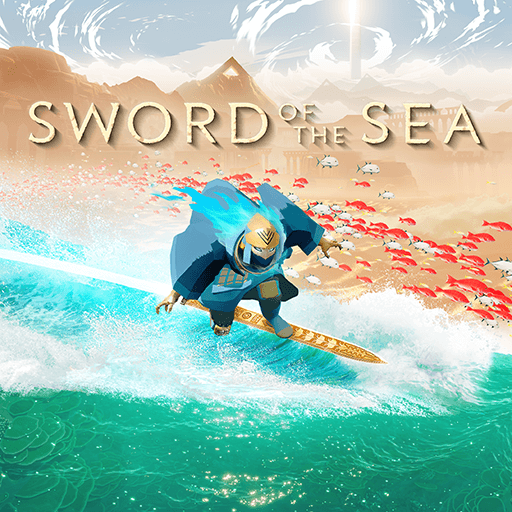
The latest game from the creators of The Pathless and ABZU, Sword of the Sea is as much a vibe as a game. A low-stakes, exploratory game that puts you in the shoes of The Wraith as they seek to restore life to a desert necropolis after a devastating war between the forces of the spirits of Fire and Water.
And it’s also a snowboarding game, sort of.
You navigate the world on the titular sword, a sort of magical hoverboard that allows you to zoom over the dunes and waves as you restore the sea and life to the desert. Whereas other boarding games may attempt to bring a sense of realism to the sport, this is all about the feeling of speed as you navigate vast wastelands and grind down cyclopean monuments. It is less about skill than it is about joy, although you can discover skate park-like challenge rooms and upgrade your arsenal of tricks by collecting gems scattered throughout the areas.
Much like Giant Squid’s previous games, The Sword of the Sea is short and light on challenge, but creates a beautiful, joyous world that you will want to linger in and explore, without the threat of a timer or hostile enemies. The game can be completed in an evening, but it is well worth savoring.
Along the way, you will discover ancient mosaics and plinths with lore depicting the state of the world, but they are less important than the labyrinths of geometry and haunting soundtrack. This game is a vibe, first and foremost.
Short and sweet, with a narrative expressed entirely without dialog while encapsulating a rush of speed that even the clumsiest newbie can achieve, The Sword of the Sea is, much like Journey, an experience not to be missed.
Sword of the Sea is available for PS5 and PC via Steam. I highly recommend it. And for PS Plus Extra subscribers, the game is included in the library, so there’s no reason not to pick it up. 

Hugh Likes Video Games: Tiny Terry’s Turbo Trip

Leave a comment

Tiny Terry’s Turbo Trip

Published by Super Rare Originals

Developed by Snekflat

Played on Nintendo Switch

The Skinny: A weird little sandbox game about driving to space.

Tiny Terry’s Turbo Trip is a truly weird but highly enjoyable sandbox game about driving to space. Terry, a child living in the entirely law-free city of Spranklewater, wants to drive to space. To accomplish his goal, he’s gotten a job as a taxi driver, with a tiny car, and which he absolutely will not do. You will, at no point in this game, give anyone a ride anywhere. What you will do is collect a lot of junk and money to upgrade your car, complete quests, and interact with the charming and bizarre town and its citizens before making your fateful trip.
Tiny Terry isn’t a long game, perhaps 6-8 hours if you try and do everything, and a slim 2-3 if you just focus on accomplishing the main quest. Terry can’t be injured and there is no lose condition, although he’ll lose money if he runs into a cactus or otherwise comes to harm. This is a very casual and kid-friendly game where you explore the town, play mini-games, dig up random piles of dirt, and trade in the junk you find to upgrade your car to one day drive all the way up the side of the town’s tallest building and eventually slip the surly bonds of gravity.
The game itself isn’t very challenging, but the hook lays in its charm. The graphics have a blocky, Gamecube-like quality to them, and the little town is packed full of quirky characters and hidden secrets. You can play soccer with the kids you’re supposed to be going to summer school with, collect bugs to help a beachside snack bar stay in business, and commit Grand Theft Auto and other crimes. The humor in the game feels like it’s a draw for the pre-teen crowd, with weird characters, eating bugs, and a guy so sunburned he catches on fire. There’s a lot packed into this tiny game, and every minute is a delight.
While it’s a bit too slight to be truly great, Tiny Terry’s Turbo Trip is a little indie gem that will get you through a relaxing weekend or a long plane ride. It was previously available from Steam and is now on consoles. It’s well worth checking out!

Hugh Likes Video Games: Animal Well

Leave a comment

Animal Well

Developed by: Shared Memory

Published by: Bigmode

Played on Nintendo Switch

The Skinny: You know where you are? You’re in the jungle, baby! You’re gonna DIE!

With its throwback graphics and simple character blob, one could be forgiven for thinking that Animal Well is a simple exploration game. But the deeper a player ventures into the labyrinthine screens of the well, the more complex and layered the game becomes.


With graphics reminiscent of a 80s console, Animal Well tasks the payer with retrieving the flames of four lamps, scattered throughout a huge maze of single-screen rooms full of puzzles and secrets. Like in any Metroidvania, the player will gain tools and weapons along the way, but the tiny blob of the player’s character can’t do much fighting, and is better off running away from the menagerie of animals found inside the well, most of which will try and make a meal out of the protagonist. The tools you discover on the way are all interesting riffs on children’s toys, such as the Slink, the Bubble Wand and the Throwing Disk. Impeccably designed, each tool has multiple uses. For example, the Disk can be used to hit switches, be ridden to distant places, or thrown to distract dogs who would otherwise chase you. Learning the different uses for every item is key to solving the mysteries of the Well. 


In addition to your main objectives, there are eggs to collect, a host of different animals to interact with and a truly staggering amount of secrets to uncover. Even after rolling credits on the game, there will still be puzzles and mysteries to uncover, with an old-school expectation that you will solve them without hints, and even an ARG-like component to puzzles that require multiple players in different instances. Truly, there is no end to the depth of this Well.
Animal Well’s graphics and sound design are also deceptively simple, but their masterful implementation shows hidden depth. Each of the single screens is full of clever lighting and animation effects that surprise and delight, elevating the Atari-style graphics. Much like with modern pixel art styles, it creates the feel of how you remember old-school graphics rather than the graphics themselves. The sound design evokes the hidden world of the Well with dripping water, off-screen effects, animal calls, and other mysterious sounds.


Animal Well is a rich, complex exploration game filled with hard as nails enemy encounters, fiendishly tricky puzzles, and tantalizing mysteries. It is available on PC and all major consoles.

Hugh Likes Video Games: Astro’s Playroom

Leave a comment

Astro’s Playroom

Developed by: JapanStudio, Team Asobi

Published by: Sony Interactive Entertainment

Played on Playstation 5

The Skinny: A colorful and vibrant tech demo that might finally give Sony the Mascot Character they’ve been looking for.

Entering the Video Game Console market as a 3rd entry in the mid-’90s, Sony historically struggled to create a family friendly mascot to represent its brand the way Nintendo’s Mario and Sega’s Sonic the Hedgehog did. The transition from 2D to 3D games made the sorts of platformer games they starred in trickier to pull off, and Sony was famously resistant to older 2D and sprite-based graphics. They had a few entries like Crash Bandicoot and Spyro the Dragon, but they didn’t quite carry the day. They didn’t have that same main character energy.
Sony soon found its footing as a more grown-up console fronting game franchises like Final Fantasy VII and Metal Gear Solid, and later God of War. But a true mascot platformer remained out of reach. But with the release of the Playstation 5, which includes the pack-in tech demo Astro’s Playroom, they might have finally done it, with a short, snappy little game that shows off the system’s capabilities with a hefty dose of Playstation nostalgia.
Astro himself is a cartoon robot that lives inside your PS5. He and his friends do the work of bringing you your games, and the game consists of a hub area and four zones that each represent different parts of your Playstation’s hardware, such as the CPU, themed as a busy speedway of flying cars, or the cooling system, which looks like a beach resort. It’s fun and clever, and the levels are challenging without being too tricky. They also make full use of the PS5’s Dualsense controller, teaching players how to use the upgraded shoulder triggers and the other new features of the system in a low-stress environment. Each level has its own mechanics as well as sections that transform Astro into a vehicle such as a robot gorilla who climbs using the triggers or a frog that hops using the analog sticks.
The game is also loaded with Playstation references and easter eggs. Throughout the levels, Astro will come across his fellow robots ‘filming’ scenes from various Playstation franchise games in little costumes. You might pass by a bot dressed as Kratos or Ratchet and Clank, posing like a part of that game. Each set of levels is also thematically tied to a specific Playstation console generation, with hidden collectables from that era, such as consoles, controllers and accessories that can all be viewed back in the hub. Players also find puzzle pieces that create a Playstation-themed mural on the hub walls.
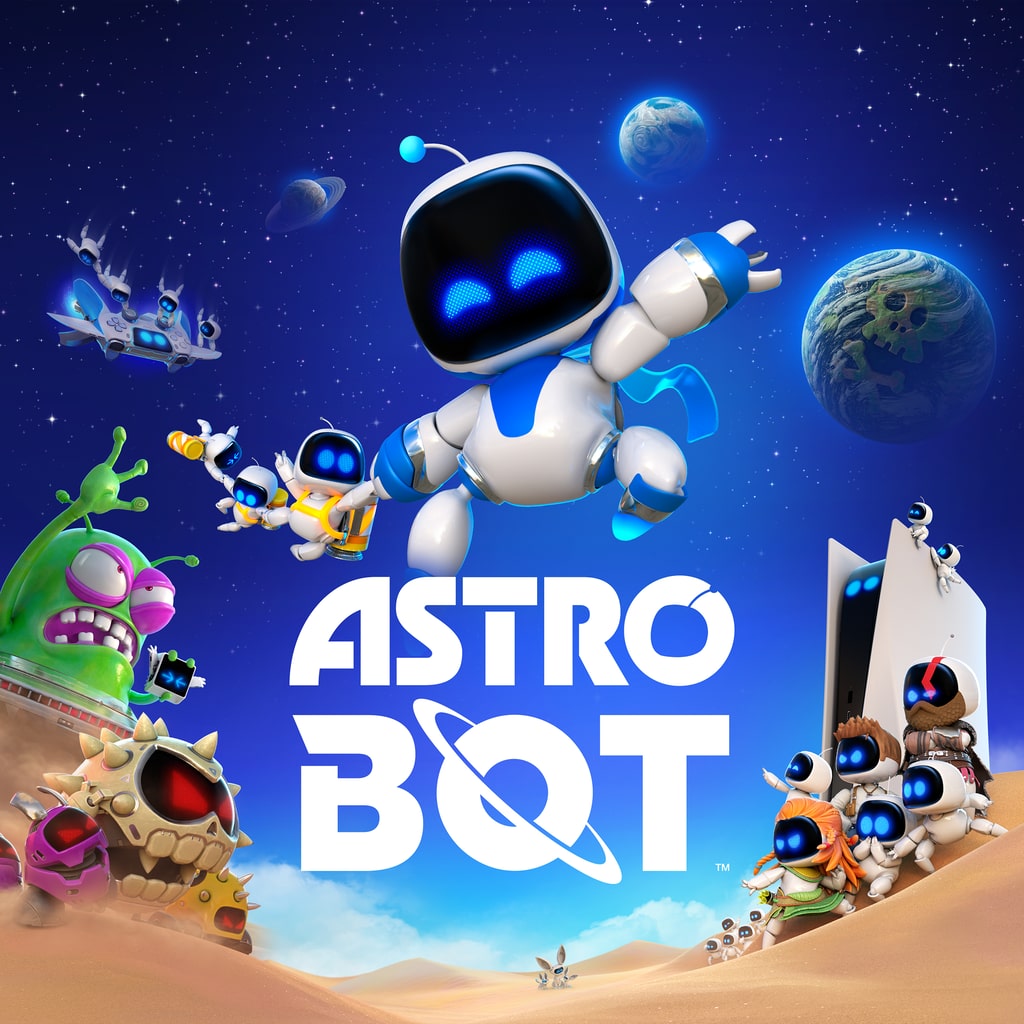
Astro’s Playroom is a great little tech demo that is just the right length and level of challenge as well as finally scratching that nostalgia itch for Playstation fans. It is included with the PS5, so if you own the console it is well worth checking out if you haven’t. Sony recently announced a full-game sequel, Astro Bot, coming this fall.

Hugh Likes Video Games: Dredge

Leave a comment

Dredge: Deluxe Edition

Developed by: Black Salt Games

Published by Team 17

Played on Nintendo Switch

The Skinny: The horror of a cozy fishing game

During the day, things are relatively calm, if bleak. Players will catch the occasional horrifying aberration, which can be sold for bonus money at the fishmonger. When the Sun goes down, things become more difficult, with the thick fog hiding deadly rocks, as well as terrifying sea creatures such as lights in the distance that appear to be other vessels, but are really giant angler fish-like monsters. Some fish can only be caught at night, though, so you’ll have to tough it out if you want to catch everything. The game does allow players to turn off random monsters and scary events if you just want to get down to the fishing.
The fishing itself if quite good, with complex but easy enough to grasp mechanics and a gentle gameplay curve and loop that encourages players to upgrade their boat and explore the game’s five diverse areas. Different rods, nets, crab pots and engines are available, and the ship itself can also be upgraded to increase durability and cargo space. You always feel like you are improving, even as the tension in the story and environments ratchets upward.
The story path is creepy, but being able to tackle it at your own pace makes it easier. The areas you go through on your quest are varied and interesting, which helps too. You’ll sail around crumbling, abandoned cliffs, a haunted atoll, a maze of mangrove trees, and volcanic ruins. Each area has their own unique catchable fish as well as their own dangers to avoid. These range from environmental obstacles like falling rocks and tornadoes in Gull Cliffs to active enemies such as the giant tentacled monstrosity crouched in the deep water of the basin. There are also other monsters and NPCs scattered around the map with their own rewards and challenges. The game is stuffed full of treasure-filled wrecked ships and planes, but some are giant crab-like mimics that will attack you when you get close, for example.
With its compelling gameplay loop and atmospheric main story, Dredge is a great little fishing game that does something different than the Bass Pro Challenges of the world. Indie game fans who are looking for something different should check this one out. Dredge is available electronically from Steam and all the usual e-shops. The physical Deluxe Edition comes bundled with the Blackstone Key expansion, which grants a couple useful items in-game, as well as a poster and art book. You can find it for current generation consoles online and wherever video games are sold.

Hugh Likes Video Games: Balatro

Leave a comment

Balatro
Developed by LocalThunk

Published by Playstack

Played on Nintendo Switch

The Skinny: The House always wins. But let’s do another run, just to be sure.

Balatro is a deck-building rogue-like based around poker. But rather than present you with a simulation of opponents, the presentation is simplified down to core elements. The player presented with a hand of cards floating in a void, and are challenged to beat an escalating series of score challenges. But while Balatro uses the structure and hands of a poker deck, it feels a lot more like Fluxx.
While you are building poker hands to survive each round, the real goal of the game is to change the rules to suit your strategy. Between rounds, players go to a Scorched Earth-style shop screen, where they are offered a rotating selection of different options to change the rules and contents of their deck. Planet cards make poker hands more valuable, while Tarot and Celestial cards have a number of different wild effects. You can also add new cards with special abilities such as giving players bonus money or points. But the most important cards for sale are the Jokers. Jokers sit outside of the player’s deck and add different ongoing rules. They might buff the scores of certain suits or change the rules to allow players to skip cards when making straights, for example. There are over a hundred Jokers, and players unlock new ones by completing hidden objectives in each run.
Optimization is the core of the gameplay, by removing the opponent and focusing on making the best hand possible with the best rules possible, Balatro takes the core gameplay of deck-builders like Slay the Spire and distills them down to a potent core loop. By removing the action and exploration elements from games like Hades, the challenge changes from reaching a goal to making the numbers go up. And the thrill of watching those numbers rise as you struggle to stay ahead of the challenge curve is the beating heart of the game. The house might always win, but watching a successful combo turn a lowly pair into an unstoppable juggernaut is a pure hit of dopamine.


Balatro’s simple, pixel-based aesthetic reinforces the focused premise. You aren’t sitting at a perfectly recreated poker table with 4K graphics to discern between every fiber of the felt surface. There aren’t any lovingly modeled clay chips that clink realistically as you bet. The cards are all pixel graphics, floating in a multicolor void that looks like an old MP3 player visualizer. There’s even a faux-CRT line grid over the whole thing, selling the simplicity of the game. The music and sound effects get the job done and are agreeable enough, though the game almost expects you to play with a podcast or audiobook in your ear.
I played on the Nintendo Switch, and while the handheld version had some disability accommodations, such as high-contrast card mode, it doesn’t quite go far enough, and after even a short session, I felt a bit of eye strain. The text in the game is quite small, and there isn’t an option to enlarge it or change the font, making it difficult to read at times. This is so far a minor nitpick in an otherwise engaging and engrossing pick up and play game.


Balatro is available on PC, Nintendo Switch, Xbox and Playstation consoles. It’s a tasty little gem, that might eat up more of your time than you expect. But what’s the harm in just one more run?

Hugh Likes Video Games: Superliminal

Leave a comment

Superliminal
Developed by Pillow Castle

Played on PC via Xbox Game Pass

The Skinny:  A delightful if short puzzle game that puts your spacial reasoning and perspective to the test!

Framed as a session of lucid dreaming therapy, 2019’s Superliminal from developer Pillow Castle is a surprising and delightful little gem of a first person puzzle game. The game is set from a first person perspective, much like Valve’s smash hit Portal, and players must navigate puzzle rooms and solve perspective challenges in order to progress to each level’s exit. The primary mechanic revolves around perspective and object manipulation. Players can pick up objects and use the surroundings and changes in perspective to manipulate them by changing their size or shape. For example, players can pick up a block from a table, and by placing it correctly in the environment, change its size. This size change is neat, but can be a bit tricky to correctly implement. I found myself dancing with objects in order to get them to be the right size, often having them shrink on my with a careless push of the mouse.


Being set in a sort of a mad science experiment turned strip mall therapy office, the game wears its Portal inspiration on its sleeve, with a snarky AI, enigmatic voice messages from the technology’s developer, and ominous whiteboard messages. The writing is never quite as sharp or as funny as Portal, but it is clever, and it doesn’t get quite as cynical either. Objects and locations are fun and surprising, and the puzzles were tricky without being too frustrating.


Clocking in at just a couple of hours, Superliminal doesn’t really have too much meat on its bones beyond the couple hours of single-player campaign. But what it does provide is fun and engaging. It is the perfect game to while away a winter afternoon with a mug of something warm nearby.
Superliminal is available as a download for PC, Xbox, Playstation network, and Nintendo Switch.

Hugh Likes Video Games: Final Fantasy Theatrhythm Final Bar Line

Leave a comment

Final Fantasy Theathythm Final Bar Line

Published by Square Enix

Played on Nintendo Switch

The Skinny: A hefty does of nostalgia, if you’ve got the gil for the whole thing.

It is a fact commonly held among gamers that Final Fantasy has amazing music.
The latest release celebrating that musical legacy, Final Fantasy Theatrhythm Final Bar Line, carries over much of the features from the original game on the 3DS, and doesn’t make many improvements, although it does refocus on button presses rather than the original game’s touch screen controls. What it does offer is a huge amount of songs. The base game features classic music from all fifteen mainline entries, along with a host of characters from each game. For the first time includes music from numerous spinoff games like Final Fantasy Tactics, Chocobo’s Mystery Dungeon, and even the obscure Final Fantasy Mystic Quest, a long-forgotten side entry originally created to try and boost the image of Japanese-style console RPGs in the west. There’s a lot in the base package, but SquareEnix wouldn’t be selling our nostalgia back to us if they weren’t able to sweeten the pot.
The day-one digital deluxe package comes with a number of extra tracks, many of which feel essential, but probably required additional licensing. These include the main themes for some of the games, such as VIII’s “Eyes on Me” and IX’s “Melodies of Life.” A host of DLC tracks are also on offer, themed by additional Squaresoft hits such as the Saga series, Chrono Trigger and Chrono Cross, and the Mana series.
The gameplay is easy to pick up but difficult to master. Basic tracks are fairly accessible, while Expert and Ultimate difficulties will prove far more taxing. Rhythm game aficionados will be able to sink their teeth into the harder difficulties, while casual players just looking to relive their gaming memories aren’t stuck with their favorite tracks hidden behind a barrier. There’s also a slow drip of unlocking characters, leveling them up, and completing quests in each song to keep players invested. Theatrhythm is well-designed to give the player what they want, whether that is a quick hit of nostalgia or a crunchy and challenging rhythm experience to lose themselves in.
Final Fantasy Theatrhythm Final Bar Line’s visual design isn’t quite as impressive as the audio and gameplay. The somewhat creepy marionette designs of the characters return, and layouts for Field Mode are often recycled, with a few standout unique ones. If you put some time into the game, you’ll see the same field, town, and castle over and over again.
Final Fantasy Theatrhythm Final Bar Line is a great little package for die-hard Final Fantasy fans and rhythm game aficionados. But be prepared to pony up the gil if you want to hear everything the game has to offer.

Older Entries