Home

Elanterra Journal 002: Humanity

Leave a comment

Humans are simultaneously the most populous and shortest-lived of the Five Peoples living on Elanterra. The reasons for this strange dichotomy deal largely with their social structures and societal norms.

Physically, Humans are taller than most of the other Peoples, ranging from between four and six feet tall. With access to a proper diet, they are the most physically adept as well, at least on dry land. Humans have smaller, more rounded ears, and lack any other distinguishing physical traits. They can be found in settlements of various size throughout Elanterra. As a rule, Humans are opportunistic. If a niche can be found, a Human with find a way to exploit it to survive. Although not necessarily as adept as the other Peoples, Humans farm, raise, fish, hunt, mine, carve, brew, and sell. Other Peoples, particularly Hill and River Folk, often employ Humans as labor.

Humans tend to organize in strict feudal states called ‘Kingdoms.’ These societies are ruled by a supreme executive called a King. In some cases, the royal family rules together, or the Kings power is held in check by a Parliament of nobles, but this isn’t common. The title of King passes by blood from the current ruler to his designated heir, usually the first-born son. Women have very few rights in these Kingdoms, and cannot inherit titles or property. A woman’s inheritance will typically instead fall to her husband or eldest son. There are some rare cases of women ruling as regents or advisors for children too young to take the throne for themselves. Although women have little direct power in these structures, they tend to have the responsibility of managing their husbands houses and affairs, giving them far more influence than expected.

The largest Human Kingdoms are Argonia in the east and Lithia in the southwest. Hydraal is also nominally considered to be a Kingdom, although its political structure is much looser. Its monarchy is considered largely symbolic.

Although the ruling class holds most of the wealth in Human society, they make up a very small percentage of the population. Non-noble Humans are known as Serfs, and they are in some matters considered the legal property of the nobles, who most farmland and hires Serfs on as tenants for a percentage of the harvests. As with the King, these arrangements pass from father to son. In exchange for their labor and service, Human nobles are expected to protect the serfs from monsters, foreign powers (usually other Human nobles) and perform other duties of their station. In cities, or settlements not overseen by a noble family, Humans are considered “Free.”

Humans, particularly serfs, suffer from generally poor conditions and a lack of varied diet. Most Humans consider the magical arts to be taboo, and avoid magical healing. Since there are very few skilled healers that are not magicians, Apothecaries are common in Human lands. Their effectiveness varies. Use of magic, and in some cases being known as a spellcaster is a crime in most Kingdoms, with a variety of punishments. Lithia is the most zealous, with an elite corps of Witch Hunters serving in their military.

Humans worship a stern, authoritative god, called the Divine Emperor. He is often depicted robed in the night sky. He is secretive, and those outside of the nobility and clergy classes are not even privy to his true name. His worship states that Humans are called upon to do the service of their station, with a very few rising to the ranks of the clergy or other specialized vocations. Those that violate the social order are severely punished. As a result, Barbarian tribes and other Humans outside of the traditional social order are often shunned for turning their backs on ‘the chosen people.’

Compilier’s Note: This entry remains pretty accurate. Humans are ruled by kings, who have all the wealth and power, and everyone else stays at the bottom. Humans do much better in the mixed cities, particularly Carabos, where they are a large minority, and consist of most of the surface labor pool. The plight of women in Human society remains particularly bad. Hill and River Folk women traveling or doing business in Human lands are required to travel with a male companion, as a woman traveling alone will likely find herself detained ‘for her own safety.’ Dwarven women, obviously, don’t have this problem. –GB

The Freelance Hunters: Glory’s Gauntlet

Leave a comment

Image

An ebook collecting all four of this year’s “Freelance Hunters” stories is finally up!  Available from Amazon or Smashwords, the volume contains “Glory’s Gauntlet,” “Blocked!” “The Least Unicorn,” and “A Splash on the Big Bridge!”  There’s a lot more coming from our band of misfit adventurers in 2014, so keep your eyes peeled here!

Why is Hugh skipping “Ender’s Game?” The reasons may surprise you.

Leave a comment

Last week there was renewed talk of the upcoming “Ender’s Game” film. Specifically, there was a renewed call to boycott the film by Queer SF fans and their allies. This is because the author of the original novel, Mr. Orson Scott Card, is most decidedly NOT a friend to the LGBT community. Mr. Card, using his religion as reasoning, has often made absolutely horrific statements, both in interviews and on his blog, concerning LGBT people. He has advocated for their arrest, and advocated for armed insurrection against any governments that sanction marriage equality. He wrote a novella based on ‘Hamlet’ smearing gay people and equating homosexuality with incest and pederasty. He sits on the board of NOM, a group with lobbies against marriage equality and spreads misinformation about LGBT people.

But of course Card has the right to say what he wishes. He made his bed, and well and good for him. The problem is, he doesn’t much feel like sleeping in it. Last week, Card gave an interview with Entertainment Weekly. Therein, he hoped that supporters of marriage equality would ‘show tolerance’ and go and see his movie.

Tolerance. You keep using that word. I don’t think it means what you think it means.

This petty little swipe, maybe meant to bolster his reactionary religious base into getting the word out, maybe an accurate portrayal of his thoughts on not boycotting his film vs. being thrown in jail for being with the person you love, certainly had an effect, just maybe not the one he wanted.

Card’s comments had the effect of pouring gasoline on a pile of embers. When trailers for the film first came out, SF fans had a generally quiet and civil discussion about the movie. On the one hand, it looked cool, and was the work of a whole team of people, many of whom were strong allies of the LGBT community. In any case, the novel is much beloved, and was it possible to separate the work from the creator? This had all simmered down when Card threw his dunce cap into the ring with his comment. Some people weren’t going to see it, other people were. Some people were going to see it but assuage their guilt by donating the ticket price to a charitable organization, because darn it, the trailer did look cool. Most people behaved like adults. They considered the options, and they decided on the one that was best for them. All was well.

Card’s comments set off a new round of anger in his adversaries. New calls, much louder this time, came for a boycott, with the clear evidence of his snide little remarks to back them up. Lionsgate, the film’s distributor, went into crisis mode, demonstrating their solidarity with the LGBT community with PR statements, celebrity supporters, and even promising a special LGBT-friendly premier of the film.

I’m still not going to see it, and my reasons have more to do with Card’s foolish interview comments than his politics. He is entitled to his opinions, but an author should know better. Card acted in an abominably unprofessional manner. Here is what he did wrong:

1. Never, never, EVER feed the troll. Even if you think you’re right. Even if you are right. Even if your opponents are godless commie mutant traitors, ALL HAIL FRIEND COMPUTER! Don’t do it. Don’t get that last word in. A troll pokes the bear. A professional cuts their losses and moves on. Don’t get that last punch in. Because it won’t be the last punch.

2. Accept that you have haters and you have fans. Engage the fans and ignore the haters. Dude is a New York Times best-selling author. He has been for decades. The SF community has seen example after example of authors trying to directly challenge their critics. In some cases, literal critics writing bad reviews. SF has never been the darling of the publishing industry anyway. We’ve long been considered literary fiction’s dorky little brother, hanging around where he isn’t wanted, swinging toy swords and making lightsabre noises with his mouth. You get the audience you get, and you cherish it, feed and water it, make it grow like a money tree. Don’t shout at the brambles. They aren’t going to do anything for you.

3. To quote another recent SF flick, “It’s not about obedience, it’s about respect.” Audiences go to your film, or buy your latest book in hard cover because… drumroll please… they want to be entertained. They see what you have to offer, and decide that it’s worth their money. Maybe they go because they’re fans, and they like you. But they don’t owe you a thing. This is the great secret I’ve learned about being a writer, slinging words out into the dark aether and hoping they land on the desk of someone who wants to read them. Nobody owes you shit. Not the industry, not your fans, and certainly not your detractors. It is the height of arrogance to expect otherwise.

Tolerance means accepting your film exists. The boycott isn’t about picketing the theaters or shutting down the studio. It’s about not paying twenty dollars to watch an earnest white boy kill buggers. And that’s fine. The film might have needed to reach a wider audience to be profitable. The negative attention might convince potential theater goers to wait for the blue ray. But that money wasn’t promised the film, and it certainly isn’t owed. Any shred of attention, anything cent spent on merchandise, or any tiny fraction of a ticket price, is the goodwill and respect of your audience. To imply that people outside your audience are being intolerant by withholding their dollars is not merely unprofessional, it’s disrespectful to them, and to your fans.

We Can Be Heroes….

Leave a comment

This is a difficult post for me to write, but I have to write something. I’ve been starting and stopping it all morning. Some friends of mine have been talking lately about writing outside your comfort zone, and now I’m taking a deep breath and stepping out of mine. But this isn’t about me. This is about something else.

I have never been comfortable talking about my sexuality. And I’ve been even less comfortable writing about it. Which is to say that I don’t. I mean, I’ve always had ideas for stories with gay themes or characters, and my notes are filled with the sort of secret histories that I never expected to share until after the last book in a best-selling series was released. I chose to write differently. I chose to write to the market. I didn’t want to muck up. I kept my head down.

Gay Fiction” is an odd sort of genre because it is about being gay. About being different. About all the ways the world has to hurt you. And sometimes the protagonists rise above, and sometimes, they don’t. Of course, there is also gay romantic fiction, but there isn’t a lot of data that gay men read romance novels, and straight women do. So, good luck finding a story for YOU, gay male reader. This is the principle of yaoi, two beautiful men for women to objectify. And if you’re a man and that’s what you’re into? Bonus. This is the kind of deep and real same-sex relationship you find after midnight between two female prison inmates on Cinemax. These are the sorts of covers featuring a nude 120 lb blond model, his frame coquettishly twisted at a three quarters view, holding a football helmet and looking whistful. But romance is not a genre I’m interested. I like fantasy. I like science fiction. I kept quiet. I kept my head down.

And in my genre of choice, there are some GLBT characters. Sometimes they even have romances. Sometimes they even live to see the end of the book. But what conflicts do these characters wrestle with? Discrimination in the magical kingdom. Don’t Ask Don’t Tell in Star Fleet. Coming out to their father the King. Space-AIDS. Their struggles are the same struggles. That is, assuming they’re the good guys. Want to steam up your villain? Give him a sexy lesbian dominatrix for a minion. Want to show how virile and masculine your hero is? Why not have the super-villain make a pass at him while they’re duking it out. Bonus points if he says he ‘likes it rough.’ Slow bit in the plot? Maybe the scheming queen could be bicurious for a couple chapters. But publishers are risk averse, and getting more so all the time. I don’t even have a novel out yet. Don’t make waves, I thought. Don’t get known as a ‘gay’ writer, I thought. I kept my head down.

I’ve always kept my head down. It has been my survival strategy for as long as I can remember. I didn’t come out until college, and even that was a long and difficult process, helped immensely by the love and support of my boyfriend, now my husband. I was quiet and shy in high school. I kept my head down.

In 2011, Jamey Rodemeyer killed himself. He was a student at Williamsville North High School, just like I was. And he died because he was bullied, because he was gay. And no one stopped it from happening. It was the kind of thing that I never expected to happen in a place like North. Some distant school in the bible belt somewhere, sure. But those were the same halls I walked through. Where I kept my head down.

I realized that we don’t change the world by observing it. We change the world by getting up and fucking changing it. It is an easy thing to say, ‘hey, it get’s better.’ And then turn our attention back to our real lives and the real problems we face as adults. The mortgage, the job, this short story that just isn’t working, the podcast deadline. It’s easy to forget that you’re still keeping your head down.

But you can’t whisper ‘yes’ when the world shouts ‘no.’ You can’t hope a You-tube video will carry the same weight as the bully, or the teacher that doesn’t see the problem. You can’t hope a 30 second story on the news will be heard over a 2.5 hour movie that says you’re better off staying in the closet.

I recently spoke with a colleague about her ‘New Adult’ novel. And I’m taking the opportunity of the next month to write one of my own. Because I feel like I can address my sexuality without framing it as a problem. I can have a main character be gay and have it not be the overriding focus of his life, to say nothing of the book. He can be the hero of his own story. He can fight off monsters and save the (other) guy. He can save the ship and not lose everything else.  The YES has to be louder than then no. I can’t wait for the world to be ready for a three-dimensional gay male lead in speculative fiction. I can’t keep my head down anymore.

“Attack of the Airship Mutants”

Leave a comment

Orson Fractus is a travel writer, advance man, and airship pirate.  He is, of course, the entirely fictional character I am portraying in an ongoing game of Abney Park’s Airship Pirates.  As a globe-trotting journalist, imagine my surprise when he began turning in articles based on his adventures.  In an effort to put more of my writing online for free, I am posting it here.  Will we see more of Orson’s writing as the game goes on?  Only time will tell.
  Special thanks to Chris for serving as GM, and putting up with my shenanigans.

ATTACK OF THE AIRSHIP MUTANTS!

As seen by Orson Fractus

What ho, faithful readers, It is I, your humble narrator Orson Fractus, here with another dispatch from the wild places of the world! And what adventuresome times it has been! The Crimson Lady, having just played a command performance for the Prince of Mount Rain, had left port and were sailing the winds for our next exotic port of call. Our noble captain had retired to his cabin, the hot and damp climate of the city having disagreed with him most severely. The lovely ladies of the ship were likewise disengaged, having earned themselves a rest.

Thus it was that the ship lay in the command of sharp-eyed Percival Flynn, and the helm under the steady automata hand of Mr. Borealis. We were not a day out when we spied a vessel, much like our own (adjective) Tiger-fish, in dire need of our assistance! Gentle readers, I will go on to say that this ship was bearing Imperial markings, but the sailors aboard wore the uniforms of the Merchant Marine, not the air navy, and all good Skyfolk know that mercy trumps borders when it comes to vessels in distress, and we did our duty, and the law of the skies, in coming to the ship’s aid.

But it was, of course a devious Imperial trap! No sooner had approached the hobbled vessel than a dozen grapnels fired from the ship’s interior, and a hive of soldiers swarmed the decks! Oh, what shock and horror we felt when we saw the depths to which those wretched servants of red-handed Vick would stoop to!

But it gets worse, dear friends, for these were no ordinary rank and file air navy grunts, no! Our eagle eyed sniper and bard, Theo spotted that they were none other than the Emperor’s misbegotten slave troops, the Chuno Ggun! Who can say how the black-hearted ruler came to create these monstrous men? Were they born of the foul poison that passes for food and drink in the Change-Cage Cities? Or were they bred by the mad science of the cages themselves? Braver explorers than I, who have braved those high walls and shadowed streets, may know for certain, but I confess, gentle reader, that I do not.

What I can tell you is that an army of the most frightening monster-men I have ever had the misfortune to lay eyes on began to climb the cables out to our ship. Clever readers may remember I have written a bit about the folk that call themselves ‘Misbegotten’ before. They may recall soft-furred Mink, or our thick-skinned Engineer, Zom. But never have I seen such horrors as this. There were men who scuttled across the lines on crab claws. There were men that had the paws of monkeys for feet and hands. There were even misbegotten who clung to the ropes by means of prehensile tails. Each and every one of them was uglier, meaner, and nastier than the one before, and they were being driven, like animals with a lash, onto our decks to bring carnage and death.

Our noble commander quickly acted to repel boarders, while our pilot took the Lady up to try and shake them loose. Our sniper picked his targets, and the rest of us readied our rifles and mammoth guns to keep them away from our fair ladies. Many of them fell, but even we could not stem their cruel numbers as they poured over the gunwales. We were all soon caught up in hand to hand fighting, Flynn with his cutlass, I with my mighty fists, and even Doctor Chesapeake was attacked by a swarthy little gentlemen whose toxic breath left her gasping for several minutes.

I found myself fighting a giant of a man, nine feet tall if he was an inch, with a second head on his shoulders! Although the brute was prodigiously strong, in this case the old adage proved false, and two heads were not better than one. With a crack on the jaw from my trusty knuckles to each of them, I laid the giant out on the deck, and tossed him over the side. Although the monstrous Imperial Ggun had numbers, and eerie abilities, they were no match for our skill, and we soon had them scuttling back down their lines, more afraid of us than their cruel handlers.

The poorly provisioned and armed Imperials, no longer in control of their beastly troops did not last long, and soon the enemy ship was awash in blood. Soon, they had even dragged their cruel captain out, and rather than face justice at the hands of the mob, he took his one life using a handy supply of grenades.

I shall spare sensitive readers the result of that grisly scene, and the horrors we found below decks, but suffice to say that by the time we secured our own lines and got a team of aboard, there was little our Doctor and her sisters could do. We did manage to find one survivor, a pale, nearly starved boy that the Imperials had kept chained up like an animal. He couldn’t even tell us his own name. Perhaps they had never given him one. We’ve brought him over to the Crimson Lady, and our Rose has seen to fattening him up, maybe for the first time in his life. But what strange stories will our newest crew member be able to tell? Keep reading, dear friends, and maybe we’ll find out together!

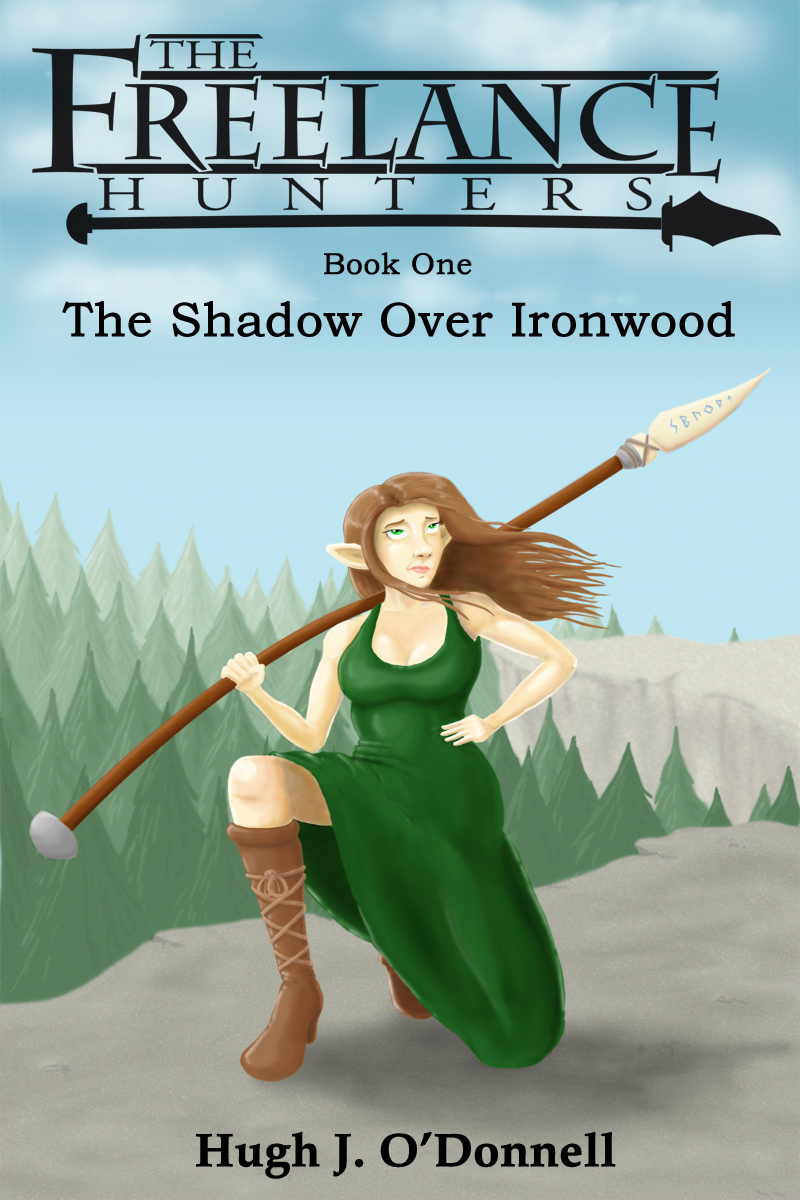
Cover reveal: “The Shadow Over Ironwood”

Leave a comment

FINAL_freelance-hunters_MEDIUM

What secrets does the Ironwood hold?

Freelance Hunters Gloriana Bywater and Joachim Verne are on the job when a desperate Elf girl offers them a king’s ransom to liberate her forest from a mysterious threat.  But no outsider has ever left the Ironwood alive.  And what has befallen their companion Bingo Proudfoot?

Coming Spring 2013 to all major eBook retailers!

I’m pleased to reveal the cover of the first Freelance Hunters fantasy adventure novel!  The cover was drawn by the talented artist Peter Tarkulich.  Go check out his excellent webcomic Bardsworth!  The Freelance Hunters logo was designed by Alex White, creator of The Gearheart.  Much thanks to both gentlemen for all of their hard work.

if you’d like to get a look at this beautiful illustration in person, I’ll be appearing at the Buffalo Small Press Book Fair on April 6th and 7th!  I’ll be giving away promotional post cards for “The Freelance Hunters” and “The Dark Wife,” and selling audio compilations of the best stories featured on The Way of the Buffalo podcast.  Come down and say ‘hi’ if you’re in the area!

Hugh plans, muses laugh

Leave a comment

In deference to the brilliant Brand Gamblin, who I stole this from, I’m committing my writing plan for 2013 here.  It wouldn’t take much effort to look back through this blog’s archives to see that I didn’t meet my goal for writing in 2012.  I try and wear a lot of different hats in the making-stuff-on-the-internet world, and this usually results in long delays as I dicker and generally run around like a chicken with my head cut off.  2012 also had its share of personal drama, both good and bad, but this isn’t a post for excuses, this is a post to get my ass in gear.  So here, dear reader, is what you can expect from me in 2013:

Short story goals:  For the past two years, I’ve halfheartedly participated in a Facebook writing group called “52 weeks, 25 Stories.”  As you can guess, I haven’t pulled through on a lot of those stories, but I have a surprisingly large number of first drafts, fragments, and story outlines that are just collecting virtual dust on my hard drive.  I’m the sort that much prefers plowing through the pure driven white page of the first draft over wielding a deadly red pen, and this has to be the year that I buckle down, take my medicine and learn to love my inner-editor.  My first goal for 2013 is to edit a story a month and get it out the door, into the hands of the doubtlessly huge throng of magazine, podcast, and anthology editors awaiting them.

So that’s twelve stories down for the year.  My other short story goal for 2013 is to submit a new story for each prompt hosted this year at a little site you may have heard of called Every Photo Tells.  I have started a lot of stories based on prompts from the site, but my writing process is a bit too loose to reliably start, finish, and edit a story in thirty days.  This needs to be fixed, and you’ll hopefully be seeing a lot more of me there in 2013.

And now, on to the big guns.

Right now, the long form work that is sitting squarely at the center of my plate is “The Shadow Over Ironwood.”  This is a novella that I’ve been working on, picking up, promising, and putting down again for years, and it needs to be finished and released in ebook by the end of March.  This is kind of a daunting task for me, because it will be my first ebook novel, and I have a lot to learn still about formatting and making the book look and function properly.

The rest of the year is going to be divided between two novels.  “FIrewalker” originally started life as a nanowrimo novel, but I found the ideas I began to play with in the work were too exciting to put down.  With some help from the folks at the Roundtable Podcast, I’ve begun to take the post-nano skeleton, and clone a real live velociraptor of a novel out of it.  My goal for this year is to mold it into shape and send it off to beta readers.

The other novel is one that I’ve been wanting to write for years, but haven’t felt ready to until now.  I’ll be beginning the first draft in February, as soon as “Shadow” is off to beta readers for final feedback.   “Changeling” is an urban fantasy story about breaking down stereotypes and finding your place in the world.  In a more immediate sense, it’s the story of a gay leprechaun hacker who solves mysteries.

Let me explain.  If there is one thing that really bothers me in media, be it movies or television or the written word, it is stereotype.  Even when characters are not necessarily NEGATIVE, I resent the idea of anyone being pigeonholed.  As a nerdy gay man of Irish-American descent, sometimes I feel like I can’t throw a rock without running into one.  “Changeling” is my attempt to steal something back, and it is extremely important to me.  I want people to be able to read it as soon as possible.

So these are my writing goals for 2013:  Three novels and two dozen short stories.  Easy, right?

Final Fantasy II: The One With The Evil Empire

Leave a comment

Original Release Date: 1988

System: Nintendo Famicom

Final Fantasy II is a game that is that feels both very different from its predecessor and very similar to its sequels. It is perhaps the strangest and most frustrating installment, but at the same time laid the foundation for many of the themes and plot elements that would become series standards.

First of all, this is a difficult game. Its learning curve is a bit steeper than the first game, and it doesn’t wait around for you to get warmed up. After the brief introductory text screen, the player is brought straight into… COMBAT! What’s more, this is a battle that your four starting characters have no hope of winning. You are completely outclassed, and MIGHT have the chance to attack once. You won’t do any damage. Rather than getting a game over screen, the characters wake up to find that they have been rescued, for the moment. Unfortunately, it’s just the three of them. One of them wasn’t found.

This missing crewman is a nice touch because it works for both the story and the gameplay, the holy duology of game writing. Leon’s disappearance personalizes and escalates the tension of the war. Having only three permanent characters leaves a slot open for new characters to join or leave the party as the game progresses, adding variety. This is a narrative trick that is commonplace later in the series, sticking characters together both for dramatic effect and to allow the player to experience multiple play styles.

While finding your missing companion is somewhat a goal of the game, the characters quickly become swept up in a rebellion against the evil empire attempting to wipe them all out. Rather than commanding a host of military units, your three characters go on supply runs, rescue missions, and commando raids to help turn the tide. This mission structure allowed FF2 to tell a much deeper story than FF1, with standout moments of betrayal, sacrifice, and triumph. The more rounded characters and personal story elevate the plot of Final Fantasy II above the comparatively retrieval quest of the first game. The thematic elements of a small band struggling against a powerful, omnipresent imperial force became a series staple.

Gameplay was also refined in the second game. Final Fantasy II completely ditched the experience points found in other games in favor of a more organic system of advancement. Instead of gaining levels by obtaining experience points, your characters’ actions determined their progress. You increased your strength by attacking, your magic by casting, and your hit points and defense by getting attacked. Weapon skills and magic worked the same way. This meant that your three characters were extremely customizable. It also meant that in order to keep gaining in power, you had to fight enemies that were more powerful than you, unless you cheated. There was a bug in the original versions of the game that allowed you to gain hit points and strength more quickly by attacking yourself. This led to some pretty unique leveling up. However, it does contribute to the game’s thematic elements. Rather than simply ticking off rungs on a latter, if feels like your characters really are developing organically.

Another unique feature to FF2 was the password system. During certain dialogues with NPC characters, the player had the chance to choose a phrase that the character had memorized, much like the dialogue trees in later Bioware RPGs. These choices usually just provided clues to the player about where they had to go next, or brought up some humorous bit of extra text. The player wasn’t able to significantly change the story by using them. It was a very basic system, but an interesting development for the time.

Despite the game’s many positive points, there are quite a few problems. The most glaring issue is the advancement system. As I stated above, the game doesn’t tell you when you gain experience, so it is VERY difficult to tell if you are making real progress. Also, because the magic system works the same way as all of the other advancement systems, your spells start out very weak. This is even true for the powerful magic you obtain late in the game. This pads out the game into a bit of a grind as the player has to fight enough random monsters so that the ultimate magic actually does a fair amount of damage.

The other major problem the game his is the hardware limitations of the 8-bit Nintendo Famicom (NES) system. FF2 has a lot of standout story moments, but many of the key plot points happen while the player is far away, searching for some macguffin in the depths of a cave on the other side of the map. Coming back to find the whole town died in the Empire’s latest attack gets old after the first couple times. Unfortunately, the 8-bit cartridge just didn’t have the power to tell the kind of story later games in the series could.

Final Fantasy II was never officially released internationally until 2003, so there is a bit less nostalgia for the game than others in the series. The game introduced some of the most enduring themes and story elements of the series, but in many ways it remains the black sheep of the Final Fantasy family.

Next up: Final Fantasy III, the point where the series began cultivating class.

Final Fantasy: This is what happens after we save the princess.

Leave a comment

Release Date: 1987

Original System: Nintendo Famicom/Nintendo Entertainment System

This is the first in a series of blog essays examining the games in the Final Fantasy Series. We’ll be considering plot, mechanics, design and other aspects of each game, and how they work together as an experience. As a far bit of warning, these essays are going to be chock full of spoilers.

This is the one that started it all, and it did something cool right out of the gate. At first glance, Final Fantasy doesn’t have much of a story or plot. A slowly crawling text screen, almost an 8-bit equivalent of the “Star Wars” opening text crawl reveals that the world is ending, and only four brave youths, each carrying an orb, aim to stop it. Next, you choose the names and jobs of your characters, making them fighters or mages. This is the only game in the series where you choose your characters’ jobs at the beginning and have to stick with your decision. Once you’ve picked out your favorite team of Fighters and Mages, the game unceremoniously deposits your party on the map screen, in a forest ringing a huge castle town.

“Final Fantasy” and the other well known Japanese RPG of the era “Dragon Quest” both stick very close to the mold of computerized Dungeons and Dragons clones. Although there are some interesting twists in the first installment, and later games create more of an identity for themselves. The first game was chock full of giants, hordes of D & D style undead, and even beholders! And much like the style of tabletop RPGs at the time, Final Fantasy did not hold your hand or give much in the way of hints, aside from pointing you in the direction of evil and demanding that you ‘Rekindle the Orbs.’

At the start of the game, the major problem is that Garland, a formerly gallant knight, has kidnapped Princess Sara and is hiding out in the creepy ruined shrine to the north. No one in the kingdom is a match for him, so it’s up to you to go knock him down. So your characters march through the goblin-haunted forest, fighting monsters and hopefully leveling up a bit before meeting your heroic destiny and saving the princess. At the time, of course, saving the princess or other damsel in distress was so common that just about every game (except for Metroid, Samus Aran is a self-rescuing princess.) featured an end goal of freeing some captive lady from a dastardly villain who set a few hours of obstacles in your path and waited patiently on the last screen. But here’s where “Final Fantasy” does things a little differently.

Slaying Garland and rescuing Sara isn’t the end goal of your long and perilous quest. It’s just your first step on a much wider and grander adventure. This may not seem like much today, but from the mindset of 1987, it was huge. Final Fantasy didn’t just present a challenge, it creates an arc.

This is a common literary device, and I wish games used it more often. Like the opening sequence to a summer blockbuster, the audience is given a compact introduction based on action rather than exposition. In the 8-bit era, the story for a game was something often left for the instruction booklet. Final Fantasy embraces a more literary aspect, while at the same time creating a ‘newbie area’ for the player to learn the gameplay without wandering into a fight they aren’t ready for.

The reason this really works is that the player doesn’t even know this until they return the princess, collect their reward, a lute that seems to be important, but has no known purpose, and leaves town.

When the player reaches the new bridge, filled with a new purpose to discover what is ill in the world, something very different happens. Credits roll. Final Fantasy might be the first game to include credits at the front of the game, much like a film.

Things get more difficult for the player on the other side of that bridge, but the game has a pretty balanced difficulty curve. Final Fantasy is essentially a huge map, and the player is invited to explore more and more of it as he overcomes challenges. These are not merely physical challenges in terms of having stronger enemies in new areas, either. The narrative functions extremely well here. As with the bridge at the beginning of the game, new methods of exploration become available and obstacles are removed from your path as you complete the story. In some cases this could feel artificial or illogical, but Final Fantasy is rather elegant about it.

The player helps a blind seer recover her crystal ball, and receives vital information about the quest. The player frees a harbor town from invading pirates, and takes their boat as a reward. The player feeds a hungry monster and opens the path it blocked. This not only progresses the story and keeps the player invested, but it gives the player a sense of agency in the game world.

Focusing on challenge and exploration does come at a cost, however. While NPC’s are are interactive and change to some degree as the story goes on, the player is piloting a barber shop quartet of tabula-rasas across the game. The Light Warriors themselves don’t have any personality at all, and their accomplishments nest very simply on the shoulders of the player. The game is much more a power fantasy than an epic.

The plot still has the ability to surprise the player, however. Late in the game, after saving the world from three arch-fiends, and firmly entrenching the world of swords and magic, the plot throws a spanner in the works.

Late in the game, something falls to earth and is buried in a cave. The player explores the cave full of monsters and discovers… a robot. It seems the last archfiend has hidden herself in the last remnants of an advanced civilization’s technology, and you’ll have to go up into space to fight her. This isn’t a medieval fantasy, it’s a post-apocalyptic one. This is a really cool twist, and one of the mainstays of the series. It is reinforced in the final dungeon, when all four now lit orbs are brought back to the Chaos Shrine from the start of the game. The real plot of the game’s villains is to use the orbs to create a time-loop which makes them immortal, at the expense of the rest of the world, and the agent responsible is of course the original princess-kidnapping knight, Garland.

Final Fantasy’s plot is bare bones, but it presents the player as an agent of change, and the antagonists as bringers of a terrible status quo. This is a refreshing standout in a medium where heroes usually served as Princess retrieval services. Final Fantasy is a game about breaking out of damaging patterns and changing the world for the better, and it certainly changed the face of electronic entertainment.

Next up: Final Fantasy II, the black sheep of the family.

Final Fantasy Origin

Leave a comment

This year is the 25th anniversary of Final Fantasy, which is to say that Final Fantasy was originally released in Japan in 1987.  I learned of the series ten years later, as an awkward high school student.  My best friend gave me a 3.5 floppy disc (kids, ask your parents) with a DOS NES emulator and a rom of Final Fantasy.  This was the same time when Final Fantasy 7, with its CGI videos and polygonal graphics was tearing up the PlayStation, but I didn’t care.  It was something amazing.  It was a game that changed my whole outlook.

Playing Final Fantasy games brought be back to fantasy and science fiction as a reader.  They were genres I had abandoned in favor of horror and thriller paperbacks.  But these games brought me back to them, and showed me that there was something great in those stories.  And I fell in love with fantasy so hard that I started writing it myself.  It’s funny to think that a video game could be the reason I became a writer, but it’s true.

In the fifteen years since I made my first party (Lugh, Bobo, Bill and Maev) the series has had its ups and downs, sequels, spin-offs, mergers and MMOs.  I’ve traveled and journeyed as well, from school to the working world, to living overseas and coming home, and getting married.  And I’ve been playing and loving Final Fantasy throughout everything.  A lot of writers, myself included, have literary heroes they admire and seek to emulate.  For me, Hironobu Sakaguchi, the designer of Final Fantasy is just as much in my pantheon of legends.

Each Final Fantasy game is different, and each one has its own flaws and strengths.  And each one has something to teach about its design, even to writers.  I am going to spend a few weeks looking at the story and plot of each Final Fantasy, to see what makes it tick, and why the game works, or doesn’t.  It’s going to be quite a ride, and I hope you stick with me on it.

Newer Entries