Home

Hugh Likes Video Games: Bravely Default

Leave a comment

Hugh Likes Video Games:  Bravely Default
Published by Square Enix
Nintendo 3DS

Bravely Default is a Playstation One or Super Nintendo era RPG that didn’t exist before.  It’s old school in all the right ways, with suprisingly deft use of 3DS features.
Why this wasn’t released as “Final Fantasy” is a mystery to me, because it is a beautiful love letter to the series.
“Bravely Default” is a fantasy role playing game following the journey of a sheltered, yet self-composed priestess and her friends.  Their goal is to reignite the power of four elemental crystals, saving them from the machinations of an evil empire bent on using they crystals to its own ends.  Along the way, they’ll fight enemies by changing classes, transforming from anything to black mages to spear-wielding fighters capable of jumping high into the air.  Let me know when it starts feeling familiar.
With absolutely gorgeous designs by Akihiko Yoshida and an engine clearly updated from the DS ports of Final Fantasy III and IV, It certainly belongs in that venerable pantheon of titles.  But as closely as it resembles Final Fantasy, there are also touches of Enix’s beloved franchise, “Dragon Warrior.”  Much like the Super Nintendo classic “Chrono Trigger,” it is a triumph greater than the sum of its parts, if they’re the sort of thing you’re into, of course.
As old-school as “Bravely Default” is, it incorporates a lot of neat touches that take advantage of the 3DS’s standby and Streetpass functions.  At the beginning of the game, one of the main characters’ village is destroyed.  By passing other players when your 3DS is in standby, and spending money on work orders, you can rebuild the town, which serves as an investment that really pays off as the game progresses.  The shops in the town will create special items that you can buy from traders throughout the game, and will send you free samples based when you rest the game.  There are even hidden bosses that can be exchanged and fought via Streetpass.  Players can also register friends to assist in battle or give characters bonuses.
The classic style of the game isn’t all great news, though.  The game is old-school tough, with lots of grinding and collecting to be done, even with the help of friends and townsfolk.  It’s also a very long game, so be prepared to invest some serious hours if you’re hoping to see the end credits.
“Bravely Default” is a master class in classic JRPG design and construction.  If you’re a long-time fan of the genre, or you were afraid that Square Enix had lost their touch, this is the game for you.  “Bravely Default” is available for the 3DS.

Hugh Likes Comics: Usagi Yojimbo

Leave a comment

Usagi

Usagi Yojimbo Omnibus Volume 1
Script and Art by Stan Sakai
Published by Dark Horse Comics

Usagi Yojimbo is kind of a difficult comic to classify in terms of age appropriateness.  As a samurai pulp, it is certainly the most accessible to a western audience of the comics I’ve discussed so far.  It lacks the gore and explicit content of “Lone Wolf and Cub,” and its setting is simpler than “Rurouni Kenshin’s” historical period.  At first glance, the cartoonish talking animal characters make it seem perfect for younger kids.  The first story in this collection even features a guest appearance by the Teenage Mutant Ninja Turtles.  But there is something nonetheless unflinching in Sakai’s tales of the long-eared wandering swordsman that resonates with the stark realities of Japan’s Shogunate period.
Although this collection is labeled as “volume one,” this collection actually contains parts  eight through ten of the series, which is the point where Dark Horse began to publish the collected volumes.  Although a great deal of backstory is referenced at times, Sakai is very good at bringing the reader up to speed quickly, and I never felt lost.
Following Miyamoto Usagi as he wanders the countryside, the stories in his collection are picaresque adventures that flow organically, and build slowly upon one another.  They don’t reach a climax in this volume, but I am quite curious about where Usagi ends up.  These stories are by turns exciting, heartwarming, and sad, and they are filled with a sense of wonder and reverence for Japanese culture and traditions.  Even though he is of the Samurai class, Usagi’s humility and genuine desire to connect with other people allow him to enter a variety of stories, from a widow struggling to avenge her husband’s death on the gambler responsible to an exploration of traditional seaweed farming.
The varied nature of the stories is delightful, but parents might want to read through first, or read with their children to be able to answer some of the difficult issues sometimes raised by this comic.  One of the most moving, but also difficult to read stories in this collection is entitled “Noodles.”  The story of a mute soba seller and his performer/pickpocket companion, it deals with some very heavy subjects, including justice, or the lack thereof, the rights of the disabled, and capital punishment.  While the conclusion to that story is satisfying, it is the darkest point in the book, and it was hard for me to get through as an adult.
Sakai’s art is superlative.  His style is at once a blend of  Carl Barks and Goseki Kojima and something entirely his own, and it is breathtaking.  His attention to detail, and his deft depiction of samurai fighting that doesn’t dip into gory self-indulgence is wonderful, and keeps  the stories moving while lending them a timeless atmosphere.
Usagi Yojimbo is an excellent comic for readers new to the genre, or for anyone with an interest in Japanese culture.  You can find the first volume on Amazon, or at your local comics shop.

Hugh Likes Comics: Rurouni Kenshin

Leave a comment

Kenshin

Written and Drawn by Nobuhiro Watsuki
Published in English by Viz Comics

Like “Lone Wolf and Cub,” “Rurouni Kenshin” is a manga about a wandering swordsman, but tonally, the two could not be farther apart.  Set in Tokyo in the 1870’s, this is the story of Kenshin Himura, a former assassin and swordsman during the Bakumatsu period of civil wars who has vowed to never kill again, but cannot give up his sword.
One of the reasons I find this comic so interesting is that it is set in set in a dynamic and chaotic historical period that I knew very little about going in.  This story is set in a Tokyo that had been Edo not very long before, still healing from the open wounds of a civli war that toppled the established social order.  It’s a fascinating setting, as full of contradictions as the characters themselves.
Through a series of events, Kenshin settles as a guest of Kaoru Kamiya, a young woman running her deceased father’s kendo school, but lacking students.  From there, he meets a series of people, each of whom has been affected by the new era in a different way.  He meets Yahiko, a young orphan whose parents were Samurai, struggling to maintain what he things honor means in a modern world, and Sanosuke, a fighter whose mentor was betrayed and killed by the Revolutionary Army Kenshin supported.  He also meets Jin-E, a swordsman like himself who, unable to put down his weapon, turned into an assassin.
“Rurouni Kenshin” fascinates me because it is so full of contradictions, and those paradoxes are built right into the characters and setting.  It is most unlike “Lone Wolf and Cub,” and other Samurai stories in that rather than praising duty over life, it is a story of a swordsman struggling to put his past behind him.  Kenshin carries a “sakabato,” a katana with the edge of the blade reversed.  This allows him to fight with his sword without killing.  These are stories not about “Life in Death,” but life beyond it, and the struggle to atone for the lives already taken.
This comic originally ran in “Shonen Jump” magazine in Japan alongside boys’ adventure stories like “Dragon Ball” and “One Piece.”  It shares some of those series’ more kid-friendly aesthetic, both in the tone of the writing and the art.  Watsuki also is heavily influenced by American super-hero comics, particularly Jim Lee’s X-Men.  The result is that Kenshin’s skills often appear more like super powers than swordsmanship techniques.  This distracts from some of the more serious themes of the comic, but still allows for some entertaining and fascinating stories from a historical period many western readers know little about.
“Rurouni Kenshin” volume one is available through Amazon, or your local comics or book store.

Hugh Likes Comics: Lone Wolf and Cub

Leave a comment

Lone Wolf and Cub Volume One:  The Assassin’s Road

Written by Kazuo Koike

Drawn by Goseki Kojima

Published by Dark Horse Comics (English Version)

Originally published in Japan in 1970, “Lone Wolf and Cub” is a seminal document of Japanese Comics (Manga). The story of an executioner turned assassin in 16th century Japan was hugely popular, becoming a best-seller and spawning a series of films, two television series, and inspiring artists and writers in Japan and around the world. Partially translated and released in the US in the 1980’s, it was not fully collected in English until Dark Horse Comics began releasing volumes in 2000.

Ogami Itto was the Shogun’s chief executioner until the treachery of the rival Yagyu clan robbed him of his position and sentenced him to sepuku. In defiance of the Shogun, Ogami became an assassin living in “Meifumado,” the Way of Demons.” He takes his only living family member, his infant son Daigoro, with him in his quest for vengeance. As such, he is called “Lone Wolf and Cub,” a peerless killer who will take on any mission for five hundred Ryo.

“Lone Wolf and Cub” is an epic story collected over twenty-eight volumes, but each volume is picaresque, discribing specific assassinations or encounters Itto and Daigoro have on their journey. Deeply beautiful and starkly violent, these stories are quintessential Japanese pulp. Like Ogami himself, they are a paradox. At once noble and at the same time murderous, they celebrate Japan’s Zen Buddhist warrior traditions while standing apart from them.

Koike’s writing details the lives of noble samurai, struggling peasants, and suffering prostitutes with a historian’s careful eye. Kojima’s work evokes Japan’s greatest artistic traditions. This is a manga where ultra-violence and gratuitous nudity are positioned directly beside deep philosophical questions and breathtaking landscapes.

“Lone Wolf and Cub” is not a comic for kids, and it may not be everyone’s cup of tea, but Volume One features nine stories of samurai action that perfectly introduces the reader to the soul of Koike and Kojima’s groundbreaking work. It was an important step in my own appreciation of the medium, and it is a great place to start if you’d like something a bit more serious in your comics reading.

Lone Wolf and Cub Vol. 1 is available digitally, in print from Amazon, or from your local comics shop.

Hugh Likes Video Games: Castlevania, Circle of the Moon

1 Comment

Published by Konami for Game Boy Advance (2001) and Wii U Virtual Console (2014)

Happy Halloween!
In honor of this dark and terrible holiday, I’m writing a bit about one of my favorite games, recently re-released.  “Castlevania: Circle of the Moon” was a launch title for the Game Boy Advance.  Although well received, it quickly came and went into relative obscurity as later installments in the series came out for the GBA and later Nintendo DS.  But it’s still a classic in my book.
Considered a side-story at best, the game’s protagonist is Nathan Graves, an earnest young man in possession of Vampire Killer, the famous Dracula-slaying weapon of the Belmont clan, whose noticeable absence is never actually addressed.  He’s out to stop the Vampire Carmilla from resurrecting Dracula and killing his mentor.
Like most of the franchise, the actual story is mostly just an excuse to show you the castle, and this is a good one.  Like Symphony of the Night, this is a sprawling open castle which grants you access to new areas as you gain abilities.  While it is a bit smaller than the Playstation’s sprawling ruin, there is a nice variety and scope to the castle, which is perfect for a portable adventure.
The gameplay is fun and feels nicely balanced.  Nathan has a neat ability to twirl the whip like a shield and block some projectiles.  He also has the DSS Cards.  These cards, which you collect throughout the castle from certain enemies, act as the game’s magic system.  Each effect and element card grants a different ability,  giving you one hundred different ones, if you collect them all.  These range from shooting fire balls to summoning angels to directly increasing your stats.  These abilities are my favorite aspect of the game.
Not everything about the game has aged gracefully, however.  The sound in particular has a low-res, monophonic quality that doesn’t do justice to the classic Castlevania music.  As a launch title for the GBA, the color palate for the game is a bit dark and muddy.  While this is thematically appropriate for the ruin of a European castle, it made the game difficult to see, particularly on the original screen, which was not backlit.  More modern devices such as the DS and Wii U tablet handle the display better, but it was a clear step backwards from Symphony of the Night’s beautiful sprites and backgrounds.
If you’re looking for some classic vampire-slaying action without the punishing difficulty of the original Castlevania, I recommend picking up “Circle of the Moon.”
Castlevania: Circle of the Moon is available as a GBA Cartridge (amazon,) or digitally from the Wii U store.

Hugh Likes Comics: Wolverine

Leave a comment

Wolverine

Written by Chris Claremont
Drawn by Frank Miller
Published by Marvel Comics

Love him or hate him, Wolverine is one of the most popular and exposed characters in Marvel’s stable of heroes.  And with the publisher set to kill him for a while, I thought it was time to take a look at the limited series that really cemented his character.
It’s easy to see why this comic was so groundbreaking.  Right off the bat, it establishes Wolverine as a much darker, more badass character than his taciturn, volatile persona on the X-Men.  This is Wolverine in his element, and that means hunting bears and fighting hordes of ninja.  After spending some time in the deep woods of Canada, Logan discovers that his letters to his girlfriend, Japanese dignitary Mariko Yashida have been returned unopened, and that she has left the US.  Wolverine follows her to back to Japan.  There, he discovers that her father, a presumed deceased crime lord, has returned, and that Mariko has been married to one of his lieutenants.
After being rolled by Yashida in a fight which would have killed him if not for his mutant powers, Logan is rescued by Yukio, a hedonistic assassin who is playing games of her own.
“Wolverine” is Claremont writing at the peak of his craft.  Unrestrained by the team dynamic and superhero tropes of the ongoing X-Men comic, he really digs down into Wolverine’s character.  This isn’t just four-color antics, but a rich, pulpy story about honor, appearances, and the nuances of a world shaded in gray.  And being drawn by a Frank Miller just coming into his own as an artist elevates the comic to a classic.
Delivering a gritty comic is harder than taking a cape and rolling in the mud for a little bit.  It’s something that has to be carefully structured.  The pieces all need to support each other in a way that the reader both can believe and doesn’t expect.  “Wolverine” delivers by revealing a deeper, darker world in the periphery of one the reader already knows.  It shows a midnight underworld hidden behind an upstanding daylight face.  And it does it beautifully.  Miller’s Japan is a labyrinth of towering yet indistinct skyscrapers, with scores of ninja hiding in every alley.  It echoes and reinforces the script beautifully.  Miller echoes seminal Japanese artist Goseki Kojima in this story of corruption hiding within the Yashida clan’s adherence to tradition, and one warrior willing to abandon all pretexts to expose the truth.
In graphic story telling, especially when a writer and an artist are both masters of their craft, the finished product can seem at odds with itself.  The words can be sharp and engaging.  The art can be beautiful, but they need to work together to properly tell a story like this.  Here, Claremont and Miller’s efforts are a synthesis that is greater than the whole of its parts.
The Wolverine is available from Amazon, Comixology, or your local comic shop.

Hugh Likes Video Games: Super Smash Bros

Leave a comment

Smash bros

Developer: Bandai Namco Games

Nintendo 3DS

Smash Bros. is one of those love it or hate it gaming franchises.  Its pick-up-and-play style and four player vs. mode have always made it as much a party game as a serious fighter, and nostalgia has always been baked in.  As a fan of Nintendo games, and a much more casual player of fighting games, it is right in my wheelhouse.

Nintendo has certainly delivered another helping for the 3DS, with a huge roster of characters and a slew of new gameplay modes, many of which focus on customization.

In addition to playing with a customizable set of Miis, Players can also tweak any of the  characters making them hit harder or move faster, or upgrading special attacks.  This gives more traditional fighting and wrestling game fans a chance to balance out a character just the way they want, and build them to fight their friends.  But it can be turned off at the flick of a button, which ensures players who aren’t willing to spend a lot of time can still sit down and play.

All-Star Mode, a special battle royale mode where characters are fought in the order they were published, and Smash Run, in which players build up a character by collecting power ups, then fight one on one, are quick and fun diversions.  Classic mode also returns, this time with branching paths that let you choose your opponent.

Nintendo seems to have wrung every drop of power they could out of the 3DS, with a huge roster of characters, and a collection of new and returning stages that look great.  But the 3DS does present some limitations.  The loose analog stick on the original 3DS makes movement a bit muddy and tough to control.  The game has trouble differentiating inputs, particularly between up and side attacks.  The screen resolution is also a bit lacking, with tiny figures occasionally lost amid the clutter.

If you are a Nintendo fan, you likely already have this one.  It is a worthy successor to previous installments, and the sheer variety of gameplay modes and characters ensures there’s something for everybody.  Smash Bros is available from Nintendo, Amazon, or your local games shop.

By the way, my Friend Code is 5327-0999-1447.

Hugh Likes Comics: The Infinity Gauntlet

Leave a comment

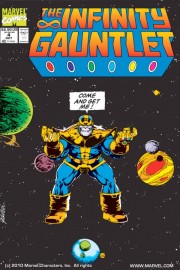
Infinity gauntlet

Written by:  Jim Starlin
Drawn by: George Perez
Published by Marvel Comics

As a rule, I really don’t like crossovers.  They’re messy, over-crowded affairs where heroes act out of character to fit the story, and their endings tend to be unsatisfying piles of continuity.  Event full of sound and fury where “everything changes” but at the end of the story, everything is pretty much back where they were.  Oh, she might be in a different costume and he might have been replaced with his sidekick, who looks the same except for the cybernetic arm.  The status quo remains king.
And then there’s “The Infinity Gauntlet.”  This is the one that got it right.  It’s a threat that is based off of years of continuity, but clear enough that one doesn’t need to invest a college savings in back issues to know who’s who.  It’s a threat that is credible, active, and present, not only for the heroes, but for the entire fictional universe.  A threat that is credible enough to not only bring the Marvel Universe together, but also put their backs against the wall.
It also manages to balance character study and knock-down, drag-out, cosmic-level fighting.  In the first issue, Thanos, elevated to genuine omnipotence thanks to the eponymous gauntlet, snuffs out half the life in the universe.  He does this because it turns out that he’d like to hook up with the Universe’s personification of Death.  Death is, naturally, a hot lady, because Comics.  Unfortunately, all of his god-like power fails to catch her eye.  Having gained unmatched power, and being unable to effectively use it is the core of Thanos’s character, and it is an interesting contrast to the surviving heroes and villains, who are left with the task of fighting a hopeless battle against the Mad Titan.
The climax of the series is a fight where he faces of and wins against first every hero in the Marvel Universe, and then the super powerful Cosmic Forces.  It gets a bit metaphysical, but the thread of the story never gets lost, and Perez’s expressionistic art captures it all perfectly.
The Infinity Gauntlet isn’t just a cheap cash in.  It is the basis for twenty years of comics storytelling, and possibly the endgame Marvel’s cinematic universe is heading towards.  Even if you have no interest in those things, it is the Platonic Ideal of a Marvel comic.  A story of superhuman power filtered by the lens of the most human emotions.
The Infinity Gauntlet is available from Comixology, Amazon, or Your Local Comics Shop.

Review: Henry V (Shakespeare In Delaware Park)

Leave a comment

The 39th season of Shakespeare in Delaware Park has begun, and this year’s first play is a history, “Henry V.” The play is very well staged and performed, with Patrick Moltane as Henry. The set design is based on original productions with minimal props and a three-level stage painted in abstract branching patterns of brown, black, and gold. The costumes evoke dress of the period, with Henry and his lords in Plantagenet tunics, and Katherine’s maid wearing an impressive wimple. The exception is The Chorus, played by veteran Tim Newell. He’s dressed in a cyberpunky outfit capped with sunglasses and a black trench coat.

While not his most problematic play, “Henry V” is perhaps one of Shakespeare’s bro-iest. It is the culmination of the English histories begun in Richard II and leading up to Henry’s ultimate triumph at the Battle of Agincourt. It was probably one of the first plays performed at The Globe in 1599, and it is sort of an Elizabethan blockbuster.

It is a direct sequel to Henry IV parts I and II. No longer the carousing and conflicted Prince Hal, Henry V has turned his back on his misspent youth, and his old friend Sir John Falstaff. But with trouble at home and a rebellious Scotland to the north, Henry decides a nice, distracting foreign war is just the thing, and so he picks a fight with France.

While Henry has some great speeches, and Moltane’s performance of the St. Crispin’s Day speech is especially effective, there isn’t a great deal of complexity or weight to Henry V. It feels almost like Shakespeare’s riff on a 40’s comic book. Henry and his forces are the fiercely patriotic English, off to fight the decadent, cowardly, and generally just all-around bad French. The French aren’t up to anything in particular, they’re just holding some lands Henry feels belong to him, and are generally jerks about it.

In spite of being greatly outnumbered, Henry cuts a swath through France. At Agincourt, where the English forces are outnumbered “five to one,” He wins a decisive victory, and the play claims that he loses less than thirty men. He attributes the victory not to himself or his men, but to God. The end is a bit disappointing in that they stage the battle with the English forces lined up facing the audience, and there is no direct fight between Hal and the Dauphin, whom he’s traded insults with via messenger the whole play. I suppose this is a more realistic depiction of Fourteenth Century warfare, but it left me wanting just a bit.

Even though this is not one of Shakespeare’s more famous comedies or tragedies, I recommend taking in “Henry V” this month. Performances run Tuesdays through Sundays until July 13th, 7:30PM at Shakespeare Hill in Delaware Park. I’m also looking forward to this season’s second show, a Steampunk production of The Comedy of Errors that begins July 24th. The show is free, but donations are appreciated. Find out more at shakespeareindelawarepark.org.


Older Entries Newer Entries