March 27, 2019
hughjodonnell
Hugh Likes Video Games, Uncategorized
Final Fantasy Legend, Game Boy, HLV, Hugh Likes Video Games Retro, Retro Games, Squaresoft
The Final Fantasy Legend
Published by Square Soft
Game Boy, 1989/1990
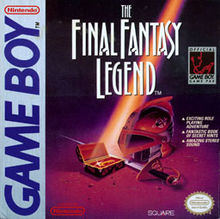
The Skinny: An early RPG about eating your enemies and hitting gods with chainsaws.
The Final Fantasy Legend launched in Japan as Makai Toushi SaGa in 1989 and came to the U.S. in 1990 for the Game Boy. It was given the name change to appeal to fans of Final Fantasy, which came out on the NES earlier that year. While the games were considered separate series in Japan, they do share some thematic similarities. Both games task you to create a party of four adventurers and battle four Elemental-themed monsters for control of magical crystals, here called “Spheres.”
But these spheres actually have a purpose besides serving as a quest’s macguffin. Each sphere unlocks a door to a tower rising to the heavens that is said to lead to Paradise. Defeating each beast lets you progress a little further in the tower, leading to new worlds, and new monsters to fight.
Helmed by Final Fantasy II designer Akitoshi Kawazu, FF Legend ditches the Dungeons and Dragons-esque Class and Level systems of other 8-bit JRPGs in favor of something more experimental. Players can choose between three different character types: Humans, Mutants, and Monsters. Furthermore, Humans and Mutants are divided into two genders with slightly altered starting stats. Each class progresses differently. Humans don’t have access to magic, but can increase their HP and stats by buying and using special potions. Mutants’ stats increase based on their actions in battle, like in a more streamlined version of the system in FFII, and also receive new abilities that change randomly. Monsters are the same as the various enemies you fight in the overworld, and can progress by eating the meat left behind by defeated foes. But the system for this is complicated and unpredictable. Eating the meat of a weaker monster will drop you back to a less powerful form.
While this system can be a bit unintuitive and frustrating, once you figure out where you’re going, it’s much more streamlined than the grind-heavy rpgs of the era. While the monochrome graphics and story are a bit pared down for the hand-held system’s limited capacity, Final Fantasy Legend does some legitimately amazing storytelling for its day. By limiting the areas to tiny ‘worlds’ along a tower, the game both provides a string of new experiences, and uses story rather than a level system to give the player a sense of progression. And as slight as these experiences are, there’s something about them that feels groundbreaking and takes the sorts of risks that I usually associate with later Square Soft games like Final Fantasy VI.
You start out visiting castles and questing for kings, but by the end of the adventure, you’ll find yourself zooming through ruined cityscapes on your flying motorcycle. And there are a bunch of little hidden side worlds you can visit as well, from a ‘hell’ where petitioners willingly undergo tortures to try and purify themselves to a poignant scene in a nuclear bomb shelter, This is where the game gives the best little punches, and I wish there had been more of these side worlds.
While it may be hard to go back to for modern gamers, replaying this now 30-year old rpg gave me a solid hit of nostalgia. Final Fantasy Legend’s design choices had a lasting impact on Square’s development, from the disparate world structure of Kingdom Hearts to the isoteric Sphere Grid of Final Fantasy X. It’s well worth tracking down a copy if you’ve never played it.
The Final Fantasy Legend hasn’t been rereleased digitally anywhere, but it’s a pretty easy cartridge to track down, if you have a game boy or game boy advance to play it on.
March 13, 2019
hughjodonnell
Hugh Likes Video Games, Review, Uncategorized
HLV, Hugh Likes Video Games, Online Games, Puzzle, Tetris

Tetris 99
Published by Nintendo
Developed by Akira
Played on Nintendo Switch
The Skinny: A fast and furious Battle Royale game I’m actually good at.
Tetris 99 is a new, free multiplayer version of the venerable puzzle game available for the Nintendo Switch. But the twist is, you aren’t playing against your friends, but 98 strangers in a fast-paced elimination competition in the style of Battle Royale games like PUBG and Fortnite.
Play options are barebones, with the option to enter battle, look at your stats, or change your control scheme slightly. The game starts out as straightforward Tetris. Shapes composed of four colorful blocks drop from the ceiling, and it is your job to arrange them into lines, which disappear. If the pile of lines reaches the top of your screen, you’re out. The multiplayer twist is that if you eliminate more than one line at a time, you’ll send those extra lines to another player to have them appear as ‘garbage blocks’ in their play area. In Tetris 99, you can choose who you want to attack with the analog sticks and control the falling pieces with the directional buttons.
This version feels very different from traditional Tetris, tying the challenge not to maintaining a long run with ever increasing difficulty, but to weathering the random storms of garbage blocks that come in unpredictably. It’s also very short. Matches take only a few minutes, depending on skill and luck, and it’s easy to get back into the next one, leading to a strong impulse to play just one more match.
As someone who was an expert back in the days of Game Boy, but hasn’t played too much Tetris since, I wished the game gave me more information about how it tracks my stats, and had more options for controls. Currently, it uses the analog sticks to control who you are attacking and the directional buttons to control your pieces, with no way to switch between the two. But those are minor quibbles for a fun, addictive little free game that is doing more to justify the cost of Nintendo’s Online Service than anything else on the platform.
You can download Tetris 99 for free from the Nintendo Switch estore.

February 20, 2019
hughjodonnell
Hugh Likes Video Games, Review, Uncategorized
HLV, Hugh Likes Video Games, Nintendo, Nintendo Switch, Smash Bros
Super Smash Bros Ultimate
Published by Nintendo
Played on Nintendo Switch

The Skinny: The venerable nostalgia-fighter returns with a massive entry on the Switch
It’s no secret that I love me some Smash Bros. My first Hugh Likes Video Games review was for the last iteration of the series, specifically the 3DS version. And this version has, well just more of everything I love about the concept, with a giant roster of returning characters and stages, and lots of brand-new content as well. I actually hesitated getting this version, but I think Ultimate might actually live up to its title.
Ultimate does a lot of things right. The roster is particularly large, and the new additions, from Castlevania protagonist Simon Belmont to Animal Crossing’s helpful assistant Isabelle are a delight to play. While there aren’t a whole lot of brand-new stages, we get nearly all of the returning stages, with multiple layouts, so there is sure to be someplace to pick. Smash mode is easy to get into, and takes full advantage of the Switch’s joycon pairing capabilities to get a large group of players in quickly.
Classic mode returns with a twist. Each character has their own finely tuned campaign to maximize their nostalgic hit. For example, Ryu fights in a series Street Fighter-like stamina battles, while Richter only fights other Echo Fighters.
As clever and nostalgic as Classic Mode is, Spirits is where the game really stretches. Building on modes in previous versions of the game, Spirits turns Smash Bros into a giant nostalgia-fueled Action RPG. Traveling around a huge map, the player fights ‘spirits,’ essentially Nintendo characters that didn’t make the cut, in the guise of tweaked battles with specialized conditions. Winning the battle nets you that character’s ‘spirit,’ which you can equip and level up in a bunch of different ways in order to take on more powerful fights. These take the place of collecting trophies or stickers in past games, and they’re neat, but the game doesn’t give you as much information about these collectables as in past installments, which is a shame.
Overall, Super Smash Bros Ultimate is another entry in the series that won’t change the minds of non-fans, but is full to the brim with attention to detail and affection for the source material. I haven’t ventured into the dark woods of online multiplayer yet, but so far couch battles have been chaotic but a heck of a lot of fun.
You can download the game yourself from the Nintendo eshop, or find a physical copy at the usual suspects of video game retailers.
February 4, 2019
hughjodonnell
Hugh Likes Video Games, Review, Uncategorized
HLV, Hugh Likes Video Games, Indie Game, Nintendo Switch
Moonlighter
Published by 11 bit studios
Developed by Digital Sun
Played on Nintendo Switch
http://moonlighterthegame.com/

The Skinny: The Daily Grind, in day job and dungeon flavors!
Moonlighter is an old-school dungeon crawler with a twist. The dungeons are randomly generated, with each room comprising a single screen, much like the original Legend of Zelda. Enemies don’t drop money or experience, but rather items tied to the visual theme of each dungeon. During the day, players can sell their findings in a shop simulator, setting their own prices, decorating their shop, and keeping an eye out for shoplifters.
Profits from the shop can be sunk into upgrading your equipment, inviting other shopkeepers who sell things like potions or decor, or expanding the shop itself. The gameplay loop has a nice rhythm, and I constantly found myself deciding to play just one more in-game day to reach a milestone I’d set for myself. The combat is quick and fairly challenging, but doesn’t vary too greatly from dungeon to dungeon. While enemies all have very different looks, they tend to do the same sorts of things. The turrets you face in the golem dungeon have the same sorts of attacks as the seed-spitting plants from the forrest dungeon, for example.
Moonlighter’s gameplay loop can get repetitive, but fortunately, it looks and sounds gorgeous. The high-res pixelated art is charming, and the soundtrack boasts a variety of catchy and evocative tunes as you make your way through the floors of each dungeon and stock your shelves. There isn’t much of a story here though, so if that isn’t enough to keep your interest, this may not be the game for you.
I enjoyed my time in Moonlighter’s tiny village, but I wish the game had given me a few more options in how I arranged and decorated my shop. The items were nice, but I’d have like to have been able to give the place a bit more personality.
Moonlighter is an old school dungeon crawling action game mixed with a sedate but engaging shopkeeping sim. The gameplay loop makes for a perfectly tuned combo in a charming world. You can pick it up for PC or through all the major console eshops.
December 17, 2018
hughjodonnell
Hugh Likes Video Games, Review, Uncategorized
HLV, Hugh Likes Video Games, JRPG, Nintendo Switch, Square Enix
Octopath Traveller
Developed by Acquire
Published by Square Enix
Nintendo Switch

The Skinny: This retro-styled JRPG creates a miniature clockwork world to explore.
I love me some Old School Japanese Role Playing Games. As a kid, I looked on with envy as my friends talked about the then mind-blowing scope of Dragon Warrior, and the Unprecedented drama of Final Fantasy VI and Chrono Trigger. When I grew older and had the means to play them myself, I lost myself in their fast maps and intricate mechanical systems. But trends come and go in gaming, and while these classics are remembered fondly, they just don’t make them anymore.
Except, of course, when they do. Octopath Traveller is a return to subgenre form, complete with pixelated sprites and tangled leveling systems. But it brings a lot of new stuff to the table as well.
The player chooses their starting character from a cast of eight protagonists, from erudite but occasionally naive scholar Cyrus to cynical thief Therion. After playing through the character’s ‘Chapter’ you leave your starting town and recruit the other characters, and play their stories as well. While you can have up to four characters in your party, each character’s story plays out as though they were alone, although you can access character asides where the others will give that character advice, or other dialog that doesn’t impact the scene.
Octopath Traveller is a remarkable success in so many ways. The visuals, a mix of pixel art and modern particle effects serve to create the illusion of a miniature world on the switch’s screen. Sand, snow and water all sparkle, and shimmer on the screen, creating not exactly realism, but an almost tactile effect. The locations look like vastly complex models. The music is gorgeous and cleverly constructed. The writing is smart, engaging, and doesn’t suffer from the bowdlerization so often present in 90’s translations. Combat is strategic and tricky. It is a joy to play.
But as much fun as it is, the game never quite breaks its illusions. The systems never let the player forget that it is a game. Its use of story as another system is interesting, and fun for me, but I found myself wishing that the characters had a bit more interaction with one another. If I have a Healer in my party, why can’t he heal the Cleric’s ill adoptive father? If another character is looking for a criminal, why can’t the Thief use their contacts to speed the process along? These barriers were a distraction to me at times.
Also, having one character that never left the party made them way more powerful than anybody else. There didn’t seem to be a reason to alway have them in the group, and by the end there was a huge gap. These are both aspects I hope they address in any potential sequels.
Octopath Traveller is an incredible JRPG experience for Nintendo Switch that is both full of warm, gooey nostalgia, and genuinely unlike anything else out there. If you have a Nintendo Switch and a hundred hours to spare, this is a must play.
December 5, 2018
hughjodonnell
Hugh Likes Video Games, Review, Uncategorized
Donut County, Have a Garbage Day, HLV, Hugh Likes Video Games, PS4, Puzzle
Donut County
Created by Ben Esposito
Published by Annapurna Interactive
Played on PS4

The Skinny: A charming and funny story-heavy puzzle game about stealing garbage.
The raccoons run Donut County. In a physics puzzle game that homages Katamari Damacy and is almost as strange, You play as BK, Donut County Delivery Raccoon, but your real job is stealing all the town’s garbage (and people, buildings, and geographical features) for the nefarious Trash King.
Each small, self-contained level puts you in the driver’s seat of a hole, which like in Katamari, starts out small and gets bigger the more stuff you grab. Each level has its own mechanical puzzle, from destroying an amusement park to making soup. All of these mechanics are intuitive and fun to use, if a bit on the easy side.
Controls on the PS4 used the buttons and analog stick. It is also available on Steam and Apple devices, and it feels like the game was meant to be played on a touchscreen. Not that it plays badly, in fact, just the opposite. The hole feels a little too responsive to the analog stick, and I was left wondering if playing with touch controls would’ve been a greater challenge.
The story is light-hearted and fun with a large cast of different denizens to hassle and eventually capture. The first half of the game is a sort of trial, as each of the town’s residents relate how BK stole all their stuff and trapped them underground, and then BK’s friend and coworker Mara figuring out how to fix everything. The visuals have a very PS2-era quality to them, but the designs are cute and the whole game is fairly attractive, even with blocky polygons. The soundtrack, by Daniel Koestner with Ben Esposito, is very chill and relaxing. This is a great game to unwind with.
While it isn’t the most taxing puzzle game I’ve played this year, Donut County is a great puzzle game to play with your kids, or to relax with. You can find it on Steam, the Playstation Store, or the Apple Store.
November 30, 2018
hughjodonnell
Hugh Likes Video Games, Review
Adventure Game, Gregg Rulz OK, HLV, Horror, Hugh Likes Video Games, Indie Game, Nintendo Switch, Platformer, Video Games
Night in the Woods
Created by Infinite Fall
Published by Finji
Played on Nintendo Switch

The Skinny: A brilliantly designed existential horror game
Night in the Woods is a game that struck very close to home for me. It is about a girl who returns to her dying hill town after dropping out of college and discovers that the home she left has changed. And there’s something in the woods at night…
An indie game that was originally published thanks to a 2012 Kickstarter, NitW has the most effective and well-crafted atmospheres I’ve seen in a long time. And considering that this is a 2-D point and click adventure game with some light platforming elements staring cartoon animals, that is really saying something. But the visuals are so on-point in this game, and they are propped up by witty, charming dialog that is the most natural I’ve seen in a long time. If you can’t fall in love with Mae, Gregg, Angus and Bea by the end of their adventure, I’m not sure you have a heart.
The mechanics of the world reinforce this. Following the story, most of the player’s decisions involve choosing which characters to follow, and talking to everyone. There are a lot of dialog options, and while they don’t seem to effect the story much, they do a great job of revealing character, and lead to so many rewarding character moments, they are worth replaying for them alone. The platforming in this game also feels really good, and walking around on the power lines feels transgressive in a way that reinforces character, and leads to lots of cool exploration and interaction moments, like finding hidden musicians and secret rooms. Going too much further into this game will ruin it, but let me suffice to say that everything in this game works together in a way that makes it more than the sum of its parts.
One of the reasons that his game struck me so profoundly, in addition to the fact that the writing is excellent, the art is eye-catching and endearing, and the mechanics just feel good, is that this is a story that happened to me. Not the mysterious disappearances and hostile forces bits, but I didn’t do so well my first year of college, and had to return to my own rustbelt hometown after a year away.
Mae’s reasons for leaving college and coming home aren’t made fully explicit until the end of the game, but I already understood them, because her experience was so similar to mine. I never hit anyone with a bat, but I felt so many of the same things she did, and playing this game gave me a bit of catharsis for those old wounds.
Night in the Woods is less a horror game than an existential horror game, and you can find it on Steam and the usual consoles. These versions also include Longest Night and Lost Constellation, two microgames the team made as Kickstarter bonuses and to test game elements. The whole package is wonderful, and this game is well worth your timeand attention. And Gregg rulz, OK?
October 29, 2018
hughjodonnell
Hugh Likes Video Games, Uncategorized
Castlevania, Dracula Season, HLV, Hugh Likes Video Games
Castlevania: The Dracula X Chronicles
Published by Konami
Originally for PSP, Played on PS Vita

The Skinny: Old School Difficulty meets mid-2000’s 3D backgrounds
Welcome to Dracula Season! With the release of Castlevania Requiem for the PS4 last week, I felt a hankering to dig into the classic games included, Symphony of the Night and Rondo of Blood. But they were both part of an earlier collection, The Dracula X Chronicles for Playstation Portable. But rather than a collection, they were unlockable bonus content in one of the most difficult games in a notoriously punishing franchise.
Dracula X is a faithful remake of Rondo of Blood using 3D Polygonal graphics instead of sprites. The models look very good, and are quite detailed, but they still feel a bit dated by modern standards. The game retains every controller-snapping bit of difficulty from the original, which came out for the PC Engine console and was not previously released outside of Japan and is one of the hardest entries in a game series known for its brutal challenge.
By finding special items hidden in the remake, players can unlock both the original Rondo of Blood in all it’s 16-bit pixelated glory, and its sequel, the breakout Playstation hit Symphony of the Night. And while these aren’ just laying out in the open (they’re found on hidden stages in somewhat more difficult paths) A few minutes of googling should help you reach them if you’re only really here for the original, which for the PSP is priced less than Requiem.
Castlevania: The Dracula X Chronicles retains all of the charm as well as the extreme challenge of the 1993 original. You can find it in the Playstation store if you have a PSP or Vita laying around.
October 23, 2018
hughjodonnell
Hugh Likes Video Games, Uncategorized
Farming, HLV, Hugh Likes Video Games, Indie Game, Nintendo Switch
Stardew Valley
Developed by ConcernedApe
Published by Chucklefish
Played on Nintendo Switch

The Skinny: “Harvest Moon” all grown up.
“Stardew Valley” is a retro-style farming life simulator made by indie developer ConcernedApe, the one-man studio of Eric Barone, in tribute to “Harvest Moon.” As in the original, they player is tasked with rebuilding their grandfather’s dilapidated old farm in an isolated rural community. Like in “Harvest Moon,” there are a lot of different activities you can do throughout the game, from growing crops and raising livestock to fishing, gathering, mining, and developing relationships with the town citizens. But the game builds on these mechanics and interrogates them in unexpected modern ways.
The player is given their farm in a letter in a cut scene at the beginning of the game, prompting them to quit their job at soulless mega-corporation Joja to pursue a new life in Stardew Valley. But the company has already gotten in a foothold in your new town, in the form of Jojamart, a supermarket that is already squeezing out the local general store. It is up to the player to decide if they want to help Joja take over and turn Stardew Valley into a Joja distribution center, or to drive them off by rebuilding the town’s dilapidated Community Center. Like most of the choices in the game, there is a decision that feels better, but it isn’t quite so black and white. Rebuilding the Center requires delivering a mountain of specific items, while siding with Joja is easier and allows the player the freedom to play however they want.
Rather than just settling in to the fantasy of small-town life, Barone has very thoughtfully examined the issues impacting rural life today and incorporated them into the game. Most NPCs are friendly, but some are hostile and distrustful of outsiders. Depression, substance abuse, and financial hardship and broken homes all play into their stories. Also, the player can choose their farmer’s appearance and gender, and can date and marry NPC’s of either gender, which feels to me like a huge step over “Harvest Moon’s” marriage options, and a natural way to include LGBTQ players.
“Stardew Valley” is one of those games that you will either hate, or will entirely absorb you as you try and delve into all the town’s secrets, find every hidden relationship cutscene, and work to raise the best crops. There are only a few things that bother me about it. One is that trees, rocks and other liter are constantly regenerating on my farm. I feel like I’m spending as much time chopping down the multiplying pine trees as I am watering and planting. The other is that the games doesn’t have a way to buy multiple items at once, a real oversight when I’m buy seeds for huge fields, or trying to buy enough hay to see my cows through the winter. This might not have been a big problem on PC, but on console, having to rapid-fire hit a button is a needless irritation.
“Stardew Valley” is available on Steam and for most major consoles. I played on the Nintendo Switch and I could hardly put it down. It is a perfect chill game for these long autumn nights.
September 24, 2018
hughjodonnell
Hugh Likes Video Games, Uncategorized
Foul Play, HLV, Hugh Likes Video Games, PS Plus, PS Vita
Foul Play
Published by Devolver Digital
Developed by Mediatonic
Played on PS Vita

The Skinny: A clever little belt-scrolling brawler disguised as a stage play.
“Foul Play” is an innovative and clever brawler for one or two players that does a lot with limited resources. You play as Baron Dashforth, a British gentleman and daemonologist. But the game doesn’t have you delving tombs and fighting monsters directly. Instead, it is set as a play, with Dashforth recounting his adventures to an audience. This is the key mechanic of the game, as the audience acts as your life bar. If you don’t keep them happy, it’s curtains.
Dashforth, and his 2p sidekick Scrapwick, don’t have life bars at all. Instead, the audience excitement meter hangs at the top of the screen. You keep them interested by racking up combos and executing advanced moves, which are unlocked as ‘acts’ of the play are completed. This leads to a fairly forgiving system. The player doesn’t have to worry about finding food or other power-ups in the environment. If they are flagging, all they need to do is get back in the fight and keep hitting square to build your meter back up.
The combat itself is rather button-mashy and the bosses especially are rather healthy, so it takes a good many wallops with your can to bring them down. But the game’s visual flair carries the day. Sets fly in and out on pulleys, actors’ faces are visible beneath monstrous costumes, and we regularly see extras attempting to stealthily exit after they’ve been ‘defeated,’ not to mention the occasional stage crew taking their break next to the wrong backdrop. It keeps the game light and engaging.
“Foul Play” leans in to Cosmic Horror but tries to keep things lighthearted. I haven’t finished the game, but so far it lampoons but steers clear of most of the unfortunate pitfalls of the genre. I’m looking at you here, Lovecraft. Dashforth present themselves as heroic experts in the dark corners of the world, but there isn’t much lionizing of the British Empire, and we’re constantly reminded that we only have the baron’s word for it.
If you’re looking for an old-school button masher that does something a bit more than ‘punch all the dudes to the right of you until your girlfriend falls out’ “Foul Play” is a good place to start. Also, for the rest of September, Playstation Plus subscribers can download it for PS4 and PS Vita for free. You can’t beat a deal like that.
Older Entries
Newer Entries
 Hugh J. O'Donnell