Home

Hugh Likes Music: Chronicles of Time

Leave a comment

Chronicles of Time
Various Artists
ChroniclesofTime.net

c_cover-min

I’m one of those writers that writes to music.  I prefer atmospheric,  instrumental pieces that catch the ear but also fade into the background, and one of my favorite sub-genres to pick from is video game soundtracks.
Which is why this year’s “Chronicles of Time” has been getting heavy rotation on my writing playlist.  This massive collaboration consists of eighty-one tracks drawn from artists and bands all over the nerd-core and O C remix communities.  A love letter to Yasunori Mitsuda’s soundtrack to the SNES classic “Chrono Trigger,” it spans five discs, a spectrum of genres, and every piece of music in the game.
And the collaborators have brought their A-material.  Tracks from artists like Carless, Mustin, Super Guitar Bros, and XPRTNovice bring an eclectic but polished sound to the collection.  The stylistically diverse covers and remixes bring everything from heavy metal to jazz guitar to dance-club remixes and hip hop to the masterful compositions.
The album is available at chroniclesoftime.net as well as iTunes and Google Play.  All proceeds benefit Doctors Without Borders.  Chronicles of Time is a treat to listen to, and makes great writing music.  I heartily recommend it.

Hugh Likes Video Games: Gone Home

Leave a comment

Gone Home: Console Edition
Created by The Fulbright Company
Played on Playstaton 4
gonehome.game

gonehome
I played “Gone Home” for the first time when it was released on PC.  Unfortunately, my Mac Mini wasn’t quite up to the task of the game’s graphics.  So I was quite pleased to be able to download it as a part of Sony’s Playstation Plus offerings for June of this year.  The span of a few years make this indie game’s 3D modeled mansion a bit less spectacular, but the game’s story and technique remain just as impressive.
The player steps into the first-person shoes of Katie Greenbriar, a college student just returned from a trip to Europe.  She arrives home in the middle of a stormy night to find the house empty, with a message from her younger sister not to come looking for her.
As you begin to explore the strange house, “Gone Home” feels like a survival horror game.  It does borrow some of that genre’s puzzle and exploration mechanics, but the game is actually something else.  As you learn more about Katie’s family through letters, buttons, scraps of notes, and other evidence, voice over narrations of her sister Sam are unlocked.  Formatted as unsent letters, they reveal the true story piece by piece.  I won’t spoil it here, but it is well worth experiencing on your own.
“Gone Home” is a by turns creepy, moving, and overall heartfelt piece of interactive fiction, and I wholeheartedly recommend it.

Hugh Likes Podcasts: Gosh Darn Fiasco

Leave a comment

HLP-Gosh-Darn Fiasco
Hosted by: Angela Webber, Richard Malena and guests
Goshdarnfiasco.simplecast.FM
GDF Podcast.jpg
Gosh-Darn Fiasco is a live-play role playing game podcast hosted by musician Angela Webber.  But where most of these kind of gaming shows feel like audio dramas, this one is more like improv.  The difference lies partly in the source material, and partly in the rotating team of talent that comes to play.
“Fiasco” is a GM-less roleplaying game in the style of classic caper movies.  Written by Jason Morningstar and published by Bully Pulpit Games, it is a storytelling RPG.  This means the goal of the game is to play out a scenario, rather than winning a battle.  As the name implies, the fun isn’t in winning, it is in snowballing the story from a small problem into a huge catastrophe.
Each episode, Weber and her guests play through one single play Fiasco game from beginning to end.  There are a variety of settings, or ‘Playsets’ that they have gone through, from a Colonial Salem to McMurdo Station to a heist at the Jim Henson Workshop.  Each episode takes the Cohen Brothers aesthetic of the game and turns it even more towards the comically ridiculous.
Frequent guest such as Lucia Fasano and Kevin M. Arnold add improv chops to the game, making it a lighthearted, gonzo joy to listen.  Gosh-Darn Fiasco is a monthly podcast that runs about 90 minutes per episode.  It’s not something you’re going to get through in a single commute, but it is a heck of a lot of fun.  Find it at Website, in iTunes, or in your preferred podcatcher.

Thanks for reading this article.  If you enjoyed it, please share it!  If your really liked it, consider supporting my Patreon for early podcast releases, exclusive fiction, and more!

Hugh Likes Podcasts: Retronauts

Leave a comment

Retronauts
Hosted by Jeremy Parish and Bob Mackey
Retronauts.com

For a long time, video games have been trying to rise as a medium from frivolous entertainment to serious art form.  Some notable successes have been achieved, but also success hasn’t been universal.  Something similar can be said for video game podcasts.  While many gaming podcasts fall into the ‘bro-gamer’ subculture that seems to permeate the internet, Retronauts rises above the field by mixing intelligent analysis with nostalgia.
Nominally hosted by gaming news site USGamer.net , Retronauts covers games from the dawn of the medium up to about ten years ago.  Hosted by two veteran game reviewers and bloggers, the cast is in-depth and smarter than it needs to be.  It not only provides a dose of heady nostalgia, but historical analysis and design critique as well.  The main show updates every two weeks considering topics such as specific games or series, but also topics like a retrospective on the career of Final Fantasy score composer Nobuo Uematsu.  These episodes go in-depth with three or four guests, running one to two hours.
Alternate weeks update with shorter microsodes that focus in deeper on more obscure, but none the less interesting topics like the groundbreaking but often overlooked survival horror adventure ‘Clock Tower,’ or the music of the SNES port of Sim City.
Host Bob Mackey and Jeremy Parish, who is also the talent behind Game Boy World, really know their stuff, and have plenty of anecdotes and inside information that really sheds a light on the game design and development process.
As someone who spent much of his childhood with an NES controller in hand, but usually couldn’t afford the latest generation system, I am a dyed-in the-wool retro gamer.  This podcast is my jam.  If you prefer pixelated nostalgia over the latest shooter, Retronauts might just be the gaming podcast you’re looking for.

Thanks for reading this article.  If you enjoyed it, please share it.  You can also support me on Patreon for exclusive content.

Hugh Likes Video Games: Monument Valley

Leave a comment

Monument Valley
UsTwo Games
Played on Android
monument-valley-game-house-cards-how-play-get-new-levels-free-beginners-guide
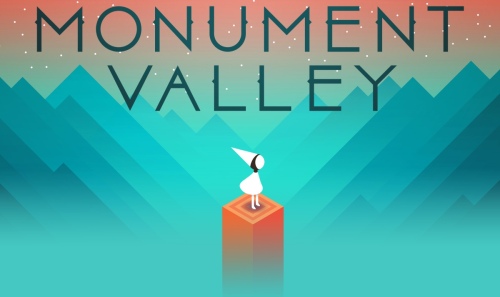
Monument Valley is less of a game and more of an experience, but it is a damn good one.  A sort of meditational challenge, Monument Valley is a M C Escher-inspired visual puzzler for mobile phones.  The goal is to guide a figure through a series of ‘monuments,’ physics-defying labyrinths that rely on forced perspective.  SImilar to the classic PSP game ‘Echochrome,’ Players rotate, flip, and skew the terrain to guide the heroine to the end of each level.
While the game itself is not overly taxing, the puzzles require players to think visually and strategically, and at its best moments, feels almost meditative.  The calm atmosphere is reinforced by top-notch visual and sound design.  The princess journeys through spires, caverns, and seas with a painterly aesthetic.  One particularly clever level is designed as a puzzle box.
The style of the game helped to alleviate any sense of frustration I felt while playing.  This was a little world that I was glad to get lost in.
Although a bit on the short side, Monument Valley is a pocket-sized gem of a puzzle game, and an oasis of calm suitable for hardcore gamers, casual players, and kids.  You can find it in the IOS, Android, and Amazon app stores.

If you enjoyed this article, please share it, or consider following me on Patreon for more content!

Hugh Likes Video Games: Fallout Shelter

Leave a comment

Fallout Shelter
Bethesda Games
Played on Android Mobile
fallout-shelter5
The Post-Apocalypse has been in the zeitgeist lately, in all it’s myriad forms of the end of the world.  From the cinematic wasteland of “Mad Max: Fury Road” to the small-screen shambling of “The Walking Dead.”  But perhaps the most iconic doomsday scenario is still Nuclear War.  And lately, nobody has taken more advantage of the irradiated wasteland than Bethesda Games’ “Fallout” games.  With Fallout 4 burning up the charts, Today seems like a good day to examine their free promotional game, Fallout Shelter for IOS and Android.
While the series is all about exploration, Fallout Shelter sticks closer to home, putting you in the chair of a Vault-Tec overseer.  Starting with some survivors, a few caps, and a hole in the ground, you have to keep your vault running, and your dwellers happy, safe, and healthy.  Imagine a simplified version of The Sims, but with more guns and radioactive scorpions.
The game is presented as a 2D grid, with rooms taking up 1 to 3 spaces on the grid.  As time goes by, and the vault population increases, players can dig deeper and deeper into the earth to expand.  While it requires a bit more horsepower than you might expect, the visuals are cute and engaging, based on the cartoonish Vault-Boy style of Fallout’s mascot.  It ran very smoothly on my Samsung Galaxy S5.  My iPhone 4S didn’t do well, though.
Each dweller has their own simplified stats and inventory based on Fallout’s S.P.E.C.I.A.L. attribute system, and most of the game involves choosing where to assign dwellers to get the best use out of their stats, which you can improve with equipment or training rooms.  Being more productive is also key to keeping dwellers happy.
One of the other main parts of the game is increasing your vault population, and unfortunately, this one wasn’t implemented quite as well.  There is only one really effective way to increase your population, and that’s the old-fashioned way.  Later in the game overseers can build radio rooms to call survivors out of the wasteland, but for the most part, your dwellers will have to get busy.  This is accomplished by putting two dwellers of opposite sex in sleeping quarters together and waiting for nature to take its course.  The result is that both dwellers get a big boost of happiness, and the woman is immediately super pregnant.  Then, both dwellers can return to their prospective tasks until the child is born.
The problem is that the game has a system for hookups, but not relationships.  Although it keeps track of parentage to prevent incest, which can accidentally happen when you have a 100+ dwellers, this information is hidden from the player.  By removing any lasting relationships, in spite of the romantic dialog they spout, the mechanic comes off as less of a wooing and more of a breeding program.  This is exacerbated by the fact that only male/female couples can hook up.  It’s not a deal breaker, but it has a lingering authoritarian (and homophobic) vibe to it.  This may have been Bethesda’s intention, as Vault-tec is usually presented as short-sightedly patriarchal in keeping with Fallout’s 1950’s-inspired vision of America, but if so, they didn’t fully commit to the message.  This is especially true considering that breeding dwellers is key to unlocking plans for new rooms.  If you want to build the best spaces for your vault, your dwellers had better get busy.
If you can get past this one glaring flaw, Fallout Shelter is a diverting and open-ended management sim with just enough style and charm to keep you going.  Fallout Shelter is free (with in-app purchases, naturally,) for IOS or Android.
If you enjoyed this article, please share it!  Or, support me on Patreon!  Any size donation gets you early and exclusive content!

The Gamer’s Guide To Writing: Final Fantasy VII and 3 Act Structure Part I

Leave a comment

Three act structure is a form of plot found very commonly in film, but which can be used in just about every kind of story. As the name suggests, it consists of three parts: The Setup, the Confrontation, and the Resolution.
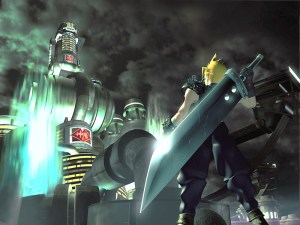
Final Fantasy VII was released by Square Soft for Sony Playstation in 1997. A breakout hit for the system, the game had a very cinematic style, and its clear narrative makes it a great example of a game with a classical three act structure. This might be at least partially due to the technological limitations of the system. FF7 originally came on three CD-Rom discs. We can look at each disc roughly equating to one ‘act’ of the three-act structure. Today let’s take a look at the first disc and how it introduces the story and characters. From here on in, we’re cutting right to spoiler territory

media_cloud_big

Disc one is the the Setup. We are introduced to ex-SOLDIER Cloud Stryfe, mercenary and former guard for the ruthless and world-controlling Shinra Electric Power Company, and Avalanche, the small band of eco-terrorists fighting against them. We meet them in Midgar, Shinra’s grimy, dystopian capital city, built in such a way that the poor are denied even sunlight.
The first act contains the Inciting Incident, the event in the story which changes the direction of the characters. In Final Fantasy VII, this is the murder of President Shinra. As the head of Shinra corporation, he serves as the main antagonist for Cloud and the others. They break into Shinra headquarters to confront him, only to discover he has already been killed by Sephiroth, a powerful SOLDIER thought to be dead. Sephiroth’s appearance as antagonist, and Shinra’s death, the trajectory of the story changes. Cloud and party escape the confines of the City of Midgar and follow Sephiroth’s trail across the expanse of the world, while they are pursued by the Turks, Shinra’s elite unit of special forces.
The first act ends with a plot point that again changes the direction of the story and propels the action into plot two. In Final Fantasy VII, this is of course another confrontation with Sephiroth and another murder. This is the infamous death of Aeris, a healer with an ancient lineage who may hold the key to stopping Sephiroth. Depending on the player, she is also probably Cloud’s primary love interest at this point. Aeris’s murder serves a dual purpose in the story. It is a setback which removes a potential solution to Sephiroth’s mysterious goals. It also raises the stakes by killing a party member and Cloud’s love interest, assuming the player chose her through his actions. This elevates the journey to find Sephiroth from a search for answers to one of revenge.
Next time, we’ll look at disc two, and discuss Rising Action as Sephiroth’s plan is put into motion, and Cloud comes face to face with who he really is.
If you enjoyed this article, please share it! Or, support my Patreon for more content!

Hugh Likes Video Games: Dragon Quest

1 Comment

Dragon Quest I for Android
Created by Yuji Horii
Published by Square Enix
dq1andios_011
Square Enix is not a company that is shy about porting its classic games to new platforms.  WIth three of the most beloved Japanese Role Playing Game brands in their stable, it’s easy to see why.  And with the ubiquity of mobile gaming, it is only good business for them to move into the tablet and phone market.  But while many of these ports have been based on early updates such as the DS or PSP ports of early Final Fantasy games, the mobile port of Dragon Quest seems to be developed for the phone.
Dragon Quest, which was called “Dragon Warrior” when it was released in North America, was a full-on phenomenon in Japan but never quite took off in the United States.  The U.S. never even saw the two Super Famicom itterations of the series until they were released for the Nintendo DS in 2009 and 2011.
The mobile version of Dragon Quest is a bit to get used to but retains all the charm of the original.  The first surprise is that it runs in portrait rather than landscape orientation.  I was put off at first, but it actually works with the game’s graphical style quite well.  DQ is arguably the first true Japanese Role Playing Game, and a lot of the tropes of the subgenre start here.  Like the original, battles take place in windows that pop up on the map rather than transitioning to their own screen.  This actually works really well in portrait mode once you get used to it.  The sprites seem to come from one of the 16-bit versions of the game, and look great, but remain simple.  The soundtrack is a gorgeous, high fidelity version that sounds great, even out of the rear speaker on my Galaxy S5.  The english translation is based on Dragon Warrior’s psuedo-Shakespearian script, which is fine, but reads oddly printed in an arial font.  Windows have the original black bubble quality, but commands are on phone buttons that look a little off.  These all felt a little distracting, but don’t get in the way of the experience.
The gameplay itself, aside from a few shortcuts from the menu, remains unchanged.  This is great, but as the origin of the JRPG, it still has some rough edges.  Be ready to spend a lot of time leveling up, and accept that sometimes the game will kill you and there will have been nothing you could have done to prevent it.  Also be prepared to wander a bit.  It’s still a fun and entertaining experience, but this game doesn’t hold your hand.
If you’re looking for a bit of a gaming history lesson, or if you’re an older gamer looking for a nostalgic refresher, Dragon Quest I for mobile platforms is a bit to get used to, but does an excellent job delivering a classic game.  You can download it from your preferred app store.
If you enjoyed this article, please share it, or support me on Patreon for more content!

Hugh Likes Video Games: Xeodrifter

Leave a comment

Xeodrifter
Renegade Kid
PC, PS4, Vita, 3DS, WiiU

xeo_screen_01

Inspired by Metroid, Xeoodrifter is an shooter/platformer/exploration game in the classic style. The player guides their space-suited explorer through the interiors of four maze-like planets while collecting power ups that let him go further. Presented in a “pixel art” style, this Metroid-clone actually has a lot to offer, with deep exploration mechanics, and fun abilities like turning into a rocket or submersible.
This game is a colorful but short Metroid clone. The gained abilities are all fun and challenging without being too complicated, but the boss fights would have benefitted from more variety rather than having the same recolored sprite with slightly upgraded powers and health. The four worlds each have their own unique look, but all feel very similar. The game hints at depth but never really delivers beyond a few hours of gameplay. It is a free game in the Playstation Plus program, though, so it is well worth checking out if you are a member.
Xeodrifter is a fun little explorer that will charm old school gamers for a short time, but leaves nothing behind after the credits roll.

Hugh Likes Video Games: Final Fantasy Adventure

1 Comment

Final Fantasy Adventure

Game Boy

Square/Sun Soft

Final_Fantasy_Adventure_Front_CoverFinal Fantasy Adventure 3

Today we’re traveling back in time for a classic edition of Hugh Likes Video Games.  Final Fantasy Adventure is a action RPG originally released for the Game Boy by Square.  Released in Japan as Seiken Densetsu, western fans may be more familiar with its blockbuster sequel, Super Nintendo’s “Secret of Mana.”  The game follows a escaped gladiatorial slave as he fights against the forces of the evil Glaive empire to protect a mysterious girl who may be the key to an ancient power.

A top-down action role playing game, Final Fantasy Adventure feels more like the Legend of Zelda than its command-based namesake.  In fact, the name was changed for the U.S. market to tie-in to the popular NES and SNES titles.  Over the course of the game, the hero, who the player names themselves, equips a variety of weapons, armor and magic, travels through a world that is surprisingly vast for the little handheld, and befriends a number of allies to help in his adventure.

Having recently replayed Final Fantasy Adventure, I can say that it holds up in some ways and not others.  The combat is solid fun, and the story is spare but enjoyable.  The repetitive dungeons and occasionally frustrating puzzles, which occasionally rely on luck rather than skill, are not.  Also aggravating are the town NPCs, who have completely idiotic pathfinding, and give long speeches whenever you touch them.  Getting out of town can occasionally be more of a hassle than the dungeon you just left.

Despite the antiquated elements of the game, Final Fantasy Adventure remains a hidden gem from the dawn of handheld gaming.  It is not yet available in the Nintendo Virtual Console store, but there was a rather bland remake for the game boy color called “Sword of Mana.”  Unfortunately, it didn’t hold up to the original.  If you have an old Game Boy or GBA laying around, pick up this one if you get the chance.

Older Entries Newer Entries