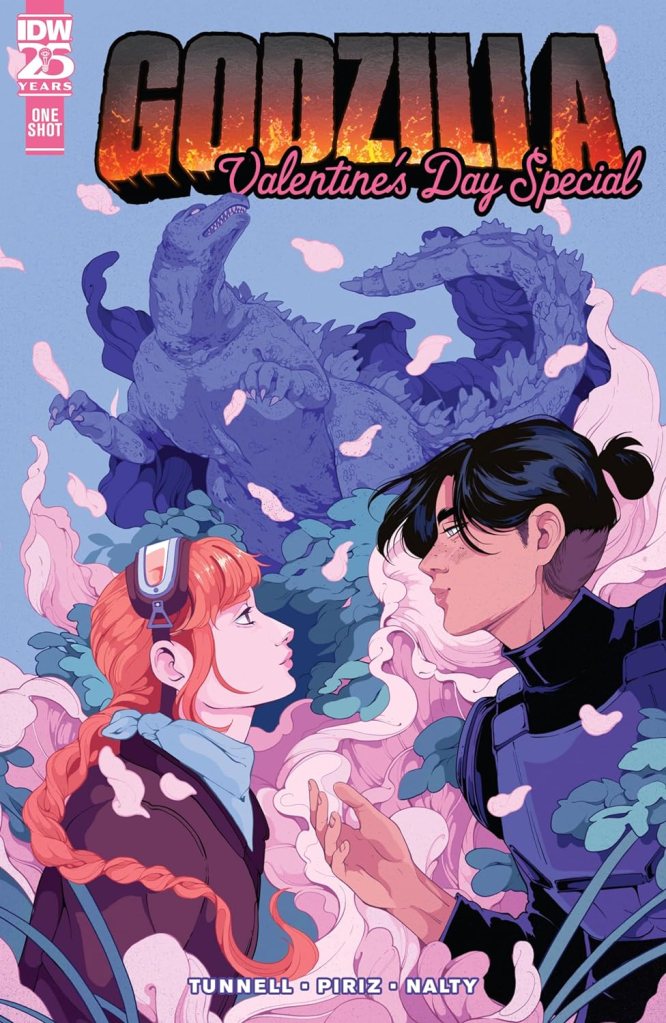
Godzilla Valentine’s Day Special #1 Written by: Zoe Tunnel Drawn by: Sebastian Piriz Colored by: Rebecca Nalty Lettered by: Johanna Nattalie Published by IDW
The Skinny: Spoiler alert: Godzilla doesn’t find romance.
For the most part, the thing that irritates me the most about Hollywood adaptations of properties such as Godzilla or Transformers is the repeated attempts to force the narrative into a human story. I cared very little for the humans when the story should be about the transforming robots or giant monsters that have secured top billing. But as a one-off story, I really enjoyed this comic, which focuses on the relationship between a, for lack of a better term, dai kaiju chaser, and an EDF lieutenant trying to keep her out of harm’s way. When Piper is caught up in a Godzilla attack while at work, she’s 1. critically injured, and 2. suddenly unemployed. But the sight of seeing the giant monster so close was exhilarating. She begins studying and chasing the giant monsters. When Sauveterre finds her running towards the danger instead of away from it, they try and stop her, through steadily escalating means, for her own safety. A cat-and-mouse game ensues, and this being a valentine’s day comic, I’m pretty sure you know where it’s heading. The writing is light and sweet, with just enough kaiju action to feel like we see enough of the behemoths to justify their presence in the story. The characters work because they don’t come on too thick and feel appropriately small compared to the giant monsters they are chasing. The art is clean and engaging, with bright colors. It is a good match for the tone of the story, and a sunny, personal contrast for the usual Godzilla stories. The reader gets a good view of the monsters, but almost always at a remove, contrasting the personal conflict with global ones. Godzilla:Valentine’s Day Special is a fun little one-shot comic, even if you aren’t a romance reader or a fan of giant monsters. You can pick up a copy digitally through Amazon, or in print at your Local Comics Shop!
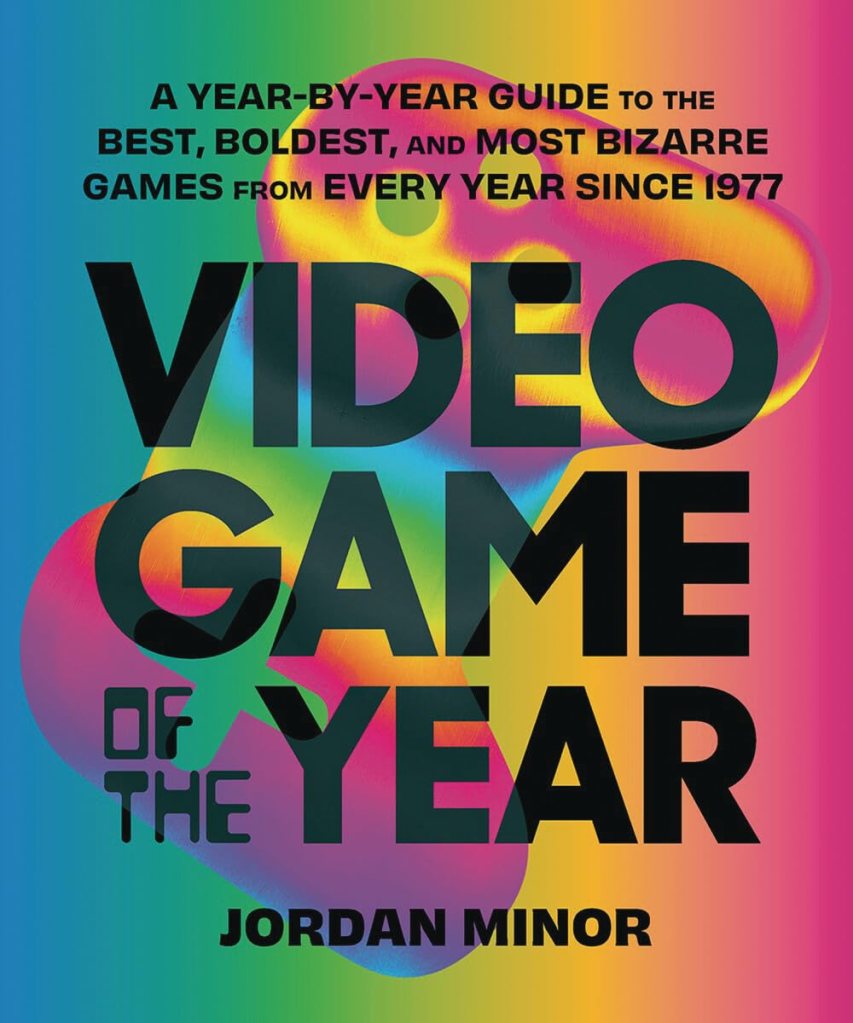
Video Game of the Year Written by Jordan Minor I llustrated by Wren McDonald Design by Heesang Lee Published by Abrams Image
The Skinny: 40 years of Video Game History, no controller required.
As a medium, Video Games are very recent and still developing their full potential. Jordan Minor’s new collection of short personal essays, Video Game of the Year, follows them from their earliest cultural impact, the breakout (heh) hit Pong through the market crash of the ’80s, the console wars of the ’90s, the rise mobile phone phenomenon Pokemon Go, and right up to the present. Using one particular title per year as an exemplar, Minor presents a compelling history of the video game industry and hobby. He doesn’t merely catalog his favorite games like a long-form listicle, but by thoughtfully presenting games in order, delivers a narrative of the medium’s development from crude novelty to complex narrative format and cultural powerhouse. Minor’s writing, accompanied by short inclusions from writers and professionals throughout the gaming industry, is a love letter to the medium, but doesn’t shy away from the darker portions of that history. His chapter on Minecraft highlights both its impact and its creator’s darker history. The chapter on Depression Quest considers games’ unique ability to consider difficult subject matter via interactivity and the ugly reaction and lingering cultural damage of Gamergate. While the chapters are brief, Video Game of the Year is an excellent overview of the history of the medium, and captures both its highs and lows. I wish that Jordan had included a bibliography, or a section suggesting further reading for more specific topics on gaming history for new readers, such as Masters of Doom, Game Over, or Fight, Magic, Items. The book is formatted as a coffee table book more than a reference or standard non-fiction book. It features wonderful and eye-catching illustrations by artist Wren McDonald, who does not get enough credit for their contributions to the book. Each chapter opens with an image of players gathered on couches in front of a TV or leaning over monitors, with an iconic shot of the game on the screen. The Video in video games is as important as the interactivity, and these illustrations do just as much work as the writing in showing the importance of the selected games, what they mean and why their inclusion in Minor’s list matters While the illustrations are great, some of the other design choices are a bit harder on the eye. The back cover copy is printed in a rainbow font on a black background, making it difficult for me to read. The style is repeated for the book’s foreword, which was also frustrating. The interior design is broken up into multiple columns on a page, like a print newspaper. I found this choice was also distracting, but none of these choices were enough to make me set the book down. Video Game of the Year is a smart, stylish look at the history of video games as a medium. It features a number of tiny glimpses, like facets in a jewel, of a grand and often fractious art movement, hobby, and industry. While it doesn’t dig quite as deep as it could into its many topics, it is a fascinating read, and a great first step for readers curious about how gaming got its start.
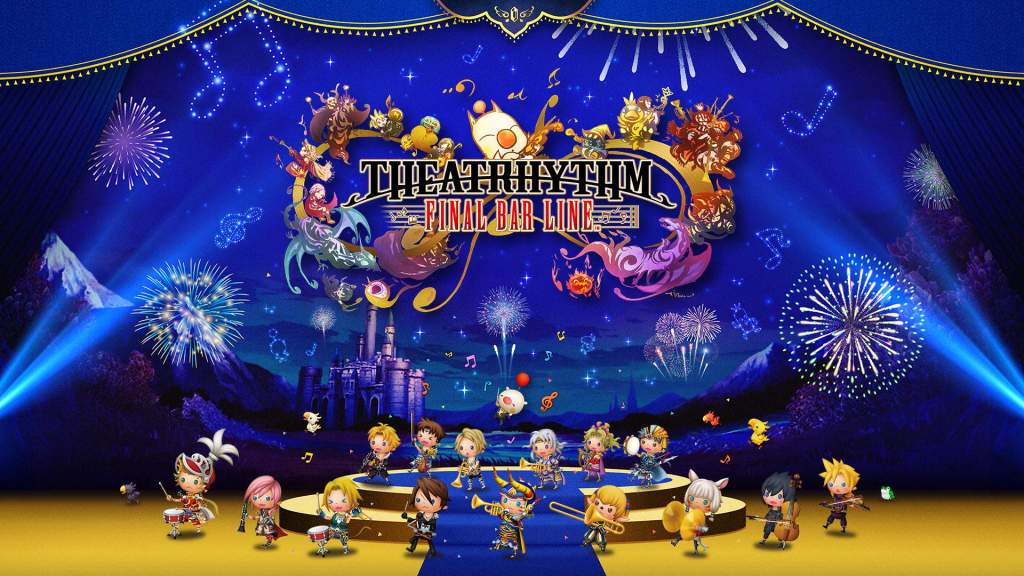
Final Fantasy Theathythm Final Bar Line Published by Square Enix Played on Nintendo Switch
The Skinny: A hefty does of nostalgia, if you’ve got the gil for the whole thing.
It is a fact commonly held among gamers that Final Fantasy has amazing music. The latest release celebrating that musical legacy, Final Fantasy Theatrhythm Final Bar Line, carries over much of the features from the original game on the 3DS, and doesn’t make many improvements, although it does refocus on button presses rather than the original game’s touch screen controls. What it does offer is a huge amount of songs. The base game features classic music from all fifteen mainline entries, along with a host of characters from each game. For the first time includes music from numerous spinoff games like Final Fantasy Tactics, Chocobo’s Mystery Dungeon, and even the obscure Final Fantasy Mystic Quest, a long-forgotten side entry originally created to try and boost the image of Japanese-style console RPGs in the west. There’s a lot in the base package, but SquareEnix wouldn’t be selling our nostalgia back to us if they weren’t able to sweeten the pot. The day-one digital deluxe package comes with a number of extra tracks, many of which feel essential, but probably required additional licensing. These include the main themes for some of the games, such as VIII’s “Eyes on Me” and IX’s “Melodies of Life.” A host of DLC tracks are also on offer, themed by additional Squaresoft hits such as the Saga series, Chrono Trigger and Chrono Cross, and the Mana series. The gameplay is easy to pick up but difficult to master. Basic tracks are fairly accessible, while Expert and Ultimate difficulties will prove far more taxing. Rhythm game aficionados will be able to sink their teeth into the harder difficulties, while casual players just looking to relive their gaming memories aren’t stuck with their favorite tracks hidden behind a barrier. There’s also a slow drip of unlocking characters, leveling them up, and completing quests in each song to keep players invested. Theatrhythm is well-designed to give the player what they want, whether that is a quick hit of nostalgia or a crunchy and challenging rhythm experience to lose themselves in. Final Fantasy Theatrhythm Final Bar Line’s visual design isn’t quite as impressive as the audio and gameplay. The somewhat creepy marionette designs of the characters return, and layouts for Field Mode are often recycled, with a few standout unique ones. If you put some time into the game, you’ll see the same field, town, and castle over and over again. Final Fantasy Theatrhythm Final Bar Line is a great little package for die-hard Final Fantasy fans and rhythm game aficionados. But be prepared to pony up the gil if you want to hear everything the game has to offer.
The Resurrection of Magneto #1 Written by Al Ewing Drawn by Luciano Vecchio Colored by David Curiel Lettered by VC’s Joe Sabino Published by Marvel Comics
The Skinny: Spoiler alert for issue four, I guess. (Also spoilers for Judgement Day)
In Big-2 comics, no character death is forever. Characters get endings, but the nature of serialized storytelling, and Marvel and DC’s highly valuable intellectual property, means that characters move in cycles rather than linear paths, and their stories come around again, through reboots or retcons. As Marvel’s Fall of X enters its finale, The Resurrection of Magneto is writer Al Ewing and artist Luciano Vecchio’s swan song with these characters, and this is by far my favorite book of the final chapter of the X-Men’s Krakoan era. While Magneto’s name is on the event, this issue is focused with laser precision on Storm, following her as she makes the decision to bring Magneto back to life in violation of his last wishes. But while usually resurrecting an X-character is easily accomplished, and in the current era more than most, Storm and Magneto had vowed to forego the chance to return to life, even destroying their ‘backups.’ So instead, Storm has to travel into the afterlife and go get him. She’s assisted by a brief cameo from the Blue Marvel, star of Ewing’s most recent Defenders series, and the ensuing magical journey is filled with symbolic battles and eye-catching, tarot inspired spreads. And let me tell you, Vecchio and Curiel kill it with the art. This is a drop-dead gorgeous book, from the opening panel of Magneto as the 5 of cups from the Rider-Whyte tarot to a climactic battle with a surprising but cool villain, this book hits all the Storm notes, and while it may feel a little bit like it’s going in the same circles, it feels pretty fitting for the end of the era. Magneto’s death was one of the most impressive moments in recent comics history, and is that rare earned ending that characters get so rarely in modern comics. Ewing and Vecchio have their work cut out for them making his journey back to the land of the living as momentous as his end. But this new first issue is a good first step. I can’t wait to see where the journey ends up. The Resurrection of Magneto #1 is available digitally from the usual suspects, and in print at your local comics shop.
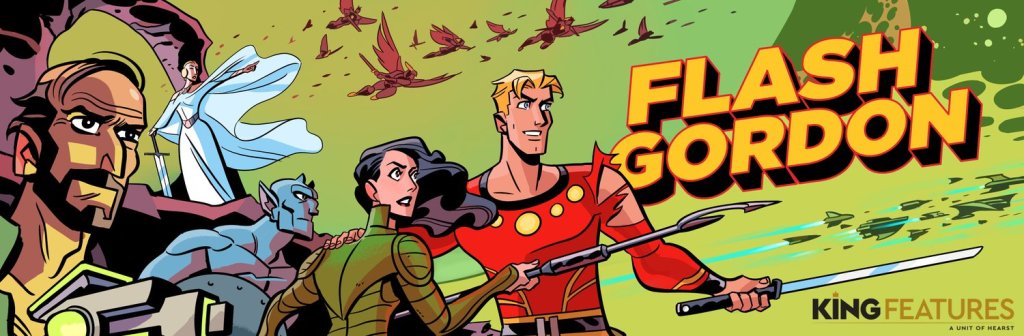
If his long-running webtoon Lavender Jack proved anything, it was that Dan Schkade knows how golden-age comics work, and how to take everything that’s great about them and present them for a modern audience. Long-since relegated to reruns, Schkade brings us into his new take on the classic hero in medias res, as we follow the Earthman on an exciting attack on Ming the Merciless that is equal parts rescue and climactic final battle. But when the smoke clears and Ming is seemingly defeated, what happens next? Following a classic newspaper serial format of six short comics and one full page a week, Schkade’s writing is thrilling without getting bogged down or getting confusing by the format, and his art is kinetic and clear in an incredibly tight space. The launch is only a couple of months old, so if you’ve ever been curious about this classic character but hesitant to pick up the originals, this is a fantastic place to start.
Birds of Prey Written by Kelly Thompson Drawn by Leonardo Romero Colored by Jordie Bellaire Lettered by Clayton Cowles Published by DC Comics
Comics are all about reinvention, and this classic team on DC’s super-heroines is getting the band back together in the wake of 2020’s Birds of Prey feature film. Reinventing the team as less of a group of superheroes and more of a heist is always a compelling choice for me, and it puts classic leader Black Canary in an interesting and fun position. The dynamic for the team is fun and explosive, and the requisite inclusion of DC’s breakout star Harley Quinn is well-handled and feels natural. The rest of the team is made up of fun fan-favorites who rarely get their on spotlights like Batgirl (Cassandra Cain) and Big Barda, which is icing on a cool superhero cake.
Hawkgirl Written by Jadzia Axelrod Drawn by Amancay Nahuelpan Colored by Adriano Lucas Lettered by Hassan Otsmane-Elhaou Published by DC Comics
This one is a gimme for my list. Hawkgirl isn’t a character I’m very familiar with, aside from a similar character from the early-00’s Justice League cartoon. Rising star Jadzia Axelrod clearly knows her stuff, though, and tells a compelling and satisfying story in six short issues. Accompanied by her own hit creation Galaxy, who debuted in a graphic novel in 2022, this is a showcase of cool high concepts and character-defining moments, delivered with the force of a superhero diving through a skylight. This is how you do legacy right, stitching character around (and sometimes through) established history while making something new and exciting. This was a six-issue mini, but I hope we see more of these characters (and this creative team) in the future. I could’ve read thirty issues, easy!
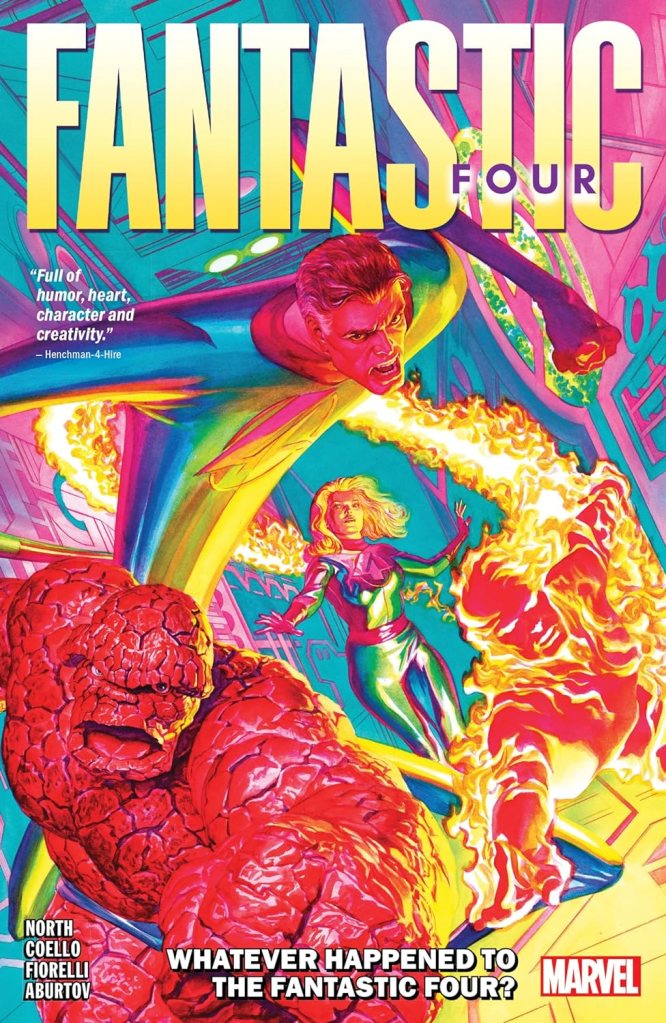
Fantastic Four Written by Ryan North Drawn by Iban Coello Colored by Jesus Aburtov Lettered by Joe Caramagna Published by Marvel Comics
I will admit that of all of the various Marvel characters and teams, The Fantastic Four has always ranked near the bottom, personally. They have a fun cohesive design, and smarter writers than I have written about how cleanly their debut marks the end of the Golden Age and the rise of the Silver Age. But aside from The Thing, I’ve never really cared much for them. They feel a bit too rooted in their time and place of creation, products of the Cold War, a nuclear family for the nuclear age. They’ve never really caught with me, and Mr. Fantastic in particular has always struck me as being a cliched relic, a Man of Science accompanied by his literally invisible housewife. But Ryan North has managed to find the great in these characters by driving them out of their secure and comfortable Manhattan skyscraper and sending them out on a trip across the country. As an X-Men fan, making your heroes pariahs is always going to be a step in the right direction for me, and giving them some meaty super-science problems to tackle outside of the mad scientist of the week has done wonders. This is going to be a run for the ages, and it’s (hopefully) just getting started. This is North’s Squirrel Girl writing all grown up.
X-Men Red Written by Al Ewing Drawn by Stefano Caselli, Jacopo Camagni, and Yildiray Cinar Colored by Federico Blee Lettered by Ariana Maher
It was difficult to choose just one X-book to put on this list, but X-Men Red takes the edge in terms of drama, scope, and shout out loud superhero moments. X-Men books are all about being outsiders, but what could be more outsider than an ancient civilization of super-powered beings finally trying to learn how to be at peace after milllenia of war? Marvel has a collection of these types of hidden civilizations, most of which came from the Fantastic Four’s rogues gallery, in fact. But the Araki have something a bit extra that groups like the Atlanteans and the Inhumans just don’t have going for them. Ewing knows his stuff and brings it to the table. It helps that we aren’t really supposed to be sure where we stand with the Araki, with their strange powers and alien morality. But where Blackbolt and his kin feel like plantation owners, perpetually ruling over an underclass they don’t view as human, the Araki are Klingons, strange and difficult, but with a refined sense of honor that can be tested. Having characters like Storm and Sunspot to bounce against them, forming rivalries and friendships, helps. That the strange warlords, who felt like they might invade Earth at any moment felt like they were also on their own back foot, from antagonists like Uranos and Genesis helped immensely as well.
Dracula, Motherf**cker! Written by Alex de Campi Drawn by Erica Henderson Published by Image Comics
The Skinny: A ’70s Neo-Noir take on the classic Dracula story.
1970s Los Angeles is a city in love with youth, and with death. And when aging starlet Bebe Beauland faces losing the former, she turns to the later, resurrectomg Dracula. The vampire was attacked and imprisoned by his brides nearly a century before. When crime-scene photography Quincy Harker sells evidence of Bebe’s apparent death, he becomes a target for the Dracula and Bebe. But his brides aren’t about to leave their job half-done. Dracula, Motherf**cker! positively oozes sleezy, ’70s neo-noir and Hammer horror personality. Short and stylish, this graphic novel pulls you in like a vampire’s gaze, demanding you pore over each sumptuous page. de Campi’s fang-sharp writing and Henderson’s at times grotesque art, colored in eye-searing saturated palates, never letting go until the very last page. Henderson’s softer drawing style creates an appealing contrast with the gritty subject matter, and her depiction of the count, not as a suave and seductive foreign nobleman, but as a sort of impenetrable, unknowable cloud of darkness, protean and shadowy, with too many eyes, mouths, or hands, shifting from panel to panel, is unsettling and masterfully juxtaposed to Quincy’s gritty and detailed corpse photography, much of which we see from the point-of-view of his camera lens. De Campi’s writing is also layered and intriguing, taking the unusual perspective of the three brides, barely bit-players in Stokers novel, raised to the status of dubious anti-heroes as they revenge themselves on their creator and disrupt his own plans for them. It’s a refreshing take on a well-tread tale, and the book is exceptional for it. If you’re looking for a treat this Halloween, Dracula, Motherf**ker! fits the bill. You can find it digitally via Comixolgy, or in print at your local comics shop.
F-Zero 99Published by NintendoPlayed on Nintendo Switch The Skinny: A drop of water in the Sand Ocean
The original F-Zero was a launch title for the Super Famicom / Super Nintendo, showing off the system’s flashy Mode 7 graphics and faster processing. Over the subsequent console generations a few sequels and media tie-ins followed, but the series always seemed to be in the shadow of Nintendo’s more popular racing franchise, Mario Kart. While series characters and vehicles have made appearances in other games, Nintendo hasn’t released a new F-Zero game in nearly twenty years. Until earlier this month, when Nintendo announced F-Zero 99 as a part of the most recent Nintendo Direct. Like previous titles Tetris 99 and Pacman 99, the game is a reimagining of a retro classic as a multiplayer battle royale. And the chaotic, fast-paced gameplay makes F-Zero a perfect addition to the franchise. Unfortunately, I’m terrible at it.Each race opens with an expanded starting area to accommodate all 99 players. Only the original four vehicles are currently available, but players are able to unlock new color schemes and customize them as they gain rank and complete challenges. Hopefully, they will release more content to add the roster and tracks from later games in the future. Starting a race is lighting fast, possibly due to high interest at launch. All players vote on a track from the original game, and can get racing in seconds. This streamlining is a nice feature, as F-Zero 99 can be absolutely brutal. The game encourages aggressive driving by adding a spin-attack which charges over time, and changing the boost so that it depletes the life meter. These options create an engaging risk and reward mechanic that rewards players not just for using them, but for using them at the correct time. Hitting opponents causes them to drop little golden pellets of energy that charge a separate meter. When filled, it replaces the boost with a second, higher track that allows players to get ahead of the competition and avoid obstacles. In addition to individual races, the game has a Grand Prix mode where players race in predetermined cups requiring tickets, and Splatoon-like team battles. These extra modes are on a timer, and aren’t always available. It’s frustrating when the race you want to do isn’t available, but it also keeps the game balanced and prevents any one player from camping at the top of the leaderboards. While F-Zero 99 is an entertaining curiosity, using slightly updated graphics from the original, It mostly just whets my appetite for a fully-featured F-Zero game, which hasn’t appeared in Nintendo’s catalog since the days of the Game Boy Advance. F-Zero 99 is a fresh take on a classic that Nintendo seems to have all but abandoned since the days of the Game Boy Advance. It’s a tasty little snack, but here’s hoping that it is a hint of a more satisfying entree on the horizon.
Birds of Prey #1 Written by Kelly Thompson Drawn by Leonardo Romero Colored by Jordie Bellaire Lettered by Clayton Cowles Published by DC Comics
The Skinny: A bold and intriguing first step for a brand new team. Plus Harley Quinn is also here.
Birds of Prey #1 by Kelly Thompson and (artist) is a delightful first issue for a new team book, and like many such books, the first issue is mostly centered around getting the team together. it’s a bit of a whirlwind tour of the DC Universe as Black Canary gathers a team for a dangerous mission to save her adopted sister. There’s lots of action while most of the plot is teased at as being off the page for now. The hook, and the engaging characters, keep the pace going. The team is one of contrasts, with Dinah not having her first pick of DC’s usual heroes. It’s a fun mix of characters that is appealing to long-time fans as well as newcomers such as myself. I never knew I wanted a scene of Cassandra Cain Batgirl and Big Barda fighting 4th World vampires, but it sings on the page. Harley Quinn is the anchor of the team in what feels like editorial reasons, but Thompson turns the unlikely recruitment around in an interesting way that builds up the characters.The art is the real MVP on this book. Romero delivers a clean, heavy-lined style that makes the action easy to follow, with a drop-dead gorgeous splash page early in the issue that I will not spoil. Along with Bellaire’s bold, solid colors, the art has a classic DC style to it that is very appealing. If they added some dot printing, it would feel like this book could have been picked up off a spinner rack in the ’70s or ’80s.This is still an early book, but this first issue delivers with a fun premise, an intriguing mystery, and a last-page reveal that made me shout out loud. I’m placing a large bet that this is going to be the DC book to watch going into the next year, and it is entirely my jam. I heartily recommend you pick up a copy from your local comics shop, or check it out digitally wherever you get your comics.
Bad Writer Developed & Published by Riddle Fox Games Available for PC and Nintendo Switch Played on Nintendo Switch
The Skinny: The Waiting Game (abbreviated) Created by one-man studio Riddle Fox Games, Bad Writer is a short game about short stories. This bite-sized pixelated story puts players in the shoes of Emily, an unemployed writer who sets out to follow her dreams of becoming a published author. Players will have a month to guide the character on the path to traditional publication. If she doesn’t get some sales, or becomes too depressed, she’ll go back to her old job and give up on her dreams forever.This simple, charming game only takes about a half an hour from start to finish and is laid out like Harvest Moon or Stardew Valley. The only stat players will have to manage is Emily’s happiness, which goes up when she talks to her wife or cat, or succeeds in her goals. It goes down when she gets a rejection or doesn’t write. If the gauge reaches zero, it’s game over.While simple and short, Bad Writer is very faithful to the life of a full-time author, and realistic in its depiction of the actual success rate of traditional submissions, even if it fast forwards through the actual writing and editing parts. It’s a wonderful, chill little gem to play if you want to learn what the writing life is like, or just want to procrastinate for an hour from your own writing.
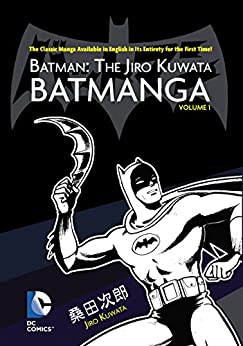
Batman: The Juro Kuwata Batmanga Volunme 1 Written and Drawn by Juro Kuwata Published by DC Comics
The Skinny: The Other ’60s Batman
During the height of the 1960s Batman TV show, Juro Kuwata a manga-ka who brought the Dynamic Duo to Japan with his own unique spin on the Caped Crusader. The resulting collection was not available in English in a complete format until 2014, but it is well worth your time and consideration. The art is a delightful mix of Golden Age DC and classic manga aesthetics, riding high on an international wave of the live-action Batman TV show’s success. The stories are all fairly straightforward and of their time, but also take some interesting swings. Eschewing the Dark Knight’s well-known rogues gallery, Kuwata turned his hand to making his own villains, opening with the very strong and exceptionally well-named “Lord Death Man” and setting Batman and Robin against a super-intelligent gorilla (not Gorilla Grodd) with a fun twist, a powerful mutant that echoes the creation of Marvel’s X-Men while looking like a weird space alien, and The Human Ball, which probably sounded less hilarious in the original Japanese. Kuwata’s art is striking and iconic, although the stories feel somewhat poorly served by manga’s black-and-white format. Several insert sections also include red tones for a deluxe feel, but one of the key clues for one of the villains includes the fact that his powers were color based. Which came out of left field in this black-and-white comic Batman and Robin also have a distinct feel to them in this version, with Batman being much more of a man of action rather than a detective, and this Dick Grayson is delightfully sassy. While not exactly ground-breaking, this collection of ‘lost’ Batman comics feels both classic and astonishingly different. Kuwata’s style is distinct and iconic, while still highly recognizable, and Batman and Robin’s adventures don’t feel too far removed from his live-action TV Adventures. It is a curious little oddity that is well worth the time of fans of both anime and Batman, if only as a reminder of where the character has gone in his many years of publication history. Batmanga Volume 1 is available digitally from Comixology or in print from your local comics shop.
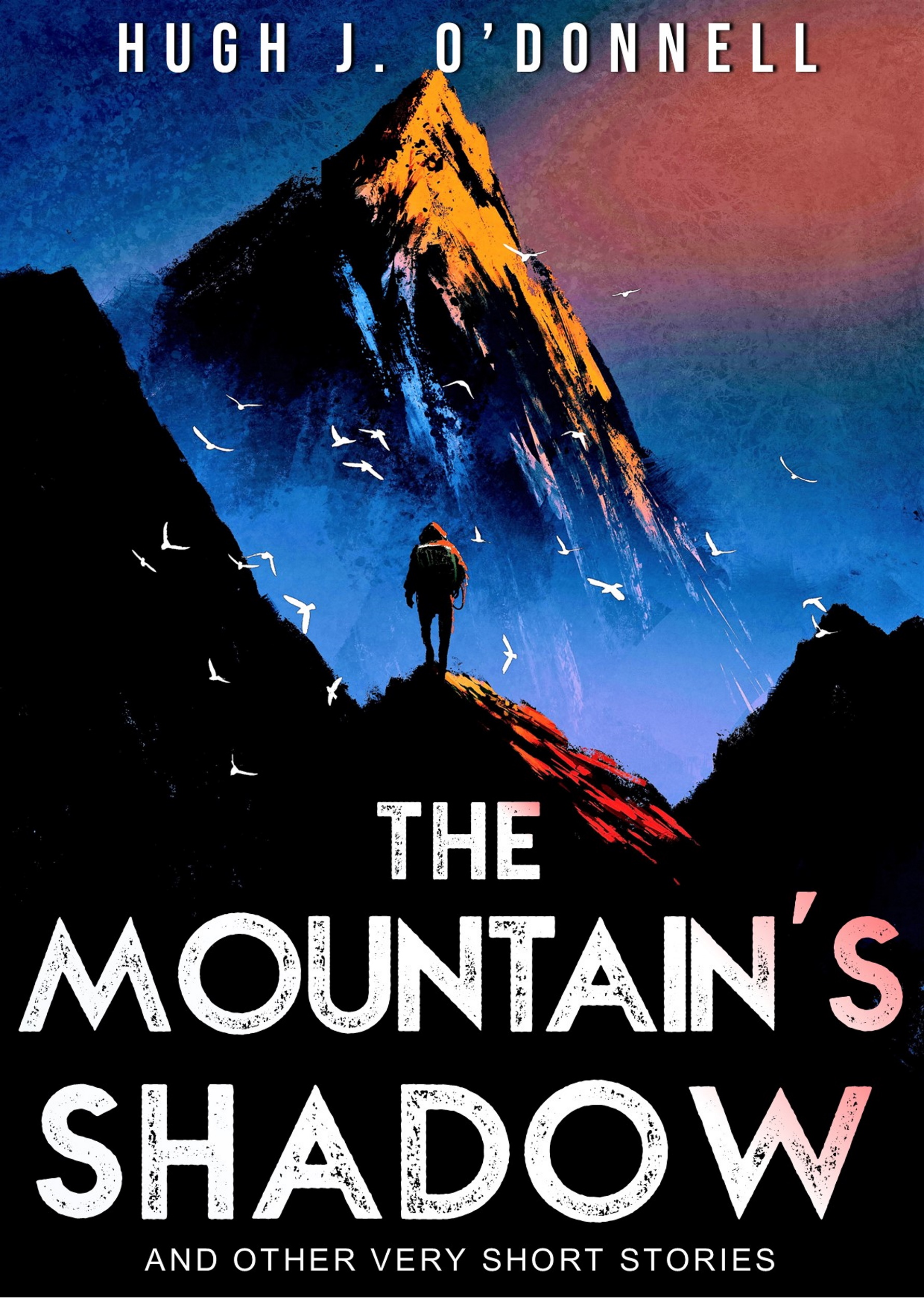
The Mountain’s Shadow is now available from Amazon and Smashwords!





 Hugh J. O'Donnell