Letter Quest: Grimm’s Journey Remastered
Bacon Bandit Games
Played on PS Vita

On the whole, I’ve never gotten into touchscreen games on the PS Vita. The functionality works for the most part, but feels imprecise and gimmicky when I have a suite of perfectly good buttons right there. Which is why I was pleasantly surprised by Letter Quest: Grimm’s Journey Remastered.
An enhanced port of a computer puzzle game, Letter Quest is a riff on the Puzzle Quest formula of mixing turn-based RPG and Puzzle Game mechanics. The twist is that the game in question is Boggle rather than Bejeweled. Players have a grid of fifteen letters to arrange into words using the touch screen, which works remarkably well here. Each letter scores points which the hero, a cute cartoon death named ‘Grimm’ turns into damage against an enemy. Each level has a few enemies that have different stats and abilities in addition to attacking the hero. For example, they can change the letters on you tiles or give your tiles nasty effects like poison or spikes for a few turns. Outside of combat, players can level up their abilities or tweak the design on their scythe or tile sets.
The puzzle combat is simple and addictive, as it should be. While the ability to level up attacks and boost particular word damage can allow children or limited wordsmiths to power through, the game has a long list of bonus objectives for completionists or players looking for a greater challenge.
As for the design, the monster and character designs are cute, and the remastered scores are pleasant but repetitive, but there isn’t much here in terms of plot. What story there is gets laid out through a set of comic panels players unlock as they progress. It’s all inconsequential and breezy, and seems almost as though these were assets left over from another project, but they all work well enough. The design doesn’t feel the need to justify itself, it’s just a pleasant background to try and rack up a ten-letter SAT word against. But that’s just fine for the price.
Letter Quest Remastered is a pleasant diversion for bibliophiles of all stripes. I played it as a part of Sony’s PS Plus collection, but it, or its slightly downgraded predecessor, is available on just about every console or mobile device store.
Hugh Likes Video Games: Letter Quest Remastered
February 1, 2017
Hugh Likes Video Games Casual Game, HLV, Hugh Likes Video Games, Letter Quest Remastered, PS Vita, Puzzle, RPG Leave a comment
Hugh Likes Video Games: Castlevania: Portrait of Ruin
October 7, 2016
Hugh Likes Video Games Castlevania, HLV, Hugh Likes Video Games, Nintendo DS, review Leave a comment
Castlevania: Portrait of Ruin
Konami
Nintendo DS, 2006

Welcome to Dracula Season, my annual celebration of my favorite defunct game franchise, Castlevania! This is the second installment of the franchise on the Nintendo DS, Portrait of Ruin. Like the other handheld titles of the era, this is a 2D side-scrolling exploration game. The twist in this one is that the player controls two characters that share the screen, Johnathan Morris and Charlotte Aulin.
A sequel to the somewhat obscure Sega Genesis title “Castlevania Bloodlines,” Johnathan is the son of one of that game’s protagonists, John Morris, and the grandson of ‘Dracula’ character Quincy Morris. He’s a more physical character, while Charlotte is a magician. Players can switch between the two, and choose to go solo, or have the other character onscreen as an AI partner. Two players can also team up over a wireless connection. Both collect equipment, sub-weapons, and spells as they explore Dracula’s Castle.
But the count is not at home. Rather, the castle is being manipulated by Brauner, a vampiric artist whose daughters were killed in World War I. He’s taken control of the castle with the aim to destroy the world. Players have to enter Brauner’s paintings in order to disrupt his hold on it.
Portrait of Ruin is visually stunning, and puts the DS’s graphics processor through its paces. The concept of entering the paintings is cool, and adds some visual flair and variety to the maps. The unusual maps and layouts challenge players in ways that call back to “Symphony of the Night.” The story is interesting but easy to follow, even for someone like myself who hasn’t played the Genesis prequel.
It would have been nice to have more paintings later in the game rather than reusing the first four, but this is a small nitpick. Portrait of Ruin is a worthy successor to the Castlevania line, and while it is no longer in print, you can probably pick up a used copy at your local games shop for a steal.
If you enjoyed this article, please share it, or support me on Patreon for more content!
Hugh Likes Video Games: Gone Home
September 19, 2016
Hugh Likes Video Games Gaming, Gone Home, HLV, Hugh Likes Video Games, Interactive Fiction, LGBTQ, PS4, review Leave a comment
Gone Home: Console Edition
Created by The Fulbright Company
Played on Playstaton 4
gonehome.game

I played “Gone Home” for the first time when it was released on PC. Unfortunately, my Mac Mini wasn’t quite up to the task of the game’s graphics. So I was quite pleased to be able to download it as a part of Sony’s Playstation Plus offerings for June of this year. The span of a few years make this indie game’s 3D modeled mansion a bit less spectacular, but the game’s story and technique remain just as impressive.
The player steps into the first-person shoes of Katie Greenbriar, a college student just returned from a trip to Europe. She arrives home in the middle of a stormy night to find the house empty, with a message from her younger sister not to come looking for her.
As you begin to explore the strange house, “Gone Home” feels like a survival horror game. It does borrow some of that genre’s puzzle and exploration mechanics, but the game is actually something else. As you learn more about Katie’s family through letters, buttons, scraps of notes, and other evidence, voice over narrations of her sister Sam are unlocked. Formatted as unsent letters, they reveal the true story piece by piece. I won’t spoil it here, but it is well worth experiencing on your own.
“Gone Home” is a by turns creepy, moving, and overall heartfelt piece of interactive fiction, and I wholeheartedly recommend it.
Hugh Likes Video Games: Metroid II
August 29, 2016
Hugh Likes Video Games Game Boy, HLV, Hugh Likes Video Games, Metroid, Nintendo, review Leave a comment
Hugh Likes Video Games-Metroid II
Metroid II: Return of Samus
Nintendo Game Boy
Published 1991
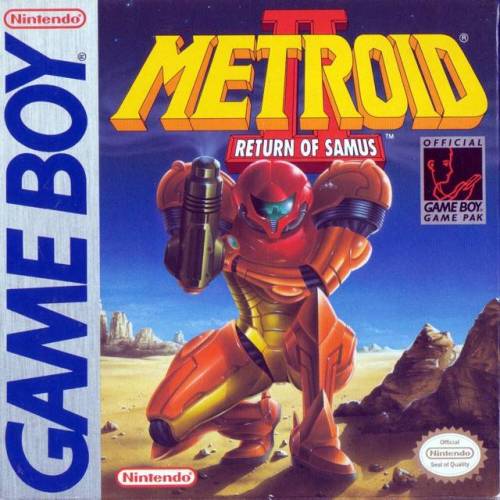
The Nintendo Game Boy was a little system that could. Propelled to success by its classic version of Tetris, the monochrome game system boasted a wide variety of games despite its low resolution and hunger for batteries. Being a child of the 80’s and 90’s with a limited budget, most of my gaming nostalgia goes back to the original, which still holds a place of pride on my display of gaming systems that have since gone to pasture.
One of my favorite games of the era was Metroid II: Return of Samus. This handheld sequel to the original NES game follows space bounty hunter Samus Aran as she traverses the caverns of an alien world to destroy weaponized aliens called Metroids.
While not narratively complex, the Metroid series offers plenty of exploration, tricky platforming, and the most badass woman in all of gaming as a protagonist. II is a bit shrunk down and more linear than its 8-bit predecessor, but the thrill of actively hunting rather than simply exploring is an improvement on the original.
The maze-like interior of planet SR388 is divided into sections, each with a number of metroids. Each section is cut off by ‘boiling acid’ which conveniently recedes when the required number of metroids have been killed. This replaces the standard Metroid mechanic of requiring upgrades to proceed, although the game is still littered with toys for Samus to collect. But the metroids Samus encounters aren’t simply the jellyfish-like floating aliens encountered in Metroid. On their home planet they havea multi-stage life cycle, and become larger and more difficult as the game progresses.
While the game is a bit linear, and, if you collect everything, easier than other Metroid games, it is still a standout of the original Game Boy library. You can find it fairly easily in used game stores, or digitally in the 3DS eshop.
Thanks for reading this article. If you enjoyed it, please share it! You can also support me on Patreon for exclusive and early access to writing, podcasts, and more!
Hugh Likes Video Games: Broforce
April 22, 2016
Hugh Likes Video Games, Uncategorized Broforce, HLV, Hugh Likes Video Games, Indie Game, Playstation, review Leave a comment
Broforce
Free Lives/Digital Devolver
Steam & PS4
Broforce is a fun and frantic action game that combines the military run-and-gun platforming of games like Contra and Metal Slug with the try-and-fail puzzle gameplay of Super Meat Boy. An over the top sendup of 80’s and 90’s action movie cliches, it provides steep challenge but the amount of variety, and the speed with which hte game resets after you lose a life make for an addictive combination. This is a game that I often started intending to play only a few rounds, only to find that several hours had passed without realizing.
The player controls a small army of ‘bros,’ each of which is a parody of a recognizable 80’s or 90’s action move hero, with part of their name replaced with ‘bro,’ such as “Commandbro’ and “Brogeiver.” Each has some kind of projectile, a melee attack, and some kind of special ability. The goal is to navigate levels filled with Terrorists, Satan (yes actual Satan,) and Xenomorph-like aliens. Players can free caged prisoners to get extra lives, but each time they do their player character changes to a new Bro, who plays slightly differently. So if you are playing with a character you really like, rescues present a neat little risk/reward. The goal is to reach the end of the level, which is sometimes difficult because just about every bit of 2D pixelated ground is destructible, meaning you can easily blow up ladders and bridges you need by firing wildly, which the game encourages with the hoard of enemies you’re up against. You are rewarded with blasting guitar riffs and flashing red white and blue lights on the PS4 controller as your Bro flies to safety hanging from a helicopter, as you do.
Broforce is so commuted to its bro-tastic, jingoistic stance that, much like Paul Verhoevens “Starship Troopers,” I’m only mostly sure it’s a parody. The general who gives you command briefings says things like “I’m pretty sure this is a country.” and “Explode them with Freedom!” And there is a dedicated button which makes your little pixelated character flex. There is also a local and online multiplayer function, so you can play this game solo, or with your own bros.
Broforce is a downloadable video game from Steam and Playstation network.
Thank you for reading this article. If you enjoyed it, please share it. You can also support me via Patreon to get more content.
Hugh Likes Video Games: Pokemon Red
April 14, 2016
Hugh Likes Video Games, Uncategorized 3DS, Game Boy, HLV, Hugh Likes Video Games, Nintendo, Pokemon Leave a comment
Pokemon Red Version
Nintendo
Nintendo 3DS/Game Boy

2016 is Pokemon’s 20th anniversary. As such, Nintendo is pulling out all the stops for a year full of new games, giveaways, and other special events. One of the first is a rerelease of the original gameboy Pokemon titles as downloads for the 3DS.
I played the original Pokemon Yellow as a teenager when it was originally released, admiring the rather deep strategic RPG gameplay beneath the cartoonish aesthetic. This new version retains the style and the feel of the original on 3DS. Like other Virtual Console releases, this is a pixel-perfect rendition, and the game looks great on the New 3DS XL screen. Unlike other game boy rereleases, Pokemon retains its multiplayer capabilities. Players can trade monsters and fight with their friends using local wireless in place of the Game Boy link cable. This system is limited to players in the same room, and is functionally identical to its 90’s link-cable counterpart.
Pokemon is an early and easily the most popular entry in the ‘collectable monster’ sub-genre of RPGs. Players take the role of a boy traveling across a large island to collect and raise Pokemon, monstrous animals that can be trained to fight. Along the way, they assist a scientist working to classify the creatures, constantly foil a criminal organization, and battle all comers in hopes of being the best there ever was.
The strategic aspect of the game is basically a more complicated version of rock papers scissors. Each monster has an elemental type, and its attacks are weaker or stronger against other types. Fire is strong against Grass and weak against Water, for example. Player raise their monsters with a fairly simple leveling system, but can teach certain moves to their team members to give them an advantage. The game strikes a nice balance of being simple enough for a child to learn with deeper enough strategy for more experienced players.
Pokemon Red, Blue, and Yellow are currently available for 3DS from the Nintendo eshop. While they don’t boast the dazzling 3D graphics of more recent entries, they are sure to delight nostalgic fans.
Thank you for reading this article. If you enjoyed it, please share it. You can also find more exclusive content on my Patreon feed!
Hugh Likes Video Games: Monument Valley
December 4, 2015
Hugh Likes Video Games, Uncategorized Gaming, HLV, Mobile Gaming, Monument Valley, UsTwo Games Leave a comment
Monument Valley
UsTwo Games
Played on Android
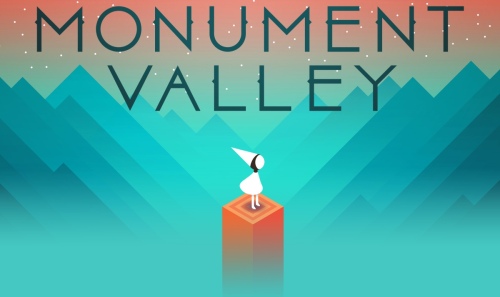
Monument Valley is less of a game and more of an experience, but it is a damn good one. A sort of meditational challenge, Monument Valley is a M C Escher-inspired visual puzzler for mobile phones. The goal is to guide a figure through a series of ‘monuments,’ physics-defying labyrinths that rely on forced perspective. SImilar to the classic PSP game ‘Echochrome,’ Players rotate, flip, and skew the terrain to guide the heroine to the end of each level.
While the game itself is not overly taxing, the puzzles require players to think visually and strategically, and at its best moments, feels almost meditative. The calm atmosphere is reinforced by top-notch visual and sound design. The princess journeys through spires, caverns, and seas with a painterly aesthetic. One particularly clever level is designed as a puzzle box.
The style of the game helped to alleviate any sense of frustration I felt while playing. This was a little world that I was glad to get lost in.
Although a bit on the short side, Monument Valley is a pocket-sized gem of a puzzle game, and an oasis of calm suitable for hardcore gamers, casual players, and kids. You can find it in the IOS, Android, and Amazon app stores.
If you enjoyed this article, please share it, or consider following me on Patreon for more content!
Hugh Likes Video Games: Fallout Shelter
November 20, 2015
Hugh Likes Video Games, Uncategorized Bethesda Software, Fallout, Fallout Shelter, Gaming, HLV, Mobile, SIM Leave a comment
Fallout Shelter
Bethesda Games
Played on Android Mobile

The Post-Apocalypse has been in the zeitgeist lately, in all it’s myriad forms of the end of the world. From the cinematic wasteland of “Mad Max: Fury Road” to the small-screen shambling of “The Walking Dead.” But perhaps the most iconic doomsday scenario is still Nuclear War. And lately, nobody has taken more advantage of the irradiated wasteland than Bethesda Games’ “Fallout” games. With Fallout 4 burning up the charts, Today seems like a good day to examine their free promotional game, Fallout Shelter for IOS and Android.
While the series is all about exploration, Fallout Shelter sticks closer to home, putting you in the chair of a Vault-Tec overseer. Starting with some survivors, a few caps, and a hole in the ground, you have to keep your vault running, and your dwellers happy, safe, and healthy. Imagine a simplified version of The Sims, but with more guns and radioactive scorpions.
The game is presented as a 2D grid, with rooms taking up 1 to 3 spaces on the grid. As time goes by, and the vault population increases, players can dig deeper and deeper into the earth to expand. While it requires a bit more horsepower than you might expect, the visuals are cute and engaging, based on the cartoonish Vault-Boy style of Fallout’s mascot. It ran very smoothly on my Samsung Galaxy S5. My iPhone 4S didn’t do well, though.
Each dweller has their own simplified stats and inventory based on Fallout’s S.P.E.C.I.A.L. attribute system, and most of the game involves choosing where to assign dwellers to get the best use out of their stats, which you can improve with equipment or training rooms. Being more productive is also key to keeping dwellers happy.
One of the other main parts of the game is increasing your vault population, and unfortunately, this one wasn’t implemented quite as well. There is only one really effective way to increase your population, and that’s the old-fashioned way. Later in the game overseers can build radio rooms to call survivors out of the wasteland, but for the most part, your dwellers will have to get busy. This is accomplished by putting two dwellers of opposite sex in sleeping quarters together and waiting for nature to take its course. The result is that both dwellers get a big boost of happiness, and the woman is immediately super pregnant. Then, both dwellers can return to their prospective tasks until the child is born.
The problem is that the game has a system for hookups, but not relationships. Although it keeps track of parentage to prevent incest, which can accidentally happen when you have a 100+ dwellers, this information is hidden from the player. By removing any lasting relationships, in spite of the romantic dialog they spout, the mechanic comes off as less of a wooing and more of a breeding program. This is exacerbated by the fact that only male/female couples can hook up. It’s not a deal breaker, but it has a lingering authoritarian (and homophobic) vibe to it. This may have been Bethesda’s intention, as Vault-tec is usually presented as short-sightedly patriarchal in keeping with Fallout’s 1950’s-inspired vision of America, but if so, they didn’t fully commit to the message. This is especially true considering that breeding dwellers is key to unlocking plans for new rooms. If you want to build the best spaces for your vault, your dwellers had better get busy.
If you can get past this one glaring flaw, Fallout Shelter is a diverting and open-ended management sim with just enough style and charm to keep you going. Fallout Shelter is free (with in-app purchases, naturally,) for IOS or Android.
If you enjoyed this article, please share it! Or, support me on Patreon! Any size donation gets you early and exclusive content!
Hugh Likes Video Games: Dragon Quest
November 6, 2015
Hugh Likes Video Games Dragon Quest, Gaming, HLV, Hugh Likes Video Games, Mobile, RPG 1 Comment
Dragon Quest I for Android
Created by Yuji Horii
Published by Square Enix

Square Enix is not a company that is shy about porting its classic games to new platforms. WIth three of the most beloved Japanese Role Playing Game brands in their stable, it’s easy to see why. And with the ubiquity of mobile gaming, it is only good business for them to move into the tablet and phone market. But while many of these ports have been based on early updates such as the DS or PSP ports of early Final Fantasy games, the mobile port of Dragon Quest seems to be developed for the phone.
Dragon Quest, which was called “Dragon Warrior” when it was released in North America, was a full-on phenomenon in Japan but never quite took off in the United States. The U.S. never even saw the two Super Famicom itterations of the series until they were released for the Nintendo DS in 2009 and 2011.
The mobile version of Dragon Quest is a bit to get used to but retains all the charm of the original. The first surprise is that it runs in portrait rather than landscape orientation. I was put off at first, but it actually works with the game’s graphical style quite well. DQ is arguably the first true Japanese Role Playing Game, and a lot of the tropes of the subgenre start here. Like the original, battles take place in windows that pop up on the map rather than transitioning to their own screen. This actually works really well in portrait mode once you get used to it. The sprites seem to come from one of the 16-bit versions of the game, and look great, but remain simple. The soundtrack is a gorgeous, high fidelity version that sounds great, even out of the rear speaker on my Galaxy S5. The english translation is based on Dragon Warrior’s psuedo-Shakespearian script, which is fine, but reads oddly printed in an arial font. Windows have the original black bubble quality, but commands are on phone buttons that look a little off. These all felt a little distracting, but don’t get in the way of the experience.
The gameplay itself, aside from a few shortcuts from the menu, remains unchanged. This is great, but as the origin of the JRPG, it still has some rough edges. Be ready to spend a lot of time leveling up, and accept that sometimes the game will kill you and there will have been nothing you could have done to prevent it. Also be prepared to wander a bit. It’s still a fun and entertaining experience, but this game doesn’t hold your hand.
If you’re looking for a bit of a gaming history lesson, or if you’re an older gamer looking for a nostalgic refresher, Dragon Quest I for mobile platforms is a bit to get used to, but does an excellent job delivering a classic game. You can download it from your preferred app store.
If you enjoyed this article, please share it, or support me on Patreon for more content!
Hugh Likes Video Games: Castlevania Aria of Sorrow
October 9, 2015
Hugh Likes Video Games Aria of Sorrow, Castlevania, GBA, HLV, Hugh Likes Video Games, review Leave a comment
Hugh Likes Video Games: Castlevania: Aria of Sorrow
Castlevania: Aria of Sorrow
Konami
Game Boy Advance, 2003


Today we’re skipping ahead a few years to look at “Aria of Sorrow,” the last of the ‘Metrovania’-style Castlevania games for the Game Boy Advance. This means that rather than consisting of numbered platforming stages that the player must complete in order, the game is instead one large 2-D map, with the player gaining access to new areas through the use of special abilities. For example, once the player gets the ability jump in mid-air, they can reach higher platforms and thus reach corridors they couldn’t previously. In the Castlevania series, this format started properly in Symphony of the Night for the Sega Saturn and Sony Playstaion.
Aria of Sorrow breaks with tradition in that rather than being set in the middle ages or 19th Century, this game takes place in the future. The game is set in 2035, but the future date doesn’t play much into it, except that you can score a sweet laser rifle later in the game. But at that point, your other options include powerful holy weapons, so it’s not really an upgrade. No cybernetic werewolves or anything.
The main character is Soma Cruz, an American teenager living in Japan. When he goes to watch a solar eclipse at a shrine operated by a childhood friend, he passes out. When he wakes up, he finds himself in Dracula’s Castle, and in possession of inexplicable power. As Soma makes his way through the castle in search of answers, he meets sinister missionaries, amnesiac exorcists, and other mysterious people.
Aria of Sorrow pushes the GBA to its limit with absolutely gorgeous graphics and a sprawling castle filled with monsters. Soma’s powers are a neat twist of the Castlevania formula, and encourage exploration in search of new souls to win and try out. It would be nice if they weren’t quite so rare, and packed a bit more of a punch, though. Especially early in the game, they don’t have the same heft to them as the classic subweapons. While this does give a sense of progress to the game as the player collects stronger and stronger abilities, it can be a grind to collect them.
Overall, “Aria of Sorrow” is a definite hit in the Castlevania score sheet, and not to be missed. If you can’t find a used copy of the cartridge, it is also available as a download from the WiiU store.
If you enjoyed this article, please share it, or support me on Patreon for early and exclusive podcasts and articles.

 Hugh J. O'Donnell