Home

Welcome Back to Mario Kart!

Leave a comment

Although I’ve had a Wii U console since February, I haven’t seen a game that made me keep the system powered until now. After a soft launch, and a library of ports like “The Legend of Zelda: Wind Waker HD” and sequels like New Super Mario Bros. U, I’ve been ignoring it. Mario Kart 8 is the game my Wii U has been waiting for, though.

To be fair, MK8 is as familiar as Nintendo’s other offerings. It is the next iteration in the beloved kart racer with a few new innovations and enhanced graphics. But man, what polish that enhancement brings.

MK8 returns with a lot of the improvements from Mario Kart Wii and Mario Kart 7 intact. Players still race for coins, can control their characters with a variety of control schemes from the Wii U classic controller to the Wiimote racing wheel. Flying and underwater track sections also return, and have never looked or played better.

If there is anything I find disheartening about Mario Kart 8, is that it signifies the final nail in the coffin of the F-Zero series. In the Super Nintendo era, F-Zero was that fast, spectacular racing game, while Mario Kart focused on lower speed, cartoonish battle races. While MK8 still maintains the series’ whimsy, upped its game for spectacle to new heights.

This game is fast! Between the flight sections and the new ability to drive along walls and vertical surfaces, there is a real sense of speed this time around. Even the process for falling off the track has been streamlined. Instead of a lengthy sequence that robs you of precious seconds, Lakitu just takes three coins from your reserve.

The graphics this time around are this most highly polished yet. HD polish agrees with Mario Kart. One of the classic tracks, “Moomoo Meadows,” really showcases the difference between the Wii and the Wii U. The new tracks look great as well, and are filled with dazzling moments, from driving up a waterfall to a track inside of a Mushroom Kingdom Disco.

There are a few nitpicks in all the polish, though. There are fewer customization options for setup, including split-screen multiplayer that is only vertical. Annoying, but not a deal breaker. Also, rather than being set in closed arenas, battles now take place on the racing tracks, which are too big to accommodate a two player match.

Mario Kart 8 is both a return to form and a surprising elevation of the familiar racing franchise. For a console that has been languishing, this is a much-needed “must have’ game.


Hugh Likes Comics Classic: Nextwave: Agents of HATE

Leave a comment

Image

Written by Warren Ellis

Drawn by Stuart Immonen

Published by Marvel Comics


2006’s “Nextwave: Agents of H.A.T.E.” is the best super-hero comic nobody read. It’s a cynical, action-heavy book about washout super-heroes that will teach you to love again. The Nextwave Squad were going to be the elite Super-hero team of the Highest Anti-Terrorism Effort. (H.A.T.E.) Until, that is, they discovered that H.A.T.E. is a front for the Beyond Corporation, a rebranded terrorist organization interested in field testing bizarre weapons of mass destruction on American Soil. They go rogue, steal an experimental aircraft, and set to work stopping H.A.T.E.

“Nextwave” was a comic ahead of its time. A parody of Marvels greatest excesses, it recast five c-list heroes as scenery chewing, trench-coat wearing action stars with severe personality issues. At a time when Marvel was pitching overblown crossovers like “Civil War,” Ellis boiled it down, doing short, fun action movies in two issues. These story’s were thrilling, easily digestible, and more importantly, irreverent. In the main universe, Marvel’s heroes were making gritty choices and compromising their ethics fro security. Nextwave was kicking broccoli-based HR Robots until they exploded.

Immonen’s art, which is absolutely gorgeous, helps. It’s as bright and beautiful as story is darkly comedic. Every kick and explosion is delivered with aplomb. The characters all have a manic gleam in their eye and a middle finger thrust towards convention.

Even the editorial team was in on the joke, with a letter page written by a delusional mail-sorting machine. “Nextwave” even had its own theme song, with the lyrics printed in issue one, and an MP3 recorded by editor Nick Lowe’s band “Thunder Thighs.”

“Nextwave: Agents of H.A.T.E” was a sly, silly, chop-socky gem of a series, and it remains a cult favorite. You can pick it up in trade omnibus from your local shop, or in digital issues from Comixology.

Hugh Likes Comics: Rat Queens

Leave a comment

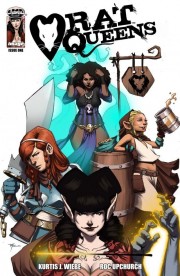
ratqueens

Written by Kurtis J. Wiebe

Drawn by Roc Upchurch

Published by Image Shadowline

Perhaps I wanted to like “Rat Queens” a bit more than I did. It’s a very good book, make no mistake. The art is gorgeous in an ultra-violent sort of way, the characters are interesting, diverse, and well-used, and the action is intense. But there’s just something about this comic that didn’t impress me as much as I hoped it would.

It sounds like I’m damning this book with faint praise, and I suppose I am. It is a gory, snarky ‘Swords and Sassery’ comic in the exact same vein as Jim Zubb and Edwin Huang’s ‘Skull Kickers.” Unfortunately, it doesn’t quite hit its beats as well.

The eponymous Rat Queens are a quartet of adventuring ladies in the familiar mold: Dwarf Fighter, Human Cleric, Elf Wizard, and Smidgen (I E Halfling) Rogue. They, and the rest of the adventuring parties, are causing a problem for the town of Palisade. All they do is drink and fight, and it’s hurting property values. When the local Captain sends them all out on quests to get them out of his hair, the Rat Queens soon discover that they’ve been set up, and assassins are on their trail.

The dialogue is snappy, filthy, and funny, but the plot is pretty bare-bones. It feels a bit too caught up in the conventions of a certain unnamed table-top Role Playing Game. While the comic starts out as a parody there comes a point where you’re not lamp-shading tropes, you’re just using them. I think that’s what disappoints me about this comic. It’s so gamey that it doesn’t have much weight to it, even when extras are being cut in half and stabbed in the eye. There’s not any real conflict in all this slaughter. I’d have liked the Rat Queens to have come up against something a bit more epic. This first volume is all random encounters.

I do like the fact that Wiebe and Upchurch really put some thought into the design and structure of the world, giving it a real multicultural feel without seeming as forced as the other aspects. The all-female team of adventurers is not presented as strange or even particularly transgressive in the world of the comic. This doesn’t just apply to gender roles, either. Race in Palisade means a bit more than white with pointed ears or white with a beard and a highlands accent. “Rat Queens” presents modern fantasy pulp perfectly by including modern gender and racial equality, and never even calling attention to itself for it. Diversity can be a touchy subject in science fiction and fantasy, with a small but vocal minority demanding the ‘authenticity’ of confirming a bias towards Straight, White and Male. The Rat Queens are here to kick ass and quaff ale, and they don’t care how much blood gets on their outfits. That’s really refreshing, if messy.

“Rat Queens” is a style-over-substance battlefield romp with four lady mercenaries who say ‘fuck.’ Quite a lot, actually. It’s not for kids, but it is an entertaining but character-sheet thin comic for adults. If you’re caught up on “Skull Kickers” and nostalgic for your multi-sided dice, “Rat Queens” might be the comic you’re looking for.


Bang! Biff! Pow! Justice League: War isn’t just for um, well, actually, who is this movie for? (Review)

Leave a comment

Let me begin by confessing that I have not read a single page of Justice League comics in the DC New 52. So I have no idea how accurate or off base “Justice League: War,” the new animated adaptation of the first arc is. Initial previews and reviews led me to believe that DC’s new direction just wasn’t my thing, and this movie did nothing to convince me to give them a second look.

The plot is rather thin and familiar. A group of well-known superheroes who don’t know each other discover something bad is about to happen. They slowly begin to gather to address the threat and do so just in time for an unstoppable alien army to jump through some portals in an American city. Towards the end of the film, their big bad leader shows up and they gang up on him. They find a way to close the portals and then the threat is suddenly over. The end.

It may not be fair to compare the film to the blockbuster live-action “Avengers,” since the comic “War” is based on appeared close to a year before that film was released, but the similarities are unavoidable. I just wish that “War” had borrowed a little bit of “Avengers” wit and charm.

The movie’s not all bad. The action is well animated, and although it can’t fully carry the ball, there are plenty of neat super-powered displays. I was actually shocked by the level of violence and profanity in this cartoon. The Justice League prevents Darkseid from using his Omega Beams by literally stabbing out his eyes. ‘Just like Oedipus!’ Wonder Woman exclaims when they hatch the plan. It’s the one smart bit of dialogue in a film that portrays these iconic characters as vulgar, petty jerks.

The depiction of characters is where this movie really falls flat. This movie has a cynical edge that it perhaps shares with ‘Man of Steel,’ portraying the public as distrustful ingrates and the heroes as the worst versions of themselves. The writers were going for more extreme, gritty versions, but unheroic, downright stupid, superheroes just leave a bad taste in my mouth. The dialog eschews cleverness for playground vulgarity, but if you really wanted to hear Green Lantern call Batman a douche bag, this is the animated film for you.

The film ends with the characters not having really learned anything, just left a pile of destruction in their wake. It left me with the question of who this adaptation was for? Fans of the New 52, presumably, but with such a high level of violence and vulgarity, it seems inappropriate for younger fans. Older fans like myself will find the thin story and unpleasant characterizations a pale shadow of the Bruce Timm and Dwayne McDuffie eras of DC Animation. I can’t recommend this movie.

The Legend of Zelda: A Link Between Worlds

Leave a comment

The Legend of Zelda: A Link Between Worlds


It has been said that Nintendo is a company stuck in the past. That they retread old ideas and characters, plying on nostalgia rather than innovation. And while there’s truth there, when they get it right, OH MAN do they get it right.

“The Legend of Zelda: A Link Between Worlds” is a 3DS sequel to the Super Nintendo’s “A Link to the Past.” Old School fans of the series will find the maps, designs and plot familiar. Mysterious figure arrives in Hyrule, is immediately revealed to be a bad guy, Link has to collect three pendants and the Master Sword to follow him to the other half of the game.

While it looks like “A Link to the Past’s” Dark World, the other section of the game takes place in Lorule, a more developed mirror kingdom complete with its own Princess and villagers. And Lorule is, for reasons that remain unclear until the end of the game, being torn apart.

Link can travel between the two dimensions using the game’s key new ability. Thanks to a magical bracelet he acquires early in the adventure, Link can change himself into a painting, and walk along walls. It’s a strange ability, and not particularly intuitive at first, but it is masterfully executed in the game, and provides a whole new set of puzzles to solve.

The other major change is that Link’s tools lack ammunition. Instead, Link has a stamina bar that slowly refills, and is shared by all of his rods, bombs, and ranged weapons. Link has access to most of his standard equipment very early in the game as well. This makes “A Link Between Worlds” a much less linear affair than previous games. Link has the ability to tackle dungeons in any order he likes.

The design of the dungeons is quite good, although some of the puzzle solutions felt a bit easy. Since the player has to do a lot less hunting for rupees and equipment, the game seems a bit short.

The artistic elements are reminiscent of the super nintendo, but trades sprites for nicely rendered 3d models. Although most of the game is seen from the top down, a few cut scenes switch to a perspective closer to the ground, and show off the 3DS’s horsepower. The actual 3d is possibly the best I’ve seen on the system. The terrain of Hyrule sinks into the screen, and enemies leap out. This is the first game where I honestly preferred to keep the 3d turned up the whole time.

“A Link Between Worlds” is a great game for players who are new to Zelda, and it rewards fans of the series with plenty of easter eggs, like Majora’s Mask, which can be found on the wall of Link’s House, but unfortunately, can’t be worn.

The game is a wonderful update on a classic, with an amazing twist ending. I highly recommend it.

Hugh Likes Comics: Amelia Cole and the Unknown World

Leave a comment

Image

Amelia Cole & the Unknown World

Written by D. J. Kirkbride and Adam P. Knave

Drawn by Nick Brokenshire.

Published by Monkeybrain (digital issues) and IDW (tpb collections)

Amelia is a magician with an unusual talent: Thanks to her Aunt and Mentor Dani, she can travel between the ‘magical’ and ‘non-magical’ world, and she has a habit of using her powers to stick her nose into matter that the police would rather she didn’t.

When the two start to merge, Dani sacrifices herself to seal them off again, and Amelia finds herself alone in a THIRD place she knew nothing about: A world where magic and technology exist side-by-side.

After she manages to settle in, however, Amelia finds out that the two aren’t exactly equal. Magicians have special status in addition to powers, and Amelia attracts the unwanted attention of “the Protector” after she uses magic to save ‘mundanes.’

“Amelia Cole” is a story about finding your place in the world, and doing the right thing. The story is fairly nuanced. Amelia’s vigilantism causes as much trouble as it solves, but she still doesn’t hesitate to do what she can. She’s a heroine that works by guts and instinct rather than a damsel in distress. Even The Protector isn’t all-bad, even if the system he works within wears him down to a core of anger and frustration.

Brokenshire’s art is a real winner. His crowds and cityscapes breath with life, and more than a few hidden easter-eggs that reward careful reading.  The designs for Amelia are great as well.  It’s sad how rarely we see a comic book heroine wearing actual clothes.

Amelia Cole and the Unknown world marks the first part of what will hopefully be a long series of adventures. Volume Two, Amelia Cole and the Hidden War, continues her adventures in the strange world she finds herself in, and I can’t wait.

Amelia Cole and the Unknown World is available digitally through Comixology, and in print from IDW.

Hugh Likes Comics: High Crimes

Leave a comment

Image

Written by Christopher Sebela

Art by Ibrahim Moustafa

Published by Monkey Brain Comics


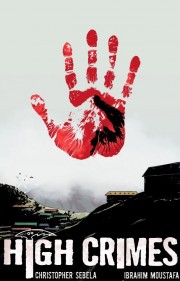
How far can you run from yourself? Zan Jansen was an Olympic snowboarder with a bright future ahead of her, until she fell and saw her chance at a gold medal slip away. After that, everything fell apart. She fled to Kathmandu, where she is drowning herself in substance abuse and guiding tourists up K2. But her real business is a bit darker than that. With the spike in adventure tourism, more and more people are climbing Mount Everest, and not all of them come back down.

When someone dies on the mountain, they are left where they fall. It is one of the hazards of the climb. So far Zan hasn’t climbed Everest. She is saving it. For her, climbing the summit is literally climbing out of the spiral she has put herself it. She says that she’ll climb Everest and keep going. But her boss has, and every time he goes up, he comes down with something someone left behind. A hand and what personal effects they carried. Once he identifies the corpse, he contacts the survivors, and offers to ship them back something to bury. For a fee, of course. It isn’t exactly illegal, but it is dirty work.

Of course, some things are meant to stay buried, and when her boss recovers the corpse of a black-ops government agent gone missing, things start to go very bad for her employer.

Moustafa’s art is fitting for this kind of noir piece. His figures are a bit stiff, but he takes some interesting risks, particularly with layout, that give the piece a nice atmosphere.

Sebela’s central characters are gritty and well defined. They feel like characters with history, and a lot of significant dialog feels unsaid. There’s a richness in what they don’t say, and that’s a tough trick to pull off in a twenty page comic.

I think that if there is a flaw in this comic, it is that the bad guys chasing Zan are a bit too cartoonishly evil. The secret military commander lacks a mustache to twirl when he shoots one of his minions in the face the second he asks a question, but he even goes so far to say that the person who has died ‘went rogue to protect the world from people like us.’

At a buck on Comixology, “High Crimes” is another Monkey Brain comic that really shows the potential of its creative team. It’s at least interesting, even if it might not reach the heights it is reaching for.

“High Crimes” is available from Comixology.

Hugh Likes Comics: The Top 5 of 2013

Leave a comment

Image

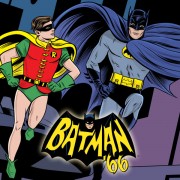
#5: Batman ’66: I like stories that go all-in. No pussy-footing around, not Super-Heroes-but-no-tights, which seems to be de-reguer, particularly at “The Big Two.” That’s why I was pleasantly surprised by this outing from writer Jeff Parker and artist Jonathan Case. They’ve returned to the source material of the ’60’s Batman TV show, complete with dancing and giant sound effect bubbles. The digital versions have a few more tricks up their sleeves to evoke the classic series. Batman ’66 embraces everything the New 52 disdains, and soars because of it.

Image

#4: Saga: Vaughan and Staples continued to knock it out of the park this year with Saga. The story of an ancient interstellar war cut with family drama, mercenaries, and the ways art can change a person make for a heady mix. The art remains evocative and controversial. Saga doesn’t pull its punches, but it isn’t crass, either.

DIG008301_2

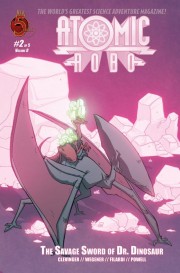
#3: Atomic Robo: The Savage Sword of Dr. Dinosaur: There was little chance for Clevenger and Wegener to escape this list as well, with this nail-biting installment that puts Atomic Robo at the site of an impossible underground city, with shadow military agents storming his headquarters, and completely unstable velociraptor mad scientist Dr. Dinosaur sitting on a stockpile of stolen nuclear warheads. Atomic Robo remains funnier and smarter than it has a right to be.

DIG010027_2

#2: Sandman Overture: We only got one issue of Neil Gaiman’s return to his seminal Byronic Dream King, but oh boy, was it ever a doozy. Filled with all of the gothic-horror elements that made Sandman great, and with exceptional art by G H Williams III, This comic is a rare treat for Morpheus fans. Hopefully, we’ll get to see it a bit more frequently in 2014.

DIG013410_1

#1: Young Avengers: Sadly ending in early 2014, Young Avengers is a comic that knows exactly what it wants and goes right for it. Under the direction of comics super-team Keiran Gillen and Jamie McKelvie, the Young Avengers bring a little bit of their indie hit “Phonogram” into the Marvel Universe. “Young Avengers” pits focuses less on what it means or takes to be a superhero than it does the trials and tribulations of modern teenagers. After a poorly planned bit of magic use, a group of teens find themselves fighting against an magical parasite that draws power from how parents don’t understand teenagers. It is a fantastic high-concept very well executed. Unfortunately, for a teen book, there is a lot of backstory for these characters that just isn’t given. I’ve felt in over my head a few times, but I’ve loved the ride. Another plus in this comic’s favor is that it has possibly the highest collection of LGBTQ characters anywhere in ‘the big two,’ and handles them with then same excellent touch as earlier Young Avengers installments.

2013 No-Prize: Dan Didio continues to be comics’ greatest super-villain. He spent the year making sure no DC Comics characters have any fun on his watch. After denying the upcoming marriage of Batwoman Kate Kane, he went on to say that none of DC’s heroes should have a stable home life, and seems to be making certain of it. His crowning achievement this year: Creating an art contest for Harley Quinn #0 which included drawing the beloved children’s TV character naked, despairing, and about to commit suicide. After much outcry, the panel did not appear in the final version.

Honorable mentions:

X-Men: Teenage Mom Jubilee, enough time-travelers to stage a production of “Les Mis” and other crazy nonsense. Marvel seemed to focus on their movie-friendly characters like the Avengers in 2013, but there was still a ton of mutants out there, including an all-female team!

Edison Rex: Artist Dennis Culver gets the nod for designing not just a new set of comics characters, but an entire major publisher’s line-up of heroes and villains. My personal favorite: ROFL, an omnipotent extra-dimensional being using the form of a muppet Grant Morrison.

Subatomic Party Girls: Simms and Bowers had the stones to use the line ‘Do you realize we’re floating in space’ unironically. Props.


Megaman I: Elegance in Design

Leave a comment

System: Nintendo NES/Famicom

Release Date: 1987

Megaman’s creator, Keiji Inafune recently funded a kickstarter for his new independent project, Mighty Number 9. Inspired by the buzz surrounding the new project, I went back and looked at the Blue Bomber’s original adventure with new eyes.

I didn’t have “Megaman” for my NES, but lots of my friends did, and I remember the games fondly from the early nineties. I also recall them being controller-threateningly difficult. I was curious to see how the first outing would stack up to my memories.

First of all, it is worth noting that the first game lacks the graphical and musical polish of the sequels. There are only six stages, and once the player determines the proper order for playing them, they fall rather quickly. Especially if you use the well-known ‘pause trick.’ Likewise, there’s not much of a story besides ‘You’re a good robot, they’re evil robots, go fight them.’ It’s the sort of fare from the era that is simple, but has been expanded upon greatly in the years since. For example, in the much-praised Megaman comic, put out by Archie Comics.

While I will agree that Megaman is hard, it was not quite so bad as I remember. Aside from a few of the end stage bosses, (and I am looking squarely at you, one-eyed rock monster) the deaths don’t feel cheap. Unlike other 8-bit era platformers, there is no countdown clock. The game gives you plenty of time to observe and experiment. Megaman really is the start of what later-generation indie developers would call ‘puzzle platformers.’ Most of the game can be best progressed by observing the challenge and discovering the pattern, or choosing the best Robot Master’s subweapon for the situation. For example, the flying torpedo enemies can often knock you into a pit when they explode, but freezing them rather than shooting them with your regular gun solves the dilemma. Most of the jumping puzzles can likewise be bypassed with the Magnet Beam.

This creates an odd challenge curve as the game actually gets EASIER as you gain new powers. The game’s non-linear nature lets you play the stages in any order, but the real challenge is figuring out an optimal path. each Robot Master has a weakness, and some levels, such as Fire Man’s stage, are practically impassable without the right weapon.

All in all, Megaman I is a solid entry in the NES’s roster of games. While its sprites and textures are a little less eye-popping than its successors, it is at the very least noteworthy for being the progenitor of something great, and a whole lot of fun. You don’t need to play it to get into the series, as there isn’t much of a story aside from the window-dressing standard to that generation, but it is certainly worth your time. Just watch out for those disappearing block puzzles.

Otakon 2013: Day One

Leave a comment

Otakon is one of the conventions I’ve been going to the longest, and with attendance of over 30,000 people, it’s certainly the biggest one I’ve been to so far. It takes over the Baltimore Convention Center, and most of the harbor, for three days every summer. In spite of it’s size, unlike the other big conventions on the East Coast like Dragon*Con and NY Comicon, it is devoted entirely to Anime and Asian culture.

I first attended Otakon in 2004, and although I have missed it once or twice, I’ve been back almost every year since. I particularly enjoy Otakon because it is for a medium I’m not trying to make an eventual living in. Balticon is great fun, but in a lot of ways, I’m still working the whole time I’m there. I’m making contacts, learning new techniques, and hunting for trade secrets in addition to spending time with all my friends from twitter. But Otakon is a chance to fully relax and enjoy the spectacle. So with that being said, let’s begin this year’s review of the show! I packed in so much this year, I’m going to go through it day by day.

Day one was my day to really watch new anime, and was filled to the brim. I watched some new things, some old things, and even a US Premier movie!

First up: “Occult Academy.” This might be my favorite series from the convention. When a teenage girl’s father dies under mysterious circumstances, she inherits the private school he owned, which is famous for its study of supernatural phenomena. But his obsession with the occult drove her parents apart, and she ‘hates the occult.’ Beset with the supernatural, a scheming faculty, and a time-traveler sent back to prevent an apocalypse centered around the school, can she save the world and find her father’s killer?

I really liked this series. It is made up of a nice blend of comedy and drama, and is centered around a tough, capable heroine who isn’t reduced to a sex object or damsel in distress in the face of the monsters. This series is on the Crunchy Roll anime streaming service, and I’m adding it to my pile to watch.

“A Certain Scientific Railgun” Fewer railguns, and much less scientific than I was expecting, but this is a slice-of-life comedy or sorts that is not without its charms. A companion piece to an apparently much more dramatic series called “A Certain Magical Index,” which I have not seen, the series is set in a futuristic city where 80% of the residents are boarding school students, and most of them have unusual ‘Esper’ talents. The Railgun of the title refers to the main character, a powerful esper girl with psycho-electric powers who can launch 100 yen coins like a railgun. She has a penchant for vigilante justice, which exasperates her roommate, who is a member of a school-based local law enforcement agency. I have no idea how that works, by the way. Anime, I guess?

As action-packed as the description sounds, most of the series involves the relationships between the two main characters and their friends. The series has a fan-servicey vibe with extremely heavy lesbian undertones, and while it was funny, I felt like a dirty old man watching these supposedly teenage girls engage in that kind of ‘horseplay.’ It was fun, but I won’t be looking for it on DVD.

“Hanasaku Iroha-Blossoms For Tomorrow” This is another slice-of-life show revolving around a teenage girl, but this one was much more grounded in reality. When a 16-year-old’s mother runs off with her boyfriend, she moves from Tokyo to her grandmother’s distant onsen. But in addition to dealing with her mother’s abandonment and moving to the small town, her grandmother, who she has never met before, expects her to work for her room and board.

This is a cute series that was far less maudlin than I had expected. The animation is high-quality, and the depiction of life at a Japanese inn was very interesting, as I stayed in one while teaching in Japan myself. I believe this is also on Crunchy Roll, and I will probably watch more of it later.

“Evangelion 3.0: You Can (NOT) Redo” Perhaps I should have rewatched the second Evangelion movie before coming to see this one, because I was a bit lost for some of the movie, but if you’ve seen any of the previous incarnations, you should be alright. The thing I liked about the first two movies is that as a necessity of run time, they cut out a lot of Shinji’s reluctance and depression. This movie, well, it’s mostly that, actually. Set 14 years after the second movie, Shinji unwittingly triggered 3rd Impact after trying to save Rei Ayanami, and now he is caught between NERV and anti-NERV organization WILLE. If he pilots an EVA again, he might be able to restore the world, or make a new one, but he could also trigger a devastating FOURTH Impact which would fully destroy the world.

So Shinji is still a terrible character, followed by worst father of all-time Gendo Ikari, but this movie had a space-ship made out of EVAs captained by Misato, (in the requisite amazing hat and giant sunglasses) so it still evens out at ‘pretty cool,’ although the movie series has finally caught up to the ‘makes no damn sense’ arc of the original TV series.

“Space Adventure Cobra” More “Star Wars” than “Star Wars” is possibly the best way to describe this early-80’s space opera movie. A lost cousin of Kirk and Solo, the main character, who’s arm turns into the dreaded “Psycho-Gun” macks on telepathic alien princesses, fights his way through a flying prison, and joins up with a platoon of female revolutionaries on rocket-powered snowboards called “Snow Gorilla.” It’s awesome, while never taking itself too seriously. The movie is also a clear influence on later anime heroes like “Vash the Stampede.”

And that’s all I did on day one of the convention. Stay tuned for Wuxia Detective films, anime music videos, and the surprising popularity of cereal-themed video games.

Older Entries Newer Entries