Home

Leave a comment

Last Saturday was Free Comic Book Day!  I stopped in at Haley’s Comics, my local shop, and picked up a few of the plethora of titles on offer.  Here’s what I thought:

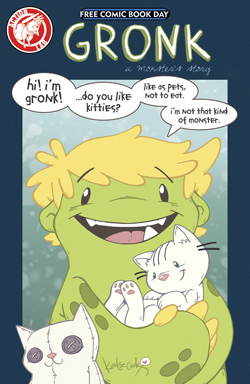
Gronk: A Monster’s Story, written and drawn by Katie Cook
FCBDGronk
This was a cute all-ages monster comic from the publisher of the outstanding “Princeless.”  It was certainly adorable and clever, with a little bit of snark thrown in.  The backup story featured talking house cats fighting robots, so it had that going for it.  It looks like a great book for younger readers.
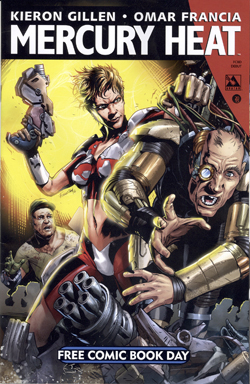
Mercury Heat, written by Kieron Gillen and drawn by Omar Francia
FCBDMercury
At the exact opposite end, we have this gritty cyborg cop drama set on the inner-most planet.  I’m pretty much onboard for any of Gillen’s projects, but the art on this one is slick and the relatively simple bust presented in the comic has a lot of intriguing world building behind it.  It certainly has the first ultra-violent cop protagonist I’ve ever seen that claims “Murder She Wrote” as a defining influence.  I’ll be picking up the series proper when it starts in July.
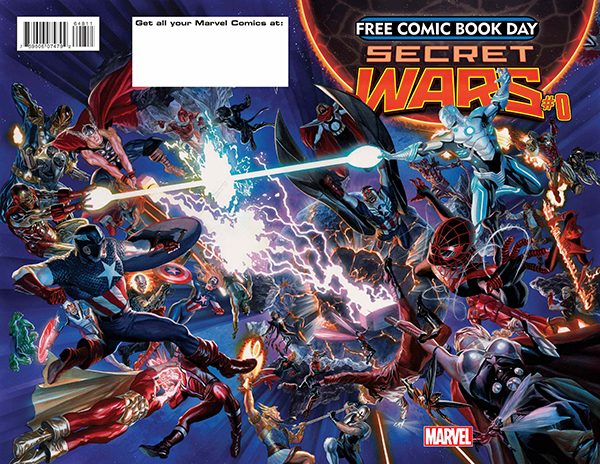
Secret Wars #0, written by Jonathan Hickman and drawn by paul Renaud
FCBDSecretwars
A preview of Marvel’s big summer event, the story is a meeting between a bunch of super-genius children, the Future Foundation, recapping what led up to the potential end of the world, and trying to build an arc to survive it.  I still have no idea what’s happening, but the backup story, an imagined fight between the Avengers and the man-eating anime giants from “Attack on Titan” is a hoot.
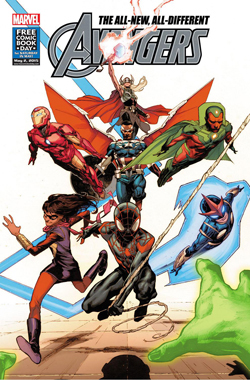
All-New, All-Different Avengers, written by Mark Waid and drawn by Mahmud Asrar
FCBDAvengers
The last of the four free books, this is apparently a look at the post-Secret Wars Avengers team.  And I can’t wait for it.  Rather than playing it safe, Waid is constructing a team built of all the new and legacy characters that have made waves in the last few years.  Led by the new Captain America, (formerly the Falcon,) the team includes Ms. Marvel (Kamala Khan,) Spider-Man (Miles Morales,) and the new lady Thor.  It’s a short story about the three new teenage members attempting to stop a bank robbery and learning a lesson about what the team means.  It’s a little schmaltzy, but I’m certainly interested in the series when it comes out this fall.
In addition to physical books, free comics were also available through Comixology, including an “Atomic Robo” story which I won’t spoil, but includes Dr. Dinosaur being his usual insane self, and is my pick of the small collection of the books I was able to sample this year.

Hugh Likes Comics: Superman Birthright

Leave a comment

Superman Brithright
Written by Mark Waid
Drawn by Lenil Francis Yu
Published by DC Comics
supermanbirthright
The retelling of a superhero’s origin story really only works if the writer and artist truly ‘get’ the character.  Extraneous details can weigh the character down, and updated elements can seem forced.  Fortunately, that isn’t the case with “Superman Birthright,” Mark Waid and Lenil Francis Yu’s take on the origin of the Man of Steel.
Originally published in 2003, this graphic novel served as an inspiration for 2013’s “Man of Steel” film, but don’t hold that against it.  This comic soars where the movie feels heavy and grim.
The comic starts out much like the film, with Clark Kent traveling around the world looking for a sense of identity.  Clark feels that his powers separate him from humanity, and he looks for a way to both live among humans and use his powers to do good.  With the help of his parents, he prepares his alter-ego and takes a job at the Daily Planet in Metropolis.  As he struggles to establish himself both as a journalist and a superhero, he quickly comes into conflict with the brilliant but twisted Lex Luthor.  This is the heart of the story, and it is handled masterfully.  This version of Lex is an astro-biologist exhaustedly hunting for intelligent alien life.  Clark briefly knew Lex when they were teenagers.  Clark was his only friend when Lex’s prodigious intellect, and accompanying ego, separated him from his classmates.
The two meet again, and their meeting as adults goes just as poorly.  Lex is an exceptional man looking for an equal among the stars, but Superman is disgusted by his actions.  This is a great modernization of the basic plot of a Superman comic, and is typical of Waid’s treatment of the characters and their motivations.
Motivation is the key to “Birthright.”  The reader knows what Superman does.  This retelling cements why he does it, and how the people of Metropolis react to it.  Fear of the unknown, both ‘out there’ and inside ourselves is a central theme.  How the characters each react to it is what makes them special.
Yu’s designs are also great, and the comic does a great job of making these seventy year old icons breathe in a modern context.
“Superman Birthright” is available as a graphic novel from Amazon, Comixology, or your local comics shop.
Patreon

Hugh Likes Comics: The Unbeatable Squirrel Girl

1 Comment

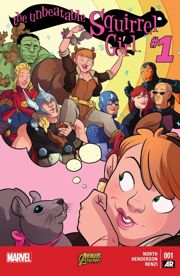
The Unbeatable Squirrel Girl #1
Written by Ryan North
Drawn by Erica Henderson
Published by Marvel Comics
squirrelgirl1
Some comics are meant to amaze.  They sculpt years of storytelling continuity into jaw-dropping moments of greatness.  Some comics are meant to shock, taking familiar tropes or safe concepts and turning them on their head by framing them in the harsh light of gritty realism.
And some comics are just plain fun.  I suspect “The Unbeatable Squirrel Girl” falls into the third category.  The eponymous S G is Doreen Green, a jokey Z-lister with the a fluffy tail, a prominent overbite, and the proportional strength and speed of a squirrel.  She also has no idea how to operate outside of the superhero mode, which is about to make her first day of college very interesting.
Written by Dinosaur Comics creator Ryan North and drawn by indie artist Erica Henderson, this book will feel familiar to anyone familiar with their work.  It’s a light, breezy tale filled with misappropriated superhero theme songs, squirrel (fish) out of water humor, and even alt text printed on the bottom of each page.  Even the art has a softer, more cartoonish quality that lends itself well to North’s wacky script.  This isn’t going to be one of those comics that changes everything, but it was a lot of fun, and I can’t wait to see what kind of trouble Doreen and her pet squirrel/sidekick Tiptoe get into with her cat-obsessed roommate, oh, and it looks like she might have to save the world after all, too.
The Unbeatable Squirrel Girl is available from Comixology or your local comics shop.

Hugh Likes Comics: Usagi Yojimbo

Leave a comment

Usagi

Usagi Yojimbo Omnibus Volume 1
Script and Art by Stan Sakai
Published by Dark Horse Comics

Usagi Yojimbo is kind of a difficult comic to classify in terms of age appropriateness.  As a samurai pulp, it is certainly the most accessible to a western audience of the comics I’ve discussed so far.  It lacks the gore and explicit content of “Lone Wolf and Cub,” and its setting is simpler than “Rurouni Kenshin’s” historical period.  At first glance, the cartoonish talking animal characters make it seem perfect for younger kids.  The first story in this collection even features a guest appearance by the Teenage Mutant Ninja Turtles.  But there is something nonetheless unflinching in Sakai’s tales of the long-eared wandering swordsman that resonates with the stark realities of Japan’s Shogunate period.
Although this collection is labeled as “volume one,” this collection actually contains parts  eight through ten of the series, which is the point where Dark Horse began to publish the collected volumes.  Although a great deal of backstory is referenced at times, Sakai is very good at bringing the reader up to speed quickly, and I never felt lost.
Following Miyamoto Usagi as he wanders the countryside, the stories in his collection are picaresque adventures that flow organically, and build slowly upon one another.  They don’t reach a climax in this volume, but I am quite curious about where Usagi ends up.  These stories are by turns exciting, heartwarming, and sad, and they are filled with a sense of wonder and reverence for Japanese culture and traditions.  Even though he is of the Samurai class, Usagi’s humility and genuine desire to connect with other people allow him to enter a variety of stories, from a widow struggling to avenge her husband’s death on the gambler responsible to an exploration of traditional seaweed farming.
The varied nature of the stories is delightful, but parents might want to read through first, or read with their children to be able to answer some of the difficult issues sometimes raised by this comic.  One of the most moving, but also difficult to read stories in this collection is entitled “Noodles.”  The story of a mute soba seller and his performer/pickpocket companion, it deals with some very heavy subjects, including justice, or the lack thereof, the rights of the disabled, and capital punishment.  While the conclusion to that story is satisfying, it is the darkest point in the book, and it was hard for me to get through as an adult.
Sakai’s art is superlative.  His style is at once a blend of  Carl Barks and Goseki Kojima and something entirely his own, and it is breathtaking.  His attention to detail, and his deft depiction of samurai fighting that doesn’t dip into gory self-indulgence is wonderful, and keeps  the stories moving while lending them a timeless atmosphere.
Usagi Yojimbo is an excellent comic for readers new to the genre, or for anyone with an interest in Japanese culture.  You can find the first volume on Amazon, or at your local comics shop.

Hugh Likes Comics: Lone Wolf and Cub

Leave a comment

Lone Wolf and Cub Volume One:  The Assassin’s Road

Written by Kazuo Koike

Drawn by Goseki Kojima

Published by Dark Horse Comics (English Version)

Originally published in Japan in 1970, “Lone Wolf and Cub” is a seminal document of Japanese Comics (Manga). The story of an executioner turned assassin in 16th century Japan was hugely popular, becoming a best-seller and spawning a series of films, two television series, and inspiring artists and writers in Japan and around the world. Partially translated and released in the US in the 1980’s, it was not fully collected in English until Dark Horse Comics began releasing volumes in 2000.

Ogami Itto was the Shogun’s chief executioner until the treachery of the rival Yagyu clan robbed him of his position and sentenced him to sepuku. In defiance of the Shogun, Ogami became an assassin living in “Meifumado,” the Way of Demons.” He takes his only living family member, his infant son Daigoro, with him in his quest for vengeance. As such, he is called “Lone Wolf and Cub,” a peerless killer who will take on any mission for five hundred Ryo.

“Lone Wolf and Cub” is an epic story collected over twenty-eight volumes, but each volume is picaresque, discribing specific assassinations or encounters Itto and Daigoro have on their journey. Deeply beautiful and starkly violent, these stories are quintessential Japanese pulp. Like Ogami himself, they are a paradox. At once noble and at the same time murderous, they celebrate Japan’s Zen Buddhist warrior traditions while standing apart from them.

Koike’s writing details the lives of noble samurai, struggling peasants, and suffering prostitutes with a historian’s careful eye. Kojima’s work evokes Japan’s greatest artistic traditions. This is a manga where ultra-violence and gratuitous nudity are positioned directly beside deep philosophical questions and breathtaking landscapes.

“Lone Wolf and Cub” is not a comic for kids, and it may not be everyone’s cup of tea, but Volume One features nine stories of samurai action that perfectly introduces the reader to the soul of Koike and Kojima’s groundbreaking work. It was an important step in my own appreciation of the medium, and it is a great place to start if you’d like something a bit more serious in your comics reading.

Lone Wolf and Cub Vol. 1 is available digitally, in print from Amazon, or from your local comics shop.

Hugh Likes Comics: Wolverine

Leave a comment

Wolverine

Written by Chris Claremont
Drawn by Frank Miller
Published by Marvel Comics

Love him or hate him, Wolverine is one of the most popular and exposed characters in Marvel’s stable of heroes.  And with the publisher set to kill him for a while, I thought it was time to take a look at the limited series that really cemented his character.
It’s easy to see why this comic was so groundbreaking.  Right off the bat, it establishes Wolverine as a much darker, more badass character than his taciturn, volatile persona on the X-Men.  This is Wolverine in his element, and that means hunting bears and fighting hordes of ninja.  After spending some time in the deep woods of Canada, Logan discovers that his letters to his girlfriend, Japanese dignitary Mariko Yashida have been returned unopened, and that she has left the US.  Wolverine follows her to back to Japan.  There, he discovers that her father, a presumed deceased crime lord, has returned, and that Mariko has been married to one of his lieutenants.
After being rolled by Yashida in a fight which would have killed him if not for his mutant powers, Logan is rescued by Yukio, a hedonistic assassin who is playing games of her own.
“Wolverine” is Claremont writing at the peak of his craft.  Unrestrained by the team dynamic and superhero tropes of the ongoing X-Men comic, he really digs down into Wolverine’s character.  This isn’t just four-color antics, but a rich, pulpy story about honor, appearances, and the nuances of a world shaded in gray.  And being drawn by a Frank Miller just coming into his own as an artist elevates the comic to a classic.
Delivering a gritty comic is harder than taking a cape and rolling in the mud for a little bit.  It’s something that has to be carefully structured.  The pieces all need to support each other in a way that the reader both can believe and doesn’t expect.  “Wolverine” delivers by revealing a deeper, darker world in the periphery of one the reader already knows.  It shows a midnight underworld hidden behind an upstanding daylight face.  And it does it beautifully.  Miller’s Japan is a labyrinth of towering yet indistinct skyscrapers, with scores of ninja hiding in every alley.  It echoes and reinforces the script beautifully.  Miller echoes seminal Japanese artist Goseki Kojima in this story of corruption hiding within the Yashida clan’s adherence to tradition, and one warrior willing to abandon all pretexts to expose the truth.
In graphic story telling, especially when a writer and an artist are both masters of their craft, the finished product can seem at odds with itself.  The words can be sharp and engaging.  The art can be beautiful, but they need to work together to properly tell a story like this.  Here, Claremont and Miller’s efforts are a synthesis that is greater than the whole of its parts.
The Wolverine is available from Amazon, Comixology, or your local comic shop.

Hugh Likes Comics: The Infinity Gauntlet

Leave a comment

Infinity gauntlet

Written by:  Jim Starlin
Drawn by: George Perez
Published by Marvel Comics

As a rule, I really don’t like crossovers.  They’re messy, over-crowded affairs where heroes act out of character to fit the story, and their endings tend to be unsatisfying piles of continuity.  Event full of sound and fury where “everything changes” but at the end of the story, everything is pretty much back where they were.  Oh, she might be in a different costume and he might have been replaced with his sidekick, who looks the same except for the cybernetic arm.  The status quo remains king.
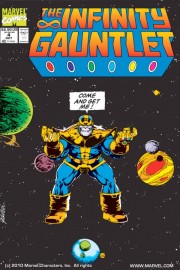
And then there’s “The Infinity Gauntlet.”  This is the one that got it right.  It’s a threat that is based off of years of continuity, but clear enough that one doesn’t need to invest a college savings in back issues to know who’s who.  It’s a threat that is credible, active, and present, not only for the heroes, but for the entire fictional universe.  A threat that is credible enough to not only bring the Marvel Universe together, but also put their backs against the wall.
It also manages to balance character study and knock-down, drag-out, cosmic-level fighting.  In the first issue, Thanos, elevated to genuine omnipotence thanks to the eponymous gauntlet, snuffs out half the life in the universe.  He does this because it turns out that he’d like to hook up with the Universe’s personification of Death.  Death is, naturally, a hot lady, because Comics.  Unfortunately, all of his god-like power fails to catch her eye.  Having gained unmatched power, and being unable to effectively use it is the core of Thanos’s character, and it is an interesting contrast to the surviving heroes and villains, who are left with the task of fighting a hopeless battle against the Mad Titan.
The climax of the series is a fight where he faces of and wins against first every hero in the Marvel Universe, and then the super powerful Cosmic Forces.  It gets a bit metaphysical, but the thread of the story never gets lost, and Perez’s expressionistic art captures it all perfectly.
The Infinity Gauntlet isn’t just a cheap cash in.  It is the basis for twenty years of comics storytelling, and possibly the endgame Marvel’s cinematic universe is heading towards.  Even if you have no interest in those things, it is the Platonic Ideal of a Marvel comic.  A story of superhuman power filtered by the lens of the most human emotions.
The Infinity Gauntlet is available from Comixology, Amazon, or Your Local Comics Shop.

Hugh Likes Comics: Dragon Ball

Leave a comment

Hugh Likes Comics:  Dragon Ball
Written and Drawn by Akira Toriyama
Published by Viz/Shonen Jump

Although it is a big part of my own path through comics, I haven’t talked about manga in this space.  Manga, broadly speaking, refers to Japanese comics, or occasionally comics drawn in a Japanese style.  These comics have a visual language all their own, enjoy vast popularity the world over, and one of the best loved of these is “Dragon Ball.”
Spanning over forty volumes, spawning four long-running animated TV shows, a vast collection of movies, and enough merchandize to sink a container ship, Akira Toriyama’s “Dragon Ball” is a full-fledged cultural phenomenon.  Originally a goofy, cartoonish Sci-Fi retelling of the Monkey King legend, this is the story of Son Goku, an incredibly strong, perfectly innocent child as he travels with teenage prodigy Bulma to gather the Dragon Balls, seven mystical stones which, when brought together, will grant any one wish.  Along the way, he becomes the greatest martial artist in the universe, and saves the world a few times, to boot.
With its beyond epic length, the thing I find really interesting about Dragon Ball is that it so completely documents the evolution of Toriyama as an artist.  His style is very round and iconic, and at the beginning of the comic, much more rooted in sophomoric humor.  It certainly isn’t what you’d expect from the martial-arts action story it becomes.  While Toriyama never completely lets go of his comedic side, the series becomes more and more of an action comic as the tale unfolds, until we reach halfway through and it becomes “Dragon Ball Z.”
With its focus on space adventure and over the top martial arts, DBZ is what got translated first.  It appeared in incomplete forms on American and Canadian TV in the 90’s.  And I fell in love with it.  But now I think I prefer the original stories about Goku’s childhood.  The adventures are more fun, more playful, and less reliant on gimmicks and ‘power levels’ to keep the tension high.  “Dragon Ball,” by contrast, remains delightful and ridiculous throughout, including a cameo crossover with his earlier work “Dr. Slump,” in which just about every character tries to squeeze into a panel for a fourth-wall breaking cameo.
“Dragon Ball” comic is particularly a comic of its time and place, but like its protagonist, it mixes goofball humor, iconic visual style, and thrilling action in perfect amounts with a perfect garnish of child-like whimsy.  Go pick up a copy, and be a kid again for a few hours.

Dragon Ball on Amazon.com (Affiliate Link)

Dragon Ball on Comixology.com


Hugh Likes Comics: Batman The Long Halloween

Leave a comment

Image


Written by Jeph Loeb

Drawn by Tim Sale

Published by DC Comics


With summer movie season already begun and a host of superhero comic book adaptations leading the pack, it is time for Hugh Likes Comics to embrace the trend and give you some hop on points for Big-2 Superheroes. These characters have long, tangled pasts, and their stories are far too often are an impenetrable soup of references, call backs, and retcons. So for the summer, I’ll be discussing some of my favorite, and most accessible stories from Marvel and DC Comics. Since we just got a lovely image of Ben Afleck moping next to his rocket car for “Batman vs. Superman,” let’s start with the Dark Knight.

In a Gotham City ruled by Organized Crime, a young Batman teams up with Commissioner Gordon and D. A. Harvey Dent. But they aren’t the only trying to bring down the mafia. Criminally insane Freaks like the Joker and Poison Ivy are muscling in, and a serial killer dubbed “Holiday” has begun killing gangsters, each on a major holiday. Can Batman truly complete the task he’s given himself, or is Gotham city doomed to be cut in half by Organized Crime and random violence?

First of all, let me start this review with a confession: I like this graphic novel better than it’s predecessor, Frank Miller and David Mazzucchelli’s groundbreaking “Batman: Year One.” “Year One” is a GREAT story, and a wonderfully gritty depiction of the kind of city that made Batman not only possible, but necessary. But “The Long Halloween” is a noir mystery filled references to “The Godfather” that ends with Batman fighting his entire rogues gallery at once, so it wins out.

Year One is an engaging look at how Jim Gordon and Bruce Wayne came to be who they are. The Long Halloween boils that origin down to a single sentence: “I made a promise to my parents that I would rid the city of the evil that took their lives.” It doesn’t get simpler than that. And as reductive as the set-up is, the book is actually a nice character driven piece about the human cost of working towards goals. Relationships get shredded by the weight of these personal quests. Jim Gordon’s relationship with his family. Harvey Dent and his wife Gilda. Even The Roman’s relationship with his children is deeply affected by his work. And then there’s Batman and Catwoman. Their relationship is extremely complicated, both in costume, and out of costume. It lends the noir elements significant weight.

But one thing that this comic does, and does really well, is temper that weight with super-heroic sections. The focus of the book is the Holiday mystery, but Batman still has to contend with The Joker, Poison Ivy, Solomon Grundy, and the rest of his villains. In a lesser run of comics, the change would be abrupt, and flow breaking. “I can’t look for clues today, The Joker is robbing that bank!” But here, everything flows naturally. The colorful characters are all weaved like brocade into the black fabric of the noir mystery. For example, at one point, Batman chases a fleeing buttonman into the sewers, where he accidental fumbles into the lair of Solomon Grundy. Later, the Falcone family brings in the riddler as a consultant, green suit and all, to help solve the murders. Instead of being asides, these sections lend a depth to Gotham City, and raising the stakes. It evokes the best parts of my introduction to the characters, Batman: The Animated Series.

Sale’s art, and Gregory Wright’s colors, bring the story to life. There’s a rich, velvety darkness to Sale’s Gotham City. The page layouts are also really well done. The book is filled with gorgeous splash pages, and Sale really knows how to guide the eye and build tension. A great deal of imagery from this book was included in Christopher Nolan’s “Dark Knight” film.

“Batman: The Long Halloween” is the perfect graphic novel for readers who want to see the World’s Greatest Detective tackle an engaging mystery and fight crazy villains without wading through 75 years of canon.  It can be found at your Local Comics Shop, or purchased digitally through Comixolgy!

Next week: The Astonishing X-Men!


Hugh Likes Comics: Loki, Agent of Asgard

Leave a comment

Image

Written by: Al Ewing

Drawn by: Lee Garbett

Published by Marvel Comics

Loki’s had a strange time of it lately in the Marvel Universe. He’s died, come back to life, co-starred in a few hit movies you might have seen, and was even on a team of (Young) Avengers. Now Marvel has given him his own series, and it’s great stuff.

As a God of Lies and Mischief, Loki understands the power of stories better than anybody, and there is a lot of information floating around about Loki’s past. That past could destroy him if he’s not careful, so he’d like to take it back. The only ones powerful enough to expunge his record is the All-Mother, a trio of ruling goddesses. So Loki’s out in the world working for them doing what he does best: making mischief.

This is a very modern take on an old character, and I love it. It’s written with fans of the movies in mind, but it reminds me a lot more of one of my favorite books, American Gods by Neil Gaiman. Forced to interact more closely with the modern world, Ewing’s Loki feels much closer to his mythical roots than Lee and Kirby’s God of Evil.

It helps that Ewing’s take springs right out of Young Avengers Vol. 3, which was my favorite comic of last year. Loki’s smart, clever, and more than a bit mysterious. He’s out robbing casinos, climbing Avengers Tower with his Seven-League Boots, and even going speed dating! My favorite bit is a spot of panels where someone sees Loki in his Asgardian clothes and asks if he came from a Con. He smiles and says “There’s always a con going on somewhere.” This comic is pure fun.

Garbett’s art is great as well, with beautiful colors by Nolan Woodard. Everything looks, well, magical, with clear but stylish layouts and splash pages. There is a bit in the third issue where Loki travels magically, and actually crosses through the gutters. It is a very cool effect.

This is a series full of myths, mystery, cleverness, and a joy. Loki’s got a plan, and it looks like it’s going to bring him into the crosshairs of ancient hero Sigurd. I can’t wait to see what the Trickster’s got up his sleeve.

Loki Agent of Asgard 1-3 is available from Your Local Comics Shop, and digitally from Comixology. And don’t forget, Saturday May 3rd is FREE COMIC BOOK DAY!

Older Entries Newer Entries