The End has come for the Marvel Universe. Through events too complicated and not actually relevant here, the arcane fictional multiverse has come to an end. But there were some survivors. On a single planet, tiny slivers of these dead Earths remain, ruled with god-like power by Victor Von Doom.
This is the short version of the premise for Marvel’s big summer crossover, “Secret Wars.” The main story follows Doom, Dr. Strange and their allies as they try and keep their last light stable in the face of internal strife and unexpected visitors. It certainly is interesting to see Dr. Doom remake the world in the image of his Game of Thrones fanfic. It even comes complete with scheming baronies and an epic, continent-long wall. But the real draw is the diverse and imaginative Battleworld tie-ins.
Marvel used to have a non-canon series called “What if?” where writers imagined what would happen if famous storylines had played out differently. Freed from the shackles of continuity, creators were able to tell any stories they wished, without having to ensure the characters all maintained the status-quo.
Battleworld feels like a vast series of these what-ifs, all playing out at once on one huge world. And while it looks like the world will be back to some semblance of normal in a few months, these stories are fascinating while they last. The sheer breadth of stories to choose from ensures that there is something for every reader. Want to watch a team of tough Lady-Avengers punch out sharks? There’s a title for that. Want to see SHIELD fight an inexorable tide of zombies, robots, and Kirby-style monsters? There’s one for that. Want to read a gritty murder mystery where all the cops are Thor? Bam. Want to see an extension of every big X-Men crossover or alternate reality since Days of Future Past? Battleworld has you covered, all while slowly building towards Secret Wars’ climax.
The writing and art from each book differs, but with so many to choose from, chances are there will be something to suit your taste. It looks like the world will come back and everything will go back to normal in a month or two. But until then, visit your local comics shop, pick something that interests you, and settle in. It’ll be a heck of a ride.
Hugh Likes Comics: Battleworld!
September 9, 2015
Hugh Likes Comics Battleworld, HLC, Hugh Likes Comics, Marvel, review Leave a comment
May 6, 2015
Hugh Likes Comics, Reviews FCBD, HLC, Hugh Likes Comics, review Leave a comment
Last Saturday was Free Comic Book Day! I stopped in at Haley’s Comics, my local shop, and picked up a few of the plethora of titles on offer. Here’s what I thought:
Gronk: A Monster’s Story, written and drawn by Katie Cook
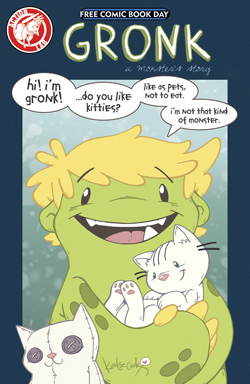
This was a cute all-ages monster comic from the publisher of the outstanding “Princeless.” It was certainly adorable and clever, with a little bit of snark thrown in. The backup story featured talking house cats fighting robots, so it had that going for it. It looks like a great book for younger readers.
Mercury Heat, written by Kieron Gillen and drawn by Omar Francia
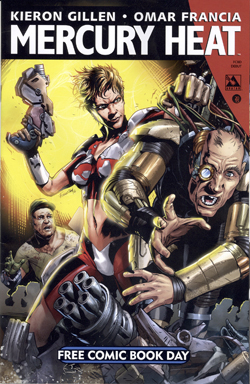
At the exact opposite end, we have this gritty cyborg cop drama set on the inner-most planet. I’m pretty much onboard for any of Gillen’s projects, but the art on this one is slick and the relatively simple bust presented in the comic has a lot of intriguing world building behind it. It certainly has the first ultra-violent cop protagonist I’ve ever seen that claims “Murder She Wrote” as a defining influence. I’ll be picking up the series proper when it starts in July.
Secret Wars #0, written by Jonathan Hickman and drawn by paul Renaud
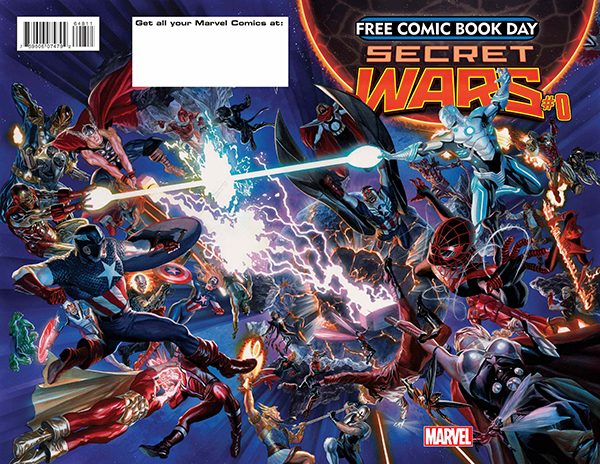
A preview of Marvel’s big summer event, the story is a meeting between a bunch of super-genius children, the Future Foundation, recapping what led up to the potential end of the world, and trying to build an arc to survive it. I still have no idea what’s happening, but the backup story, an imagined fight between the Avengers and the man-eating anime giants from “Attack on Titan” is a hoot.
All-New, All-Different Avengers, written by Mark Waid and drawn by Mahmud Asrar
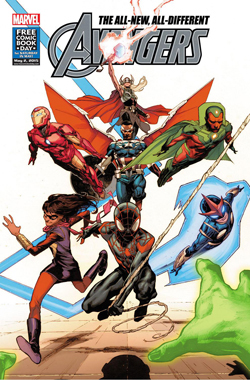
The last of the four free books, this is apparently a look at the post-Secret Wars Avengers team. And I can’t wait for it. Rather than playing it safe, Waid is constructing a team built of all the new and legacy characters that have made waves in the last few years. Led by the new Captain America, (formerly the Falcon,) the team includes Ms. Marvel (Kamala Khan,) Spider-Man (Miles Morales,) and the new lady Thor. It’s a short story about the three new teenage members attempting to stop a bank robbery and learning a lesson about what the team means. It’s a little schmaltzy, but I’m certainly interested in the series when it comes out this fall.
In addition to physical books, free comics were also available through Comixology, including an “Atomic Robo” story which I won’t spoil, but includes Dr. Dinosaur being his usual insane self, and is my pick of the small collection of the books I was able to sample this year.
Hugh Likes Comics: Superman Birthright
February 11, 2015
Hugh Likes Comics DC Comics, HLC, Hugh Likes Comics, Lenil Yu, Mark Waid, review, Superman, Superman Birthright Leave a comment
Superman Brithright
Written by Mark Waid
Drawn by Lenil Francis Yu
Published by DC Comics

The retelling of a superhero’s origin story really only works if the writer and artist truly ‘get’ the character. Extraneous details can weigh the character down, and updated elements can seem forced. Fortunately, that isn’t the case with “Superman Birthright,” Mark Waid and Lenil Francis Yu’s take on the origin of the Man of Steel.
Originally published in 2003, this graphic novel served as an inspiration for 2013’s “Man of Steel” film, but don’t hold that against it. This comic soars where the movie feels heavy and grim.
The comic starts out much like the film, with Clark Kent traveling around the world looking for a sense of identity. Clark feels that his powers separate him from humanity, and he looks for a way to both live among humans and use his powers to do good. With the help of his parents, he prepares his alter-ego and takes a job at the Daily Planet in Metropolis. As he struggles to establish himself both as a journalist and a superhero, he quickly comes into conflict with the brilliant but twisted Lex Luthor. This is the heart of the story, and it is handled masterfully. This version of Lex is an astro-biologist exhaustedly hunting for intelligent alien life. Clark briefly knew Lex when they were teenagers. Clark was his only friend when Lex’s prodigious intellect, and accompanying ego, separated him from his classmates.
The two meet again, and their meeting as adults goes just as poorly. Lex is an exceptional man looking for an equal among the stars, but Superman is disgusted by his actions. This is a great modernization of the basic plot of a Superman comic, and is typical of Waid’s treatment of the characters and their motivations.
Motivation is the key to “Birthright.” The reader knows what Superman does. This retelling cements why he does it, and how the people of Metropolis react to it. Fear of the unknown, both ‘out there’ and inside ourselves is a central theme. How the characters each react to it is what makes them special.
Yu’s designs are also great, and the comic does a great job of making these seventy year old icons breathe in a modern context.
“Superman Birthright” is available as a graphic novel from Amazon, Comixology, or your local comics shop.
Patreon
Hugh Likes Comics: The Unbeatable Squirrel Girl
January 8, 2015
Hugh Likes Comics, Review Erica Henderson, HLC, Hugh Likes Comics, Marvel, review, Ryan North, Squirrel Girl, Unbeatable Squirrel Girl 1 Comment
The Unbeatable Squirrel Girl #1
Written by Ryan North
Drawn by Erica Henderson
Published by Marvel Comics
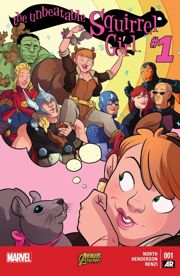
Some comics are meant to amaze. They sculpt years of storytelling continuity into jaw-dropping moments of greatness. Some comics are meant to shock, taking familiar tropes or safe concepts and turning them on their head by framing them in the harsh light of gritty realism.
And some comics are just plain fun. I suspect “The Unbeatable Squirrel Girl” falls into the third category. The eponymous S G is Doreen Green, a jokey Z-lister with the a fluffy tail, a prominent overbite, and the proportional strength and speed of a squirrel. She also has no idea how to operate outside of the superhero mode, which is about to make her first day of college very interesting.
Written by Dinosaur Comics creator Ryan North and drawn by indie artist Erica Henderson, this book will feel familiar to anyone familiar with their work. It’s a light, breezy tale filled with misappropriated superhero theme songs, squirrel (fish) out of water humor, and even alt text printed on the bottom of each page. Even the art has a softer, more cartoonish quality that lends itself well to North’s wacky script. This isn’t going to be one of those comics that changes everything, but it was a lot of fun, and I can’t wait to see what kind of trouble Doreen and her pet squirrel/sidekick Tiptoe get into with her cat-obsessed roommate, oh, and it looks like she might have to save the world after all, too.
The Unbeatable Squirrel Girl is available from Comixology or your local comics shop.
Hugh Likes Comics: Sex Criminals
December 17, 2014
Hugh Likes Comics, Review Brimping, Chip Zdarski, Comics, HLC, Hughl Likes Comics, Matt Fraction, review, Sex Criminals Leave a comment
Sex Criminals: One Weird Trick
Written by Matt Fraction
Drawn by Chip Zdarski
Published by Image Comics
“Sex Criminals” is my jam. A heady combination of character study, an intriguing high-concept premise, and dick jokes, it is one of those books that feels like it was written just for me.
It is the story of Suzie and Jon, two people with the rare ability to stop time when they have sex. Each believing themselves to be unique, they meet each other at a party. As their relationship develops, and they find themselves in a world inhabited only by themselves, they do what comes naturally in a budding relationship: They rob banks. Specifically, one bank. The bank which is foreclosing on the library where Suzie works, which is the same one where Jon works a depressing 9 to 5 job he hates, which is also the place where Suzie’s father died in a random shooting when she was just a girl. So there’s a lot going on there. As they plan their heist, however, they learn they aren’t the only ones with this ability after all, and someone is on to them.
“Sex Criminals” is a beautiful, funny, and especially dirty look at the awkward, sad, and joyous paths of self-discovery. It is also a uniquely affecting look at the early stages of a relationship, filtered through a surprisingly poignant sex comedy. Moving back-and-forth through time and featuring a plethora of ingenious sight gags, this is a comic that rewards careful re-reading.
Zdarski’s art is great, and The Quiet has a beautiful, unearthly look that is fantastic. It works in perfect concert with Fraction’s script, delivering every awkward teenage gut-punch and nonsensical sex joke to life with aplomb. My absolute favorite gag is a fourth wall breaking sequence in a pool hall where a spontaneous dance to “Fat Bottomed Girls” starts up, while the text apologetically explains that they could not secure the rights to the lyrics.
This is a magical, rare comic, which, like a great lover, challenges and moves the reader, but still can make you laugh when you least expect it. “Sex Criminals” is available from Amazon, Comixology, or your local comics shop.
Hugh Likes Comics: Rurouni Kenshin
November 18, 2014
Hugh Likes Comics HLC, Manga, review, Rurouni Kenshin Leave a comment

Written and Drawn by Nobuhiro Watsuki
Published in English by Viz Comics
Like “Lone Wolf and Cub,” “Rurouni Kenshin” is a manga about a wandering swordsman, but tonally, the two could not be farther apart. Set in Tokyo in the 1870’s, this is the story of Kenshin Himura, a former assassin and swordsman during the Bakumatsu period of civil wars who has vowed to never kill again, but cannot give up his sword.
One of the reasons I find this comic so interesting is that it is set in set in a dynamic and chaotic historical period that I knew very little about going in. This story is set in a Tokyo that had been Edo not very long before, still healing from the open wounds of a civli war that toppled the established social order. It’s a fascinating setting, as full of contradictions as the characters themselves.
Through a series of events, Kenshin settles as a guest of Kaoru Kamiya, a young woman running her deceased father’s kendo school, but lacking students. From there, he meets a series of people, each of whom has been affected by the new era in a different way. He meets Yahiko, a young orphan whose parents were Samurai, struggling to maintain what he things honor means in a modern world, and Sanosuke, a fighter whose mentor was betrayed and killed by the Revolutionary Army Kenshin supported. He also meets Jin-E, a swordsman like himself who, unable to put down his weapon, turned into an assassin.
“Rurouni Kenshin” fascinates me because it is so full of contradictions, and those paradoxes are built right into the characters and setting. It is most unlike “Lone Wolf and Cub,” and other Samurai stories in that rather than praising duty over life, it is a story of a swordsman struggling to put his past behind him. Kenshin carries a “sakabato,” a katana with the edge of the blade reversed. This allows him to fight with his sword without killing. These are stories not about “Life in Death,” but life beyond it, and the struggle to atone for the lives already taken.
This comic originally ran in “Shonen Jump” magazine in Japan alongside boys’ adventure stories like “Dragon Ball” and “One Piece.” It shares some of those series’ more kid-friendly aesthetic, both in the tone of the writing and the art. Watsuki also is heavily influenced by American super-hero comics, particularly Jim Lee’s X-Men. The result is that Kenshin’s skills often appear more like super powers than swordsmanship techniques. This distracts from some of the more serious themes of the comic, but still allows for some entertaining and fascinating stories from a historical period many western readers know little about.
“Rurouni Kenshin” volume one is available through Amazon, or your local comics or book store.
Hugh Likes Comics: Lone Wolf and Cub
November 4, 2014
Hugh Likes Comics HLC, Hugh Likes Comics, Koike, Kojima, Lone Wolf And Cub, Manga, review Leave a comment
Lone Wolf and Cub Volume One: The Assassin’s Road
Written by Kazuo Koike
Drawn by Goseki Kojima
Published by Dark Horse Comics (English Version)
Originally published in Japan in 1970, “Lone Wolf and Cub” is a seminal document of Japanese Comics (Manga). The story of an executioner turned assassin in 16th century Japan was hugely popular, becoming a best-seller and spawning a series of films, two television series, and inspiring artists and writers in Japan and around the world. Partially translated and released in the US in the 1980’s, it was not fully collected in English until Dark Horse Comics began releasing volumes in 2000.
Ogami Itto was the Shogun’s chief executioner until the treachery of the rival Yagyu clan robbed him of his position and sentenced him to sepuku. In defiance of the Shogun, Ogami became an assassin living in “Meifumado,” the Way of Demons.” He takes his only living family member, his infant son Daigoro, with him in his quest for vengeance. As such, he is called “Lone Wolf and Cub,” a peerless killer who will take on any mission for five hundred Ryo.
“Lone Wolf and Cub” is an epic story collected over twenty-eight volumes, but each volume is picaresque, discribing specific assassinations or encounters Itto and Daigoro have on their journey. Deeply beautiful and starkly violent, these stories are quintessential Japanese pulp. Like Ogami himself, they are a paradox. At once noble and at the same time murderous, they celebrate Japan’s Zen Buddhist warrior traditions while standing apart from them.
Koike’s writing details the lives of noble samurai, struggling peasants, and suffering prostitutes with a historian’s careful eye. Kojima’s work evokes Japan’s greatest artistic traditions. This is a manga where ultra-violence and gratuitous nudity are positioned directly beside deep philosophical questions and breathtaking landscapes.
“Lone Wolf and Cub” is not a comic for kids, and it may not be everyone’s cup of tea, but Volume One features nine stories of samurai action that perfectly introduces the reader to the soul of Koike and Kojima’s groundbreaking work. It was an important step in my own appreciation of the medium, and it is a great place to start if you’d like something a bit more serious in your comics reading.
Lone Wolf and Cub Vol. 1 is available digitally, in print from Amazon, or from your local comics shop.
Hugh Likes Comics: Wolverine
October 14, 2014
Hugh Likes Comics, Review Chris Claremont, Comics, Frank Miller, HLC, Hugh Likes Comics, Marvel, review, Wolverine Leave a comment

Written by Chris Claremont
Drawn by Frank Miller
Published by Marvel Comics
Love him or hate him, Wolverine is one of the most popular and exposed characters in Marvel’s stable of heroes. And with the publisher set to kill him for a while, I thought it was time to take a look at the limited series that really cemented his character.
It’s easy to see why this comic was so groundbreaking. Right off the bat, it establishes Wolverine as a much darker, more badass character than his taciturn, volatile persona on the X-Men. This is Wolverine in his element, and that means hunting bears and fighting hordes of ninja. After spending some time in the deep woods of Canada, Logan discovers that his letters to his girlfriend, Japanese dignitary Mariko Yashida have been returned unopened, and that she has left the US. Wolverine follows her to back to Japan. There, he discovers that her father, a presumed deceased crime lord, has returned, and that Mariko has been married to one of his lieutenants.
After being rolled by Yashida in a fight which would have killed him if not for his mutant powers, Logan is rescued by Yukio, a hedonistic assassin who is playing games of her own.
“Wolverine” is Claremont writing at the peak of his craft. Unrestrained by the team dynamic and superhero tropes of the ongoing X-Men comic, he really digs down into Wolverine’s character. This isn’t just four-color antics, but a rich, pulpy story about honor, appearances, and the nuances of a world shaded in gray. And being drawn by a Frank Miller just coming into his own as an artist elevates the comic to a classic.
Delivering a gritty comic is harder than taking a cape and rolling in the mud for a little bit. It’s something that has to be carefully structured. The pieces all need to support each other in a way that the reader both can believe and doesn’t expect. “Wolverine” delivers by revealing a deeper, darker world in the periphery of one the reader already knows. It shows a midnight underworld hidden behind an upstanding daylight face. And it does it beautifully. Miller’s Japan is a labyrinth of towering yet indistinct skyscrapers, with scores of ninja hiding in every alley. It echoes and reinforces the script beautifully. Miller echoes seminal Japanese artist Goseki Kojima in this story of corruption hiding within the Yashida clan’s adherence to tradition, and one warrior willing to abandon all pretexts to expose the truth.
In graphic story telling, especially when a writer and an artist are both masters of their craft, the finished product can seem at odds with itself. The words can be sharp and engaging. The art can be beautiful, but they need to work together to properly tell a story like this. Here, Claremont and Miller’s efforts are a synthesis that is greater than the whole of its parts.
The Wolverine is available from Amazon, Comixology, or your local comic shop.
Hugh Likes Comics: The Infinity Gauntlet
September 20, 2014
Hugh Likes Comics, Review Crossovers, George Perez, HLC, Hugh Likes Comics, Infinity Guantlet, Jim Starlin, Marvel, Omnipotence, review, Thanos Leave a comment
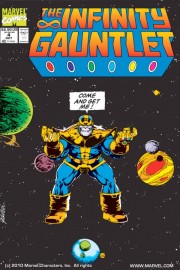
Written by: Jim Starlin
Drawn by: George Perez
Published by Marvel Comics
As a rule, I really don’t like crossovers. They’re messy, over-crowded affairs where heroes act out of character to fit the story, and their endings tend to be unsatisfying piles of continuity. Event full of sound and fury where “everything changes” but at the end of the story, everything is pretty much back where they were. Oh, she might be in a different costume and he might have been replaced with his sidekick, who looks the same except for the cybernetic arm. The status quo remains king.
And then there’s “The Infinity Gauntlet.” This is the one that got it right. It’s a threat that is based off of years of continuity, but clear enough that one doesn’t need to invest a college savings in back issues to know who’s who. It’s a threat that is credible, active, and present, not only for the heroes, but for the entire fictional universe. A threat that is credible enough to not only bring the Marvel Universe together, but also put their backs against the wall.
It also manages to balance character study and knock-down, drag-out, cosmic-level fighting. In the first issue, Thanos, elevated to genuine omnipotence thanks to the eponymous gauntlet, snuffs out half the life in the universe. He does this because it turns out that he’d like to hook up with the Universe’s personification of Death. Death is, naturally, a hot lady, because Comics. Unfortunately, all of his god-like power fails to catch her eye. Having gained unmatched power, and being unable to effectively use it is the core of Thanos’s character, and it is an interesting contrast to the surviving heroes and villains, who are left with the task of fighting a hopeless battle against the Mad Titan.
The climax of the series is a fight where he faces of and wins against first every hero in the Marvel Universe, and then the super powerful Cosmic Forces. It gets a bit metaphysical, but the thread of the story never gets lost, and Perez’s expressionistic art captures it all perfectly.
The Infinity Gauntlet isn’t just a cheap cash in. It is the basis for twenty years of comics storytelling, and possibly the endgame Marvel’s cinematic universe is heading towards. Even if you have no interest in those things, it is the Platonic Ideal of a Marvel comic. A story of superhuman power filtered by the lens of the most human emotions.
The Infinity Gauntlet is available from Comixology, Amazon, or Your Local Comics Shop.
Hugh Likes Comics: Dragon Ball
August 25, 2014
Hugh Likes Comics, Review, Uncategorized Akira Toriyama, anime, DBZ, Dragon Ball, Goku, HLC, Hugh Likes Comics, Japan Leave a comment
Hugh Likes Comics: Dragon Ball
Written and Drawn by Akira Toriyama
Published by Viz/Shonen Jump
Although it is a big part of my own path through comics, I haven’t talked about manga in this space. Manga, broadly speaking, refers to Japanese comics, or occasionally comics drawn in a Japanese style. These comics have a visual language all their own, enjoy vast popularity the world over, and one of the best loved of these is “Dragon Ball.”
Spanning over forty volumes, spawning four long-running animated TV shows, a vast collection of movies, and enough merchandize to sink a container ship, Akira Toriyama’s “Dragon Ball” is a full-fledged cultural phenomenon. Originally a goofy, cartoonish Sci-Fi retelling of the Monkey King legend, this is the story of Son Goku, an incredibly strong, perfectly innocent child as he travels with teenage prodigy Bulma to gather the Dragon Balls, seven mystical stones which, when brought together, will grant any one wish. Along the way, he becomes the greatest martial artist in the universe, and saves the world a few times, to boot.
With its beyond epic length, the thing I find really interesting about Dragon Ball is that it so completely documents the evolution of Toriyama as an artist. His style is very round and iconic, and at the beginning of the comic, much more rooted in sophomoric humor. It certainly isn’t what you’d expect from the martial-arts action story it becomes. While Toriyama never completely lets go of his comedic side, the series becomes more and more of an action comic as the tale unfolds, until we reach halfway through and it becomes “Dragon Ball Z.”
With its focus on space adventure and over the top martial arts, DBZ is what got translated first. It appeared in incomplete forms on American and Canadian TV in the 90’s. And I fell in love with it. But now I think I prefer the original stories about Goku’s childhood. The adventures are more fun, more playful, and less reliant on gimmicks and ‘power levels’ to keep the tension high. “Dragon Ball,” by contrast, remains delightful and ridiculous throughout, including a cameo crossover with his earlier work “Dr. Slump,” in which just about every character tries to squeeze into a panel for a fourth-wall breaking cameo.
“Dragon Ball” comic is particularly a comic of its time and place, but like its protagonist, it mixes goofball humor, iconic visual style, and thrilling action in perfect amounts with a perfect garnish of child-like whimsy. Go pick up a copy, and be a kid again for a few hours.
Dragon Ball on Amazon.com (Affiliate Link)
 Hugh J. O'Donnell