Toil and Trouble #1
Written by Mairghread Scott
Drawn by Kelly and Nichole Matthews
Published by Archaia
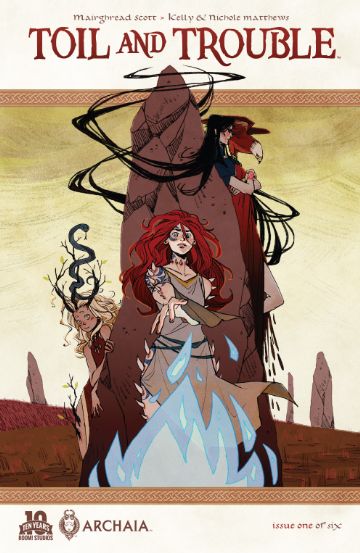
Shakespeare enjoys a peculiar place in the canon of English literature. Both a foundational document and endlessly mutable, it is performed, reenacted, remixed, and endlessly reinterpreted. Romeo and Juliet inspired the musical West Side Story. King Lear was translated into Akira Kurosawa’s opus film Ran. Recently, the tragedy of Hamlet was remixed into the Choose-Your-Own-Adventure style game-book, To Be or Not To Be. Toil and Trouble takes up from Macbeth, focusing not on the Thane, but the Witches.
Structurally, it resembles the Tom Stoppard Play “Rosencrantz and Guildenstern Are Dead,” which follows the two titular henchmen from before their introduction and up to their bumbling, offstage demise. (Spoiler alert for a four-hundred and a fifty year old play, respectively.) The comic follows Smertae, one of the three witches, returning to Scotland after being banished. The reason for her banishment is unclear, but seems to involve Macbeth. Like the Stoppard play, the action of the original Shakespeare drifts around and through the dialog of the comic. In this first issue, the reader sees an expanded version of the opening scene.
In Scott’s version of events, the witches are agents of Fate, tasked with ensuring the continuity of Scottish royalty. To accomplish this, they mean to strike down Macbeth in order to give Prince Malcolm a trial to ready him for the throne. Smertae is against the plan, but reluctantly agrees. We then follow the witches in their work cursing Macbeth’s camp, and in the battle the next day, where Smertae makes a decision that goes against fate.
I was drawn to this comic because I am a huge fan of the Scottish Play. The plot is an interesting take, and I’m excited to see how it interacts with the original. The writing is actually quite solid, and the dips into 17th Century language feel natural with the rest of the dialog. The world building is the biggest break from the original, but I’m a sucker for the concept of a fading magical world, struggling in the face of onrushing modernity, and Scott absolutely nails this fantasy milieu.
What surprised me is the exceptional quality of the art. The Matthewses style is absolutely gorgeous, and the designs, particularly of the three witches, are immediately eye-grabbing and carry a lot of the story’s weight. The three represent Sea, Earth, and Sky. Smertae has crab-like spikes jutting from her body, and her sisters equally expressive of their elements. The ‘acting’ of the characters is also very well done. The meeting scene is wonderfully emotional without relying too heavily on the dialog to convey meaning, for example. The art is helped by bright and detailed coloring and inventive layouts, such as the climactic battle splash page, which features small circular insets showing the effects of the witches curses in the epic clash.
“Toil and Trouble” is the first part of a series I can’t wait to read more of. Find it on Comixolgy, or in the rack at your local comics shop.
Hugh Likes Comics: Toil and Trouble
September 23, 2015
Hugh Likes Comics Comics, HLC, Hugh Likes Comics, review, Shakespeare, Toil and Trouble Leave a comment
Hugh Likes Comics: Wayward
September 16, 2015
Hugh Likes Comics Comics, HLC, Hugh Likes Comics, Image, Japan, Jim Zub, Steve Cummings, Urban Fantasy, Wayward Leave a comment
Wayward Vol. 1: String Theory
Written by Jim Zub
Drawn by Steve Cummings
Published by Image Comics

Rori Lane isn’t your typical teenager. The daughter of an Irish engineer and a Japanese seamstress, she moves to Japan to live with her mom after her dad ‘didn’t work out.’ Before she can settle in, she begins to have visions of glowing red thread, and is soon drawn in to the dangerous hidden world of the Yokai, or Japanese monsters. But she isn’t on her own. She makes friends with other mythological denizens: An energetic cat girl, a classmate laboring under a curse, and a mysterious homeless boy with untapped powers.
Cummings’s art is gorgeous, and dispenses with pop-culture cuteness. The Yokai in this book are by turns tough, terrifying, and absolutely disgusting. There are no fuzzy-wuzzy kitsune mascots, and the kappa have a taste for human flesh, not cucumbers. The gore is a little brutal at times, but the grown-up monster designs do a great job of just how deep and dark the well they they’ve stumbled into is.
The detail in the art is quite appealing as well. Having worked as a English as a Second Language teacher in Japan, I noticed lots of little details in the background art that made the Tokyo of the book come alive.
“Wayward” is one of those odd little books that is too adult for YA based on the fact that the teenaged characters act a little too realistically. Rori is foul-mouthed and psychologically damaged in ways that would make Katness Everdeen crap her pants. Her mother is loving, but busy and at times distant. Rori’s real teenage problems fitting in to a new environment are a nice parallel to her supernatural adventures. While too much for youngsters, this is an excellent, but serious fantasy adventure for older teens. Parental discretion advised, of course.
Hugh Likes Comics: Sex Criminals
December 17, 2014
Hugh Likes Comics, Review Brimping, Chip Zdarski, Comics, HLC, Hughl Likes Comics, Matt Fraction, review, Sex Criminals Leave a comment
Sex Criminals: One Weird Trick
Written by Matt Fraction
Drawn by Chip Zdarski
Published by Image Comics
“Sex Criminals” is my jam. A heady combination of character study, an intriguing high-concept premise, and dick jokes, it is one of those books that feels like it was written just for me.
It is the story of Suzie and Jon, two people with the rare ability to stop time when they have sex. Each believing themselves to be unique, they meet each other at a party. As their relationship develops, and they find themselves in a world inhabited only by themselves, they do what comes naturally in a budding relationship: They rob banks. Specifically, one bank. The bank which is foreclosing on the library where Suzie works, which is the same one where Jon works a depressing 9 to 5 job he hates, which is also the place where Suzie’s father died in a random shooting when she was just a girl. So there’s a lot going on there. As they plan their heist, however, they learn they aren’t the only ones with this ability after all, and someone is on to them.
“Sex Criminals” is a beautiful, funny, and especially dirty look at the awkward, sad, and joyous paths of self-discovery. It is also a uniquely affecting look at the early stages of a relationship, filtered through a surprisingly poignant sex comedy. Moving back-and-forth through time and featuring a plethora of ingenious sight gags, this is a comic that rewards careful re-reading.
Zdarski’s art is great, and The Quiet has a beautiful, unearthly look that is fantastic. It works in perfect concert with Fraction’s script, delivering every awkward teenage gut-punch and nonsensical sex joke to life with aplomb. My absolute favorite gag is a fourth wall breaking sequence in a pool hall where a spontaneous dance to “Fat Bottomed Girls” starts up, while the text apologetically explains that they could not secure the rights to the lyrics.
This is a magical, rare comic, which, like a great lover, challenges and moves the reader, but still can make you laugh when you least expect it. “Sex Criminals” is available from Amazon, Comixology, or your local comics shop.
Hugh Likes Comics: Usagi Yojimbo
December 2, 2014
Hugh Likes Comics Comics, Dark Horse, Hugh Likes Comics, Japan, review, Samurai, Stan Sakai, Usagi Yojimbo Leave a comment

Usagi Yojimbo Omnibus Volume 1
Script and Art by Stan Sakai
Published by Dark Horse Comics
Usagi Yojimbo is kind of a difficult comic to classify in terms of age appropriateness. As a samurai pulp, it is certainly the most accessible to a western audience of the comics I’ve discussed so far. It lacks the gore and explicit content of “Lone Wolf and Cub,” and its setting is simpler than “Rurouni Kenshin’s” historical period. At first glance, the cartoonish talking animal characters make it seem perfect for younger kids. The first story in this collection even features a guest appearance by the Teenage Mutant Ninja Turtles. But there is something nonetheless unflinching in Sakai’s tales of the long-eared wandering swordsman that resonates with the stark realities of Japan’s Shogunate period.
Although this collection is labeled as “volume one,” this collection actually contains parts eight through ten of the series, which is the point where Dark Horse began to publish the collected volumes. Although a great deal of backstory is referenced at times, Sakai is very good at bringing the reader up to speed quickly, and I never felt lost.
Following Miyamoto Usagi as he wanders the countryside, the stories in his collection are picaresque adventures that flow organically, and build slowly upon one another. They don’t reach a climax in this volume, but I am quite curious about where Usagi ends up. These stories are by turns exciting, heartwarming, and sad, and they are filled with a sense of wonder and reverence for Japanese culture and traditions. Even though he is of the Samurai class, Usagi’s humility and genuine desire to connect with other people allow him to enter a variety of stories, from a widow struggling to avenge her husband’s death on the gambler responsible to an exploration of traditional seaweed farming.
The varied nature of the stories is delightful, but parents might want to read through first, or read with their children to be able to answer some of the difficult issues sometimes raised by this comic. One of the most moving, but also difficult to read stories in this collection is entitled “Noodles.” The story of a mute soba seller and his performer/pickpocket companion, it deals with some very heavy subjects, including justice, or the lack thereof, the rights of the disabled, and capital punishment. While the conclusion to that story is satisfying, it is the darkest point in the book, and it was hard for me to get through as an adult.
Sakai’s art is superlative. His style is at once a blend of Carl Barks and Goseki Kojima and something entirely his own, and it is breathtaking. His attention to detail, and his deft depiction of samurai fighting that doesn’t dip into gory self-indulgence is wonderful, and keeps the stories moving while lending them a timeless atmosphere.
Usagi Yojimbo is an excellent comic for readers new to the genre, or for anyone with an interest in Japanese culture. You can find the first volume on Amazon, or at your local comics shop.
Hugh Likes Comics: Wolverine
October 14, 2014
Hugh Likes Comics, Review Chris Claremont, Comics, Frank Miller, HLC, Hugh Likes Comics, Marvel, review, Wolverine Leave a comment

Written by Chris Claremont
Drawn by Frank Miller
Published by Marvel Comics
Love him or hate him, Wolverine is one of the most popular and exposed characters in Marvel’s stable of heroes. And with the publisher set to kill him for a while, I thought it was time to take a look at the limited series that really cemented his character.
It’s easy to see why this comic was so groundbreaking. Right off the bat, it establishes Wolverine as a much darker, more badass character than his taciturn, volatile persona on the X-Men. This is Wolverine in his element, and that means hunting bears and fighting hordes of ninja. After spending some time in the deep woods of Canada, Logan discovers that his letters to his girlfriend, Japanese dignitary Mariko Yashida have been returned unopened, and that she has left the US. Wolverine follows her to back to Japan. There, he discovers that her father, a presumed deceased crime lord, has returned, and that Mariko has been married to one of his lieutenants.
After being rolled by Yashida in a fight which would have killed him if not for his mutant powers, Logan is rescued by Yukio, a hedonistic assassin who is playing games of her own.
“Wolverine” is Claremont writing at the peak of his craft. Unrestrained by the team dynamic and superhero tropes of the ongoing X-Men comic, he really digs down into Wolverine’s character. This isn’t just four-color antics, but a rich, pulpy story about honor, appearances, and the nuances of a world shaded in gray. And being drawn by a Frank Miller just coming into his own as an artist elevates the comic to a classic.
Delivering a gritty comic is harder than taking a cape and rolling in the mud for a little bit. It’s something that has to be carefully structured. The pieces all need to support each other in a way that the reader both can believe and doesn’t expect. “Wolverine” delivers by revealing a deeper, darker world in the periphery of one the reader already knows. It shows a midnight underworld hidden behind an upstanding daylight face. And it does it beautifully. Miller’s Japan is a labyrinth of towering yet indistinct skyscrapers, with scores of ninja hiding in every alley. It echoes and reinforces the script beautifully. Miller echoes seminal Japanese artist Goseki Kojima in this story of corruption hiding within the Yashida clan’s adherence to tradition, and one warrior willing to abandon all pretexts to expose the truth.
In graphic story telling, especially when a writer and an artist are both masters of their craft, the finished product can seem at odds with itself. The words can be sharp and engaging. The art can be beautiful, but they need to work together to properly tell a story like this. Here, Claremont and Miller’s efforts are a synthesis that is greater than the whole of its parts.
The Wolverine is available from Amazon, Comixology, or your local comic shop.
Happy Marvel Day!
June 16, 2014
Uncategorized 616, Bloomsday, Comics, HLC, Joyce, June 16th, Marvel 1 Comment
In literary circles, June 16th is “Bloomsday,” this single day on which James Joyce’s beloved classic Ulysses takes place. Folks take the day to either honor or malign the author and his works. As a thinking person of Irish descent, I’ve made several attempts to conquer the novel, but never completed it.
This year, I’m going to neither praise nor condemn the man. Instead, I’m going to celebrate another significant numeral of 6/16.
In the Marvel comics universe, or rather multiverse, 616 is the number associated with the version of Earth where the stories take place. There are other Earths, where these characters don’t exist, or live radically different lives. Occasionally, readers get a glimpse of these ‘alternate’ realities, but for the most part, our heroes are the ones from Earth-616. So this year on 6/16, rather than celebrate a work I have a complicated history with, or an author who has his own complex history of achievements and failures, I’m going to watch “The Avengers” and enjoy some literary works that may not be as highbrow as Joyce, but still were a force for good in the world.
Captain America was a symbol of hope and encouragement in the darkest days of World War II. Even up until the present, he has served as a reminder of the greatest ideals of my country: Freedom, Equality, Tenacity and Acceptance. The X-Men are icons of the struggle civil rights in every community. Iron Man is a symbol of what we can achieve if we dream big enough and work hard enough, and also of the fact that no matter how high we fly, we can’t outrace our demons. And of course, Spider-Man is an example of the responsibility to use power for the benefit of others.
These characters might not breathe the same rarefied air as literary icon Leopold Bloom, but I learned more from their stories than I ever did from Joyce’s high-barred, punctuation-less tome. But I won’t admonish any literary fans from enjoying today as they see fit. But as for me? Pour me a glass beer, put “The Avengers” in the DVD player, and hand me my “Astonishing X-Men” collection, and make mine Marvel.
How are you celebrating today?
Hugh Likes Comics Classic: Nextwave: Agents of HATE
April 20, 2014
Uncategorized Comics, Comixology, Explosions, Facekicks, HLC, Hugh Likes Comics, Nextwave, review Leave a comment

Written by Warren Ellis
Drawn by Stuart Immonen
Published by Marvel Comics
2006’s “Nextwave: Agents of H.A.T.E.” is the best super-hero comic nobody read. It’s a cynical, action-heavy book about washout super-heroes that will teach you to love again. The Nextwave Squad were going to be the elite Super-hero team of the Highest Anti-Terrorism Effort. (H.A.T.E.) Until, that is, they discovered that H.A.T.E. is a front for the Beyond Corporation, a rebranded terrorist organization interested in field testing bizarre weapons of mass destruction on American Soil. They go rogue, steal an experimental aircraft, and set to work stopping H.A.T.E.
“Nextwave” was a comic ahead of its time. A parody of Marvels greatest excesses, it recast five c-list heroes as scenery chewing, trench-coat wearing action stars with severe personality issues. At a time when Marvel was pitching overblown crossovers like “Civil War,” Ellis boiled it down, doing short, fun action movies in two issues. These story’s were thrilling, easily digestible, and more importantly, irreverent. In the main universe, Marvel’s heroes were making gritty choices and compromising their ethics fro security. Nextwave was kicking broccoli-based HR Robots until they exploded.
Immonen’s art, which is absolutely gorgeous, helps. It’s as bright and beautiful as story is darkly comedic. Every kick and explosion is delivered with aplomb. The characters all have a manic gleam in their eye and a middle finger thrust towards convention.
Even the editorial team was in on the joke, with a letter page written by a delusional mail-sorting machine. “Nextwave” even had its own theme song, with the lyrics printed in issue one, and an MP3 recorded by editor Nick Lowe’s band “Thunder Thighs.”
“Nextwave: Agents of H.A.T.E” was a sly, silly, chop-socky gem of a series, and it remains a cult favorite. You can pick it up in trade omnibus from your local shop, or in digital issues from Comixology.
Bang! Biff! Pow! Justice League: War isn’t just for um, well, actually, who is this movie for? (Review)
February 26, 2014
Review Comics, DC, HLC, movies, review Leave a comment
Let me begin by confessing that I have not read a single page of Justice League comics in the DC New 52. So I have no idea how accurate or off base “Justice League: War,” the new animated adaptation of the first arc is. Initial previews and reviews led me to believe that DC’s new direction just wasn’t my thing, and this movie did nothing to convince me to give them a second look.
The plot is rather thin and familiar. A group of well-known superheroes who don’t know each other discover something bad is about to happen. They slowly begin to gather to address the threat and do so just in time for an unstoppable alien army to jump through some portals in an American city. Towards the end of the film, their big bad leader shows up and they gang up on him. They find a way to close the portals and then the threat is suddenly over. The end.
It may not be fair to compare the film to the blockbuster live-action “Avengers,” since the comic “War” is based on appeared close to a year before that film was released, but the similarities are unavoidable. I just wish that “War” had borrowed a little bit of “Avengers” wit and charm.
The movie’s not all bad. The action is well animated, and although it can’t fully carry the ball, there are plenty of neat super-powered displays. I was actually shocked by the level of violence and profanity in this cartoon. The Justice League prevents Darkseid from using his Omega Beams by literally stabbing out his eyes. ‘Just like Oedipus!’ Wonder Woman exclaims when they hatch the plan. It’s the one smart bit of dialogue in a film that portrays these iconic characters as vulgar, petty jerks.
The depiction of characters is where this movie really falls flat. This movie has a cynical edge that it perhaps shares with ‘Man of Steel,’ portraying the public as distrustful ingrates and the heroes as the worst versions of themselves. The writers were going for more extreme, gritty versions, but unheroic, downright stupid, superheroes just leave a bad taste in my mouth. The dialog eschews cleverness for playground vulgarity, but if you really wanted to hear Green Lantern call Batman a douche bag, this is the animated film for you.
The film ends with the characters not having really learned anything, just left a pile of destruction in their wake. It left me with the question of who this adaptation was for? Fans of the New 52, presumably, but with such a high level of violence and vulgarity, it seems inappropriate for younger fans. Older fans like myself will find the thin story and unpleasant characterizations a pale shadow of the Bruce Timm and Dwayne McDuffie eras of DC Animation. I can’t recommend this movie.
Hugh Likes Comics: Amelia Cole and the Unknown World
February 5, 2014
Uncategorized Adam P Knave, Amelia Cole, Comics, D J Kirkbride, Fantasy, HLC, Hugh Likes Comics, IDW, Monkeybrain, Nick Brokenshire, review Leave a comment

Amelia Cole & the Unknown World
Written by D. J. Kirkbride and Adam P. Knave
Drawn by Nick Brokenshire.
Published by Monkeybrain (digital issues) and IDW (tpb collections)
Amelia is a magician with an unusual talent: Thanks to her Aunt and Mentor Dani, she can travel between the ‘magical’ and ‘non-magical’ world, and she has a habit of using her powers to stick her nose into matter that the police would rather she didn’t.
When the two start to merge, Dani sacrifices herself to seal them off again, and Amelia finds herself alone in a THIRD place she knew nothing about: A world where magic and technology exist side-by-side.
After she manages to settle in, however, Amelia finds out that the two aren’t exactly equal. Magicians have special status in addition to powers, and Amelia attracts the unwanted attention of “the Protector” after she uses magic to save ‘mundanes.’
“Amelia Cole” is a story about finding your place in the world, and doing the right thing. The story is fairly nuanced. Amelia’s vigilantism causes as much trouble as it solves, but she still doesn’t hesitate to do what she can. She’s a heroine that works by guts and instinct rather than a damsel in distress. Even The Protector isn’t all-bad, even if the system he works within wears him down to a core of anger and frustration.
Brokenshire’s art is a real winner. His crowds and cityscapes breath with life, and more than a few hidden easter-eggs that reward careful reading. The designs for Amelia are great as well. It’s sad how rarely we see a comic book heroine wearing actual clothes.
Amelia Cole and the Unknown world marks the first part of what will hopefully be a long series of adventures. Volume Two, Amelia Cole and the Hidden War, continues her adventures in the strange world she finds herself in, and I can’t wait.
Amelia Cole and the Unknown World is available digitally through Comixology, and in print from IDW.
Hugh Likes Comics: The Top 5 of 2013
January 7, 2014
Review 2013, Atomic Robo, Batman, Comics, HLC, Hugh Likes Comics, review, Saga, Sandman, Top 5, Young Avengers Leave a comment
#5: Batman ’66: I like stories that go all-in. No pussy-footing around, not Super-Heroes-but-no-tights, which seems to be de-reguer, particularly at “The Big Two.” That’s why I was pleasantly surprised by this outing from writer Jeff Parker and artist Jonathan Case. They’ve returned to the source material of the ’60’s Batman TV show, complete with dancing and giant sound effect bubbles. The digital versions have a few more tricks up their sleeves to evoke the classic series. Batman ’66 embraces everything the New 52 disdains, and soars because of it.

#4: Saga: Vaughan and Staples continued to knock it out of the park this year with Saga. The story of an ancient interstellar war cut with family drama, mercenaries, and the ways art can change a person make for a heady mix. The art remains evocative and controversial. Saga doesn’t pull its punches, but it isn’t crass, either.
#3: Atomic Robo: The Savage Sword of Dr. Dinosaur: There was little chance for Clevenger and Wegener to escape this list as well, with this nail-biting installment that puts Atomic Robo at the site of an impossible underground city, with shadow military agents storming his headquarters, and completely unstable velociraptor mad scientist Dr. Dinosaur sitting on a stockpile of stolen nuclear warheads. Atomic Robo remains funnier and smarter than it has a right to be.

#2: Sandman Overture: We only got one issue of Neil Gaiman’s return to his seminal Byronic Dream King, but oh boy, was it ever a doozy. Filled with all of the gothic-horror elements that made Sandman great, and with exceptional art by G H Williams III, This comic is a rare treat for Morpheus fans. Hopefully, we’ll get to see it a bit more frequently in 2014.

#1: Young Avengers: Sadly ending in early 2014, Young Avengers is a comic that knows exactly what it wants and goes right for it. Under the direction of comics super-team Keiran Gillen and Jamie McKelvie, the Young Avengers bring a little bit of their indie hit “Phonogram” into the Marvel Universe. “Young Avengers” pits focuses less on what it means or takes to be a superhero than it does the trials and tribulations of modern teenagers. After a poorly planned bit of magic use, a group of teens find themselves fighting against an magical parasite that draws power from how parents don’t understand teenagers. It is a fantastic high-concept very well executed. Unfortunately, for a teen book, there is a lot of backstory for these characters that just isn’t given. I’ve felt in over my head a few times, but I’ve loved the ride. Another plus in this comic’s favor is that it has possibly the highest collection of LGBTQ characters anywhere in ‘the big two,’ and handles them with then same excellent touch as earlier Young Avengers installments.
2013 No-Prize: Dan Didio continues to be comics’ greatest super-villain. He spent the year making sure no DC Comics characters have any fun on his watch. After denying the upcoming marriage of Batwoman Kate Kane, he went on to say that none of DC’s heroes should have a stable home life, and seems to be making certain of it. His crowning achievement this year: Creating an art contest for Harley Quinn #0 which included drawing the beloved children’s TV character naked, despairing, and about to commit suicide. After much outcry, the panel did not appear in the final version.
Honorable mentions:
X-Men: Teenage Mom Jubilee, enough time-travelers to stage a production of “Les Mis” and other crazy nonsense. Marvel seemed to focus on their movie-friendly characters like the Avengers in 2013, but there was still a ton of mutants out there, including an all-female team!
Edison Rex: Artist Dennis Culver gets the nod for designing not just a new set of comics characters, but an entire major publisher’s line-up of heroes and villains. My personal favorite: ROFL, an omnipotent extra-dimensional being using the form of a muppet Grant Morrison.
Subatomic Party Girls: Simms and Bowers had the stones to use the line ‘Do you realize we’re floating in space’ unironically. Props.
 Hugh J. O'Donnell