He found a likely corner and put on the little red hat. It was kind of a cliche, but people expected it. He set up the bucket and rang the bell. Somewhere time ticked by. One more coin, he promised himself. Then, he could get out of the cold. Someone tried to dip their hand in the bucket. He couldn’t have that, So he ran out and jumped on the thief’s head. There was a satisfying bop. Somewhere, a chime rang. That made a hundred coins. Which meant an extra life. The Save a Princess Foundation was finally getting somewhere.
Hugh Is Comics
May 12, 2014
Uncategorized #I am Comics, #We are Comics Leave a comment
Recently on my Tumblr page, I participated in the We Are Comics project. This project is to highlight and promote diversity amongst comics fans, creators, and professionals. As a married gay white middle-class American man, I personally struggle with being a minority. especially since I can ‘pass’ as straight if I wanted to. Often, that temptation is very great, but I want to show my commitment to diversity in nerd communities. But tumblr can be an echo chamber for these kinds of campaigns, so I’m reposting my entry here. Go visit the page and read the stories that others have sent in. And send in your own. A chorus of voices can change the status quo, even in the comics industry. Thanks for supporting this, and thanks to the We Are Comics team for their amazing project.
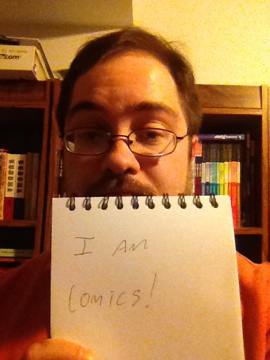
I’m Hugh and I Am Comics.
Growing up gay, I was terrified as a teenager. Terrified that I’d be dragged out of the closet, terrified that I would be disowned, terrified that I’d be the victim of a hate crime, terrified that I would become a statistic. In hindsight, a lot of these fears were silly, and I have been blessed with a loving family and an ever-growing support network, but as a scared kid, I had superheroes.
The X-Men taught me that I could survive in a world where I was different, even if I wasn’t ready to. Heroes like Spider-Man and Batman showed me that someone could put ON a mask and become who they really were. They showed me that a person might be more than who they were during the day. As a kid living with a secret that frightened him to the core, that was a powerful thing.
As I grew older, and my tastes became more diverse, comics showed me worlds of possibility beyond super-heroics. Those experiences helped inspire me to become a writer myself. Comics were a life preserver for me during the most difficult parts of my life, and that’s why I’m Comics.
Balticon Schedule 2014
May 9, 2014
Uncategorized Balticon Leave a comment
I’ll be returning as a guest to Balticon 48! Here’s where you can find me:
- Podcasting 101 (Panel) (Participant), Fri 19:00 – 19:50, Derby (Hunt Valley Inn)
- Conducting Podcast Interviews (Panel) (Participant), Sat 11:00 – 11:50, Chesapeake (Hunt Valley Inn)
- GLBT Issues in YA Fantasy and SF (Panel) (Participant), Sat 18:00 – 18:50, Parlor 1026 (Hunt Valley Inn)
- Podcasters Against Humanity (Panel) (Moderator), Sat 23:00 – 23:50, Chesapeake (Hunt Valley Inn)
- Dueling Drabbles (Panel) (Moderator), Sun 14:00 – 14:50, Parlor 1041 (Hunt Valley Inn)
- Storytelling in Video Games (Panel) (Participant), Sun 17:00 – 17:50, Derby (Hunt Valley Inn)
- Social Media Promotion (Panel) (Participant), Sun 20:00 – 20:50, Chesapeake (Hunt Valley Inn)
- The Street/Freelance Hunters Launch (Panel) (Moderator), Sun 22:00 – 23:50, Parlor 1041 (Hunt Valley Inn)
I’ll be blogging about Balticon in more depth as the Con gets closer. I hope to see you there!
Elanterra Journal 006: The Half Elves
May 8, 2014
Elanterra Journal Elanterra Journal, Half Elves, Writing Leave a comment
Although they aren’t officially one of the Five Peoples, Half Elves represent a sizable population in Elanterra, and their numbers seem to be growing rapidly. Legends indicate that the earliest Half-Elves were scions of romantic pairings between Elves and Humans, often chivalrous Human knights and fair Elven maidens, whom they rescue from some danger or other. In these tales, the pairing is always stressed as taboo, and the couple brings disaster upon themselves by eloping. The child is left an orphan, and either becomes a great hero or, more often, a terrible villain. What historical records survive are sketchy at best, but paint a similar picture. Elves, for all their self-proclaimed Immortality, fare poorly outside of their forests. They sicken, rot, or kill themselves, usually within a few decades of leaving the Ironwood. Sometimes they simply disappear, abandoning their human spouse and children. These trysts are becoming more and more rare as the years pass, but it is not uncommon for an Elven ‘Ambassador’ to leave a clutch of bastards in his wake after his assignment is completed. These unfortunate mothers and their children are often exiled when their crime comes to light. In some Human kingdoms the children are even drowned, a practice which draws no comment at all from the Elves.
Half-Elves are tall, thin beings whose appearance draws about equally from their heritage. Half Elves are especially long lived, aging at about a third the rate of a normal human once they reach puberty. Half-Elves can usually be found in the great cities, where they band together for mutual protection. They are considered monstrosities by their Elven kin, and far less than Human as well. Half Elves are effectively a slave caste in many Human kingdoms, ranking even lower than serfs. Since they are stronger than they appear and live long lives, they are often used in the most dangerous jobs, such as mining and sailing.
Even with their high mortality rates, Half Elves reproduce at a similar rate to humans, but remain fertile for most of their long lives. It is not uncommon for a Half Elf matron to be caring for five or even six generations of grandchildren. Humans try and tightly control Half Elf families, for fear that they will be overwhelmed by sheer numbers.
“Free” Half Elves in the great cities still find themselves to be the victims of prejudice, since they are the product of a taboo pairing. Higher education and skilled labor are usually denied them, and many turn to underground or criminal organizations for support. It is said that a Half Elf, given enough time, can get you anything, if you pay their price.
Compiler’s Note: The Half-Elves have suffered greatly over the centuries, bing the arrow fodder of every army, working the most uncomfortable and dangerous jobs, and suffering innumerable degradations. It is distasteful to say, but a Human who disdains a Half Elf for the ‘unnatural acts’ of her parents will often not think twice of taking one against her will as ‘spoils of war.’ The Half Elves wait, and maintain their population. And those outside the Human kingdoms wonder when the Half Elves’ anger will turn to violence.–G. B.
Fiction: The Space War
May 4, 2014
Writing Fiction, The Space War, Writing Leave a comment
The Space War began twenty-five light years from Earth. Mankind had never actually managed to figure out a way past the speed of light, so our exploration of the stars progressed slowly, with whole generations losing contact with home just to set foot on the soil of distant worlds. The first dozen or so missions visited dead, Mars-like worlds, and the general public lost interest in deep space exploration. Then, the Hawking IV craft was lost.
The initial reaction was one of puzzlement and sadness at the tragedy, though no one could confirm what, exactly, the tragedy was from sifting through the quarter-century old data. The Hawking V was sent to continue the mission, with special cameras designed to record everything the crew saw. Before it too was destroyed, it sent back murky, unfocused footage of an attacking space craft.
There was a tightly controlled panic in Mission Command. The enemy craft had been too quick to film, and overwhelmingly powerful. The Hawking wasn’t able to gather much data before it was destroyed, but two things were clear: We weren’t alone in the universe, and the company wasn’t friendly. The distance between stars made communication with our own ships nearly impossible. Finding a way to speak with the aliens was out of the question. Eventually, they decided that war was the only option.
The carefully released information caused a predictable wave of chaos and fear, but in the wake of the riots, mankind showed a resolve it never had before. All of humanity banded together, buried their differences, and worked together to protect themselves. The next few decades saw huge advances in scientific achievement. Humanity built a great fleet of warships that would travel far out into space, and face our unknown enemy. Outposts were built, and we made ourselves ready for the coming conflict. More ships were mysteriously lost.
Finally, there was the ultimate breakthrough. A team of scientists developed a method of time-travel that would allow troops and armaments to seem to go faster than the speed of light. The next fleet could arrive as soon as it left, or even before it was built! The war could be over in months instead of years. The generals in command agreed to the plan. Earth and its neighbors were nearly stripped bare to provide resources for it. If mankind was safe at last, the cost would be worth the price.
After ten years of work, the scientists unveiled their finished time machine. The ship was sleek and fast. It was outfitted with bleeding edge weapons technology. Due to the stresses of time travel, the ship was unmanned. It launched to its destination, and transmitted instantaneous data back to Command. There was a ship at the coordinates. The generals and scientists were ecstatic. When they saw the vessel clearly, however, their joy turned to shock. The vessel had Hawking IV, IDSA stenciled in bright white letters on the side. For they had met the enemy…
The Canals of Mars
May 3, 2014
Uncategorized Drabbles, Writing Leave a comment
The first humans on Mars had a good idea of what to expect. Or at least they thought they knew. The canals had been well studied by robot and remote camera before any boots hit the red, rocky soil. The evidence for and against the habitation of Mars had been studied, and the papers had settled the question. Science had proven that Humanity was alone in the solar system. Except for maybe Ganymede, of course. But while science was sure that the famous canals were a natural formation, the team was unable to explain the presence of the water skis.
Elanterra Journal 005: The Elves
May 1, 2014
Elanterra Journal 005, Elanterra Journal, Elves, Freelance Hunters Leave a comment
The Elves, the Forest People, dwell almost exclusively in the massive Ironwood, a sea of trees which dominates Elanterra’s South-Eastern peninsula. Very few outsiders have ever stood at the heart of the Elven holdings, and their stories are often contradictory. What is known for certain is that the Ironwood is a natural fortress of maze-like trails, bloodthirsty animals and plants, and wild magic. To enter their domains without Elven guides is fatal.
The Elves are taller than a human, but usually very thin. Their features are delicate and beautiful. They claim to be ageless, although little proof exists to support this claim. Elves are greatly skilled at magic, but only practice the skill with other peoples reluctantly. Their use of magic is highly religious, and they claim that other practitioners somehow misuse ‘the gifts of the Mother.’ Whether this refers to the earth itself or to their mysterious Goddess is unclear.
ALthough they are not welcoming hosts, some Elves have engaged with the rest of Elanterra. They are strong supporters of the Alliance, and dutifully send ambassadors across the Island. The nature of these diplomatic visits causes the Elves to be seen as haughty and intrusive to the other Peoples.
There is a great benefit to these travels, however. Elves have laid roads across the island that are strong, wide, and easy to navigate. Trade and travel flourish along these byways, and banditry is almost unheard of. They even engage in some trade with Ferros, selling their Ironwood, which is said to have many great qualities, to the Dwarves for precious metals and gems.
Elves have the dubious distinction of being the only people able to mate successfully with Humans. The Half-Elves, as they are called, are shunned by both societies, and Elves known to consort with Humans are exiled. They rarely live long outside of their forest homes, but Half-Elves are becoming more and more common in the Great Cities.
Compiler’s Note: Aside from their seat on the Council of Five Peoples, the Elves have completely retreated beyond the reach of other Peoples. Even then, they say little and do nothing more than watch. The reasons for their withdrawal are unclear. Some sages theorize that a plague or some other catastrophe has struck the Heartwood. Others claim a political shift. In any case, There have been no corroborated sightings of an Elf outside of Isleheart Castle in more than a century. The Half-Elves only grow more and more common, however, and most sightings of ‘True’ Elves are likely scams perpetrated by their base-born kin.
“Elanterra Journal” is a look into the People, Places, and history of the Island of Elanterra, the setting of the Freelance Hunters stories. “Glory’s Gauntlet,” an ebook collection of four Freelance Hunters shorts, is available from Amazon and Smashwords.
Hugh Likes Comics: Loki, Agent of Asgard
April 28, 2014
Uncategorized HLC, Hugh Likes Comics, Loki, Marvel Leave a comment

Written by: Al Ewing
Drawn by: Lee Garbett
Published by Marvel Comics
Loki’s had a strange time of it lately in the Marvel Universe. He’s died, come back to life, co-starred in a few hit movies you might have seen, and was even on a team of (Young) Avengers. Now Marvel has given him his own series, and it’s great stuff.
As a God of Lies and Mischief, Loki understands the power of stories better than anybody, and there is a lot of information floating around about Loki’s past. That past could destroy him if he’s not careful, so he’d like to take it back. The only ones powerful enough to expunge his record is the All-Mother, a trio of ruling goddesses. So Loki’s out in the world working for them doing what he does best: making mischief.
This is a very modern take on an old character, and I love it. It’s written with fans of the movies in mind, but it reminds me a lot more of one of my favorite books, American Gods by Neil Gaiman. Forced to interact more closely with the modern world, Ewing’s Loki feels much closer to his mythical roots than Lee and Kirby’s God of Evil.
It helps that Ewing’s take springs right out of Young Avengers Vol. 3, which was my favorite comic of last year. Loki’s smart, clever, and more than a bit mysterious. He’s out robbing casinos, climbing Avengers Tower with his Seven-League Boots, and even going speed dating! My favorite bit is a spot of panels where someone sees Loki in his Asgardian clothes and asks if he came from a Con. He smiles and says “There’s always a con going on somewhere.” This comic is pure fun.
Garbett’s art is great as well, with beautiful colors by Nolan Woodard. Everything looks, well, magical, with clear but stylish layouts and splash pages. There is a bit in the third issue where Loki travels magically, and actually crosses through the gutters. It is a very cool effect.
This is a series full of myths, mystery, cleverness, and a joy. Loki’s got a plan, and it looks like it’s going to bring him into the crosshairs of ancient hero Sigurd. I can’t wait to see what the Trickster’s got up his sleeve.
Loki Agent of Asgard 1-3 is available from Your Local Comics Shop, and digitally from Comixology. And don’t forget, Saturday May 3rd is FREE COMIC BOOK DAY!
Hugh Likes Comics Classic: Nextwave: Agents of HATE
April 20, 2014
Uncategorized Comics, Comixology, Explosions, Facekicks, HLC, Hugh Likes Comics, Nextwave, review Leave a comment

Written by Warren Ellis
Drawn by Stuart Immonen
Published by Marvel Comics
2006’s “Nextwave: Agents of H.A.T.E.” is the best super-hero comic nobody read. It’s a cynical, action-heavy book about washout super-heroes that will teach you to love again. The Nextwave Squad were going to be the elite Super-hero team of the Highest Anti-Terrorism Effort. (H.A.T.E.) Until, that is, they discovered that H.A.T.E. is a front for the Beyond Corporation, a rebranded terrorist organization interested in field testing bizarre weapons of mass destruction on American Soil. They go rogue, steal an experimental aircraft, and set to work stopping H.A.T.E.
“Nextwave” was a comic ahead of its time. A parody of Marvels greatest excesses, it recast five c-list heroes as scenery chewing, trench-coat wearing action stars with severe personality issues. At a time when Marvel was pitching overblown crossovers like “Civil War,” Ellis boiled it down, doing short, fun action movies in two issues. These story’s were thrilling, easily digestible, and more importantly, irreverent. In the main universe, Marvel’s heroes were making gritty choices and compromising their ethics fro security. Nextwave was kicking broccoli-based HR Robots until they exploded.
Immonen’s art, which is absolutely gorgeous, helps. It’s as bright and beautiful as story is darkly comedic. Every kick and explosion is delivered with aplomb. The characters all have a manic gleam in their eye and a middle finger thrust towards convention.
Even the editorial team was in on the joke, with a letter page written by a delusional mail-sorting machine. “Nextwave” even had its own theme song, with the lyrics printed in issue one, and an MP3 recorded by editor Nick Lowe’s band “Thunder Thighs.”
“Nextwave: Agents of H.A.T.E” was a sly, silly, chop-socky gem of a series, and it remains a cult favorite. You can pick it up in trade omnibus from your local shop, or in digital issues from Comixology.
Nice Kicks!-April, 2014
April 14, 2014
Uncategorized kicstarter, Nice kicks! Leave a comment
I love crowd-funding! It combines the heart-warming pleasure of supporting friends and projects I believe in with the thrill of gambling on a project’s success. Here are my latest finds:
Hosted by Mark and Chris from the Misdirected Mark Podcast, Queen City Conquest is a 3-day table-top gaming convention in Buffalo, NY. It’s a smaller, more intimate convention, and a lot of fun. This year’s con is going to fall on September 19th-21st, so of course they’re going to have a pirate theme. They are mostly looking for pre-sale tickets and sponsors, but if you are near the Buffalo area, back this project and come game with me!
Another podcast related project, “Movie Fighters” is a premium bad-movie podcast hosted by Matt Wilson and Chris Sims of War Rocket Ajax. They began the ‘cast as an incentive when their sponsoring site, Comics Alliance, briefly shut its doors. Every episode, they watch a b-movie of a certain style, and follow up with an in-depth review. They’ve watched live-action video game adaptations, wrestling movies, and the worst in holiday films. The original cast was hosted on Band Camp, which is not a great system for longer podcast files. They want to move the podcast onto iTunes, and this project will pay for another year of terrible cinema expirences.
Storium is an online game that combines storytelling with tabletop RPG elements to let groups of people make their own stories. I’m not exactly sure how this is going to work in practice, but the game has support from some of my absolute favorite new writers. Mur Lafferty, Saladin Ahmed, and Chuck Wendig are all providing settings for the game, amongst others. Have you and your friends ever wanted to play in the head of your favorite author? Storium looks like your chance.
On the Indiegogo side of the fence, Scott Roche is crowdfunding the sequel to his original all-ages Sci-fi novel Ginnie Dare: Crimson Sands. I greatly enjoyed the first one, and am excited for Ginnie’s next adventure.
 Hugh J. O'Donnell