Being the first Final Fantasy game for the Super Nintendo, Final Fantasy IV featured several technical advancements over the previous incarnations. The graphical tile set shares some similarity with FF III, but 16-bit graphics and an expanded color palate give the objects more depth. Everything feels a bit more real. The added power of the hardware also allowed for two key graphical improvements. The first is layering, which created better visual effects, filling the screen with fog or smoke, and lending atmosphere to the dungeons and other locations. The second is Mode 7 graphics. Mode 7 was an ability that the Super Nintendo had which allowed the background plane to be rotated against another object in a variety of ways. This was used by the Super Nintendo to create the illusion of a 3D environment with 2D backgrounds. FF IV uses the effect for airship sequences in the game. As the airship takes off, the ground literally tilts and shrinks away, creating an appearance of altitude. Square continued to refine and experiment with these effects in later games for the Super Nintendo.
The real thing that makes FF IV stand out in the series, however, is the battle system. Final Fantasy IV is the origin of the Active Time Battle System. In previous games, your characters would line up on one side of the screen, the monsters would take the other side, and you’d take turns hitting each other with swords and magic. IV introduced a system where the speed at which your characters acted was actually based on their speed stats. So faster characters wouldn’t just land more blows on their opponents, they acted more often. This was another break-out moment for the series, and was a key part of the game for years, although players could still set the controls so that monsters would politely wait if you were called away during a fight.
The other unique feature was a five-person party over the previous games’ four. This is the largest they ever got, and challenged the player with a difficult choice. Like in II and III, players could set characters in the front row to do more physical damage, or the back to boost defense. But in IV, some slots were reserved for the front, and others for the back, letting the players choose, but preventing them from putting everyone up front or in back. Again, the player had to familiarize themselves with the characters, and learn their strengths and weaknesses. Usually this wasn’t particularly difficult with knights up front and wizards in the back. However, some sections of the game gave you a party that favored one style over the the other, and left you with more vulnerable characters, or with choosing who to stick in the back for a while.
Final Fantasy IV is a game that focused on delivering one story, and challenging players to master it with very little of the customization offered by previous and later installments. Still, it delivers it so well, and the mechanics are so deep, that it still remains one of my favorites in the series.
Final Fantasy IV, Part two: The Fifth Man
June 14, 2013
Uncategorized FFIV, Final Fantasy, Gaming Leave a comment
Final Fantasy IV: Part One: Marrying the Personal and the Epic
June 13, 2013
Gaming, Uncategorized FFIV, Final Fantasy, Gaming 1 Comment
Picking back up in my look at the Final Fantasy series, let’s take a look at the first entry into the Super Nintendo era, Final Fantasy IV. Leaving aside the technical and nerdy depths of the game’s various versions and releases, today I want to talk about the game’s plot, and the huge step forward it represented for the series.
Final Fantasy IV is the story of Cecil, a Dark Knight of Baron, and the commander of the kingdom’s dreaded airship corps, the Red Wings. The game opens with a lengthy cut scene of Cecil flying to the country of Mysidia, attacking, and stealing their crystal. This is a unique opening for the series, as there is almost no game-play as the player is introduced to Cecil, his friends and subordinates, and his inner turmoil. Cecil is caught between his loyalty to the king and his desire to do what is right.
When he questions why the kingdom is committing such horrible crimes, the king strips him of his rank and demands he deliver a message to a nearby village, alone and on foot. Cecil’s best friend and Dragoon Kain stands with him. This is where the adventure, and the game, really begin. The first few hours of the game chronicle Cecil’s journey as he gains and loses allies, and fights to make sense of the world and his place in it. Finally, he washes up alone and broken on the shores of Mysidia, coming face to face with the horror of what he did at the start of the narrative.
The only way for Cecil to atone for his crime is to climb Mt. Ordeals and become a Paladin, shedding the darkness of his past. And in doing so, the greater motion of the plot is revealed, as he is opposed by fiends serving Golbez, a powerful, shadowy figure gathering crystals to himself for some purpose. And in becoming a Paladin, he transcends his quest to save himself, and takes on a mission to save the world.
Final Fantasy IV marked a turning point for the series. The quartet of tabula rasas with blank spaces for names were replaced by more fully formed characters that had a place and stake in the world. They had their own drive and agency, and drew the story forward as they wove in and out of the adventure tale’s intricate story. IV didn’t give the player any choice as to who was in the party at any given time. It was dictated by the story and the actions of the characters rather than the player. And all the characters had a reason to be there, be it a sense of obligation, a desire for revenge, or just a desire to keep the other characters safe. Square eased up on the narrative drive in later games, giving the player a bit more control, but this is the game when the party really became characters. It was a remarkable step forward, and it had a lasting impression on the series.
Next time: The technical innovations of the 16 bit era, and the five person party.
Boldly Going Nowhere (Spoilers, also Language.)
June 10, 2013
Uncategorized Bandersnatch Cumberbund, Kicking the Shit out of Stuff, Nerd Rage, review, Star Trek 1 Comment
So yeah, Star Trek into Darkness.
Spoilers ahead, Kids!
.
..
…
….
….
…
..
.
And we’re back.
There’s a lot to like in the new “Star Trek” film. The acting is top-notch. The visual effects are outstanding, and the set pieces and dialog all have the same clever, pop-corn selling flair they had in the last movie. But they all add up to a film that is less than the sum of its parts.
Let me put it to you this way: if you hired a Philharmonic Orchestra to make a Ramones tribute album, and recorded it in high-definition surround sound, it would sound better. The music would be clearer. The musicians would have more craft. But it would miss the point entirely. “Star Trek Into Darkness” is the Boston Pops playing “I Want to be Sedated.”
Most of the films problems lie with the overall plot structure of the film, which sets up conflict and complete forgets about them rather than using it to further any character growth. Case in point: The opening scene of the movie is the crew engaging in a dangerous heist to stop a volcano from blowing up a planet. Which is maybe a thing that could happen, I guess. For reasons that aren’t really well explained The Enterprise is submerged in the planet’s oceans rather than in orbit. Something bad happens, and Kirk is forced to choose between saving Spock’s life, and breaking the Prime Directive. If you aren’t a big Star Trek fan, the Prime Directive is the rule that says you don’t fuck with a developing culture. Cut to being back on Earth, and we see Kirk being woken by his alarm after a night with a full on PAIR of ACTUAL CAT-GIRLS! He’s excited, because he assumes that he did SUCH A GOOD JOB, that Star Fleet is going to give him a big promotion. It turns out he lied about breaking the Prime Directive, and he’s being fired and sent back to the academy. Now, all this would be reasonable, and a good set up if the movie were in any way, shape or form about Kirk growing up and learning to lead rather than just kicking the shit out of your problems.
But this is about where Space-terrorist Benedict Cumberbatch shows up, and Kirk is called back up to help deal with one guy on the other side of the planet, because there are twelve people in Starfleet, apparently. Inside of ten minutes, Kirk’s mentor is dead, he’s got a burning thirst for revenge, and he’s back in the captain’s chair having learned nothing. The Prime Directive, or the fact that Kirk RUINED A CIVILIZATION is not discussed for the rest of the film.
This is a mistake that is repeated throughout the movie. A problem is brought up, not really confronted, and forgotten about to make room for another contrived reference and action sequence. And while the action sequences are all pretty good, nostalgia is not nearly so good at holding a movie together as a logical plot structure. The fixation on references is so blatant, it has nostalgia for the 2009 Star Trek movie! There is literally a scene in which two characters are talking in a bar, and one of them says ‘Remember that awesome bar fight from the last movie?’
Most of the references are to Khan, of course. If you haven’t already heard, Cumberbatch is really Khan. This has the affect of not only being problematic from the standpoint of, well, racism, but completely derailing the movie. The last glimmer of hope that J. J. Abrams is making a serious film that questions Starfleet’s role as a military force in a Utopian society is swallowed up by Wrath of Khan II: Lens Flare Remix.
The movie goes so far as to do the tragic death of Spock from the original movie, but in THIS TIMELINE, it’s KIRK that dies! Cue dramatic sound effect here. And of course, since it is Kirk fixing the warp core, the solution to the problem is for him to, wait for it, kick the living shit out of it. That’s right. Kirk beats up the warp core until it comes back online. And then he dies, sending Spock into a screaming rage where he runs Khan down and beats him up on a flying car or something. That’s right. This wasn’t a movie about Kirk learning to step back and lead. It’s a movie about SPOCK LEARNING TO KICK THE SHIT OUT OF STUFF!
The lights dim, the orchestra prepares, and the first strands of “Blitzkrieg Bop” drift over the audience.
Balticon 2013 schedule
May 15, 2013
Uncategorized Balticon Leave a comment
Hey folks!
Balticon, also known as “Podcaster New Year” is a week and a half away! This year I’m going to be a panelist, and boy, do I have a full schedule! Keeping in mind that this is all subject to change, here’s where you’ll be able to find me this year:
Saturday
8 pm NM-51 Podcast Editing with Chris Snelgrove, Chris ester, PG Holyfield, and PC Haring
Sunday
10 pm Podcasters Against Humanity-Come see voices from around the podosphere playing “Cards against Humanity,” and join in the fun! This is going to be a 18+ panel, and we won’t mean anything we say. Honest.
Monday
10 am NM-31 Introvert’s Guide To Social Media
11 am NM-35 Dueling Drabbles-I’ll provide some topics, keywords and maybe even some fabulous prizes! Who can write the best story in 100 words and just a few minutes?
“Attack of the Airship Mutants”
April 24, 2013
Uncategorized Orson, Steampunk, Writing Leave a comment
Orson Fractus is a travel writer, advance man, and airship pirate. He is, of course, the entirely fictional character I am portraying in an ongoing game of Abney Park’s Airship Pirates. As a globe-trotting journalist, imagine my surprise when he began turning in articles based on his adventures. In an effort to put more of my writing online for free, I am posting it here. Will we see more of Orson’s writing as the game goes on? Only time will tell.
Special thanks to Chris for serving as GM, and putting up with my shenanigans.
ATTACK OF THE AIRSHIP MUTANTS!
As seen by Orson Fractus
What ho, faithful readers, It is I, your humble narrator Orson Fractus, here with another dispatch from the wild places of the world! And what adventuresome times it has been! The Crimson Lady, having just played a command performance for the Prince of Mount Rain, had left port and were sailing the winds for our next exotic port of call. Our noble captain had retired to his cabin, the hot and damp climate of the city having disagreed with him most severely. The lovely ladies of the ship were likewise disengaged, having earned themselves a rest.
Thus it was that the ship lay in the command of sharp-eyed Percival Flynn, and the helm under the steady automata hand of Mr. Borealis. We were not a day out when we spied a vessel, much like our own (adjective) Tiger-fish, in dire need of our assistance! Gentle readers, I will go on to say that this ship was bearing Imperial markings, but the sailors aboard wore the uniforms of the Merchant Marine, not the air navy, and all good Skyfolk know that mercy trumps borders when it comes to vessels in distress, and we did our duty, and the law of the skies, in coming to the ship’s aid.
But it was, of course a devious Imperial trap! No sooner had approached the hobbled vessel than a dozen grapnels fired from the ship’s interior, and a hive of soldiers swarmed the decks! Oh, what shock and horror we felt when we saw the depths to which those wretched servants of red-handed Vick would stoop to!
But it gets worse, dear friends, for these were no ordinary rank and file air navy grunts, no! Our eagle eyed sniper and bard, Theo spotted that they were none other than the Emperor’s misbegotten slave troops, the Chuno Ggun! Who can say how the black-hearted ruler came to create these monstrous men? Were they born of the foul poison that passes for food and drink in the Change-Cage Cities? Or were they bred by the mad science of the cages themselves? Braver explorers than I, who have braved those high walls and shadowed streets, may know for certain, but I confess, gentle reader, that I do not.
What I can tell you is that an army of the most frightening monster-men I have ever had the misfortune to lay eyes on began to climb the cables out to our ship. Clever readers may remember I have written a bit about the folk that call themselves ‘Misbegotten’ before. They may recall soft-furred Mink, or our thick-skinned Engineer, Zom. But never have I seen such horrors as this. There were men who scuttled across the lines on crab claws. There were men that had the paws of monkeys for feet and hands. There were even misbegotten who clung to the ropes by means of prehensile tails. Each and every one of them was uglier, meaner, and nastier than the one before, and they were being driven, like animals with a lash, onto our decks to bring carnage and death.
Our noble commander quickly acted to repel boarders, while our pilot took the Lady up to try and shake them loose. Our sniper picked his targets, and the rest of us readied our rifles and mammoth guns to keep them away from our fair ladies. Many of them fell, but even we could not stem their cruel numbers as they poured over the gunwales. We were all soon caught up in hand to hand fighting, Flynn with his cutlass, I with my mighty fists, and even Doctor Chesapeake was attacked by a swarthy little gentlemen whose toxic breath left her gasping for several minutes.
I found myself fighting a giant of a man, nine feet tall if he was an inch, with a second head on his shoulders! Although the brute was prodigiously strong, in this case the old adage proved false, and two heads were not better than one. With a crack on the jaw from my trusty knuckles to each of them, I laid the giant out on the deck, and tossed him over the side. Although the monstrous Imperial Ggun had numbers, and eerie abilities, they were no match for our skill, and we soon had them scuttling back down their lines, more afraid of us than their cruel handlers.
The poorly provisioned and armed Imperials, no longer in control of their beastly troops did not last long, and soon the enemy ship was awash in blood. Soon, they had even dragged their cruel captain out, and rather than face justice at the hands of the mob, he took his one life using a handy supply of grenades.
I shall spare sensitive readers the result of that grisly scene, and the horrors we found below decks, but suffice to say that by the time we secured our own lines and got a team of aboard, there was little our Doctor and her sisters could do. We did manage to find one survivor, a pale, nearly starved boy that the Imperials had kept chained up like an animal. He couldn’t even tell us his own name. Perhaps they had never given him one. We’ve brought him over to the Crimson Lady, and our Rose has seen to fattening him up, maybe for the first time in his life. But what strange stories will our newest crew member be able to tell? Keep reading, dear friends, and maybe we’ll find out together!
Cover reveal: “The Shadow Over Ironwood”
March 30, 2013
Uncategorized Appearances, BSP Book Fair, Cover, The Freelance Hunters, Writing Leave a comment
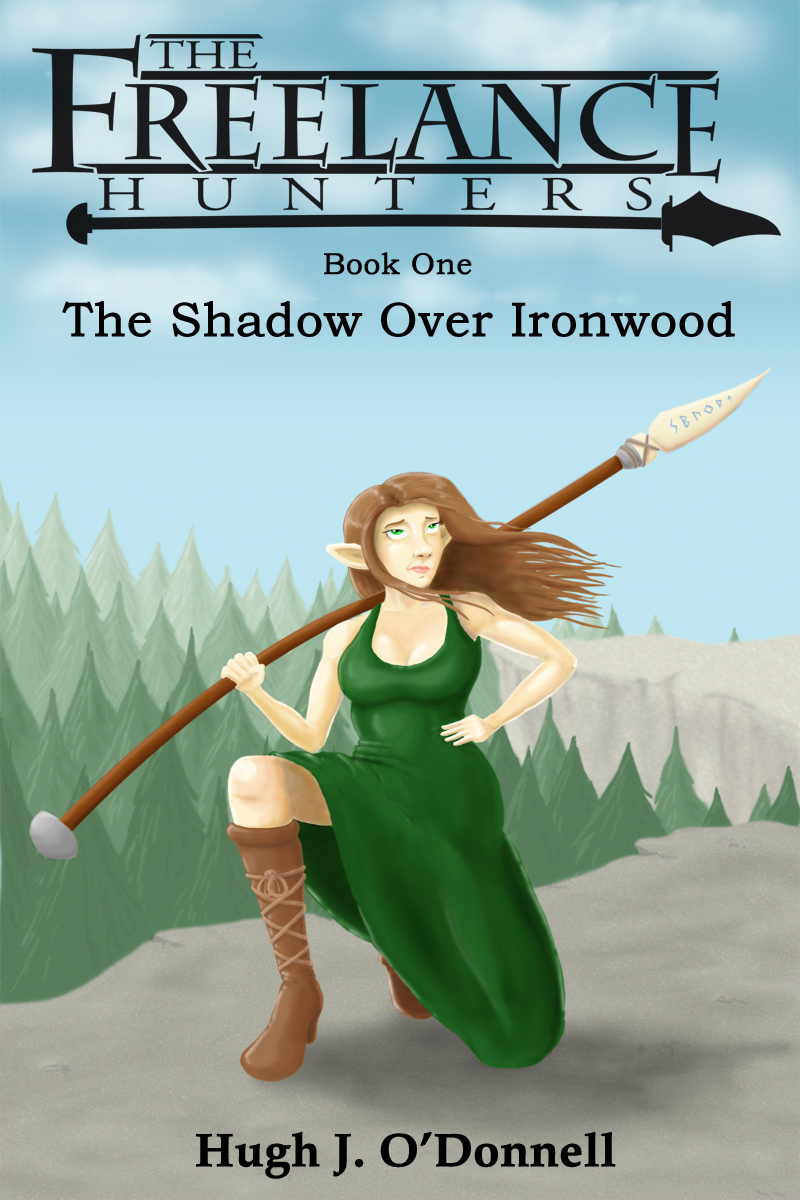
What secrets does the Ironwood hold?
Freelance Hunters Gloriana Bywater and Joachim Verne are on the job when a desperate Elf girl offers them a king’s ransom to liberate her forest from a mysterious threat. But no outsider has ever left the Ironwood alive. And what has befallen their companion Bingo Proudfoot?
Coming Spring 2013 to all major eBook retailers!
I’m pleased to reveal the cover of the first Freelance Hunters fantasy adventure novel! The cover was drawn by the talented artist Peter Tarkulich. Go check out his excellent webcomic Bardsworth! The Freelance Hunters logo was designed by Alex White, creator of The Gearheart. Much thanks to both gentlemen for all of their hard work.
if you’d like to get a look at this beautiful illustration in person, I’ll be appearing at the Buffalo Small Press Book Fair on April 6th and 7th! I’ll be giving away promotional post cards for “The Freelance Hunters” and “The Dark Wife,” and selling audio compilations of the best stories featured on The Way of the Buffalo podcast. Come down and say ‘hi’ if you’re in the area!
Final Fantasy III: An RPG with Class
March 17, 2013
Uncategorized Final Fantasy, Gaming, review Leave a comment
After FF2’s dramatic departures, Final Fantasy III is a return and refinement to the style of the original Final Fantasy. While there is a bit of hand waving to establish the four unnamed children of destiny as orphans living in a remote village, We’re pretty much back to the non-character party of Final Fantasy. Later remakes worked a bit harder at this, but for the NES era, we have four tabula rasa, which actually fits the premise well. This time, you they aren’t stuck in the same job for the whole game. This is the game where Square introduced the popular Job change mechanic.
How it works is players receive Job Points as they progress through the game along with experience and gold. As the game progresses, the story unlocks more available jobs to change into, allowing new classes for the characters. This gives the player a chance to experiment with different abilities without being corralled by the game.
Although it was originally released in Japan in 1990, the rest of the world didn’t get to (legally) play Final Fantasy III until 2006. The game was a late addition to the Nintendo Famicom library, and Square chose to release its 16-bit successor in the US as Final Fantasy II instead. For being released so late in the console’s life, the game takes better advantage of the hardware than the two previous entries. The game’s palette is brighter, the sprites are more detailed, and the game world is larger and more complex. Many of the games textures and sprites would be upcycled and reused in the Super Nintendo release of Final Fantasy IV.
The basic plot of Final Fantasy III combines the mechanics and exploration based gameplay of the first game with the more dramatic elements of the second. The player characters are four orphans in silly helmets who fall into a cavern after an earthquake. There, they discover a magical crystal, and are charged with solving the mystery of what caused the elemental macguffin to be sealed away in the first place, along with the other three, of course. The crystal gives them the ability to have and switch between a variety of different jobs. Each one has its own strengths and weaknesses, and gives the characters benefits when they level up. Fighters use swords and give more HP when leveling up, White Mages use magic and give better Magic Defense. As with the other entries in the series, These are old hat ideas now, but were excitingly innovative at the time.
As the game progresses, and the player explores more and more of the game world, each new crystal discovered grants new jobs. A colorful cast of NPCs provide the plot, and drive the story forward. This is where Final Fantasy III shines, expanding on the job-based gameplay from FF I and the drama-laden narrative from FF II.
This drama comes in the form of NPC characters who join up with the Light Warriors as they traverse the fields, forests, caves and ruins of the world. The party’s driving goal at any one time is determined by the needs of the tag-along characters, even if they don’t ride shotgun in battle the way they did in FF II. The party helps Cid get home safely, rescues the Prince of a war-torn kingdom from his possessed father, and more. Each of these episodic diversions feels like more than a simple side quest. They breathe life into the game world, and provide a welcome break from the 8-bit formula of now go to this dungeon and get the next crystal formula. And at the climax of the game, it is the good the player did in the world that proves more powerful than the arcane jewelry they spent the last 20 hours focusing on.
Final Fantasy III is the height of RPG craft in the NES era, and it is a shame that fans never got to play it in the days of its 8-bit glory. The game doesn’t hold up so well today, even with graphics and story updates. Much like the Disney film version of “John Carter of Mars,” this is something we’ve seen expanded and perfected in the years since it was originally devised. Going back to it is a fun history lesson, but only the hard-core need apply. Also, avoid the mobile versions. The control scheme is unworkably terrible.
Hugh Likes Comics: Saga # 1
January 22, 2013
Uncategorized Comics, HLC, Hugh Likes Comics, reviews, Saga Leave a comment
Hugh Likes Comics: Saga #1
Written by Brian K. Vaughan
Art by Fiona Staples
Lettering and Design by Fonographics
Saga is a great comic.
It is the story of a young couple who struggle to build a life for themselves in spite of being caught on opposite sides of a terrible war. Hardly a new idea, but Vaughan throws some big twists into the mix. This isn’t their love story. It starts with the birth of their daughter. And the parents are from two alien species that have been fighting an intergalactic war for as long as recorded history.
Marko is an escaped prisoner of war. Alana is the guard who helped him escape, and everyone on both sides wants them dead. Alana just gave birth to their daughter, and the only things they have to protect them is his magic, her gun, and a dubious treasure map. That’s an epic challenge that only a pair of extraordinary individuals could accomplish.
But Marko and Alana aren’t heroes by any stretch of the imagination. Much like his previous work, the epic “Y the Last Man,” Vaughan is telling a story of ordinary people in extraordinary circumstances. The fact that this particular set of circumstances is on a fantastical world on the far side of a distant galaxy only goes to show his talent as a writer.
“Saga,” much like that other big-time SF series, (You know the one, also begins with an ‘S’ it’s on the tip of my tongue) is the kind of space fantasy that only comes around once in a generation, and rewrites all the rules. Space fiction is primarily divided by scope. Either it is sprawling Space Opera, with grand scale battles and political maneuverings, or it is more personal and sociological fiction focusing on single characters and personal events. Saga does both, and does it in a brilliant way that satisfies the need for personal drama in the new family’s bid for freedom, and the large canvas as we see the robots, wizards, spies and bounty hunters all line up their sights on the helpless couple and their newborn.
Staple’s gorgeous and provocative art seals the deal. The opening birth scene, while not quite as in-your-face as “Miracle-Man,” doesn’t shy away. Especially when two teams of police interrupt to apprehend the fugitives. Another fine point to the art is the hand-lettered narration, which is incorporated directly in the images.
I won’t spoil any more of the plot, but Vaughan and Staples have me firmly on board for more. Right now, Saga #1 is free on Comixology. I recommend you go take advantage of that.
Hugh Likes Comics: The Top 5 of 2012
January 9, 2013
Uncategorized Atomic Robo, Bandette, Edison Rex, Hugh Likes Comics, review, Skullkickers, Wolverine And the X-Men Leave a comment
Number 5:
Atomic Robo and the Flying She-Devils of the Pacific
Written by Brian Clevenger
Art by Scott Wegener, Colors by Nick Filardi
“Atomic Robo” is a fun, smart action comic. The dialog sparkles, the art is bright and engaging, and the characters have a depth and grace that doesn’t get bogged down in ‘gritty’ melodrama.
This volume, set in the South Pacific after World War II, dealt with some heavy topics: the extreme determination of the Japanese Imperial Army, the discrimination faced by female pilots and mechanics in the second world war, and the abandoned stockpiles of ordinance and other deadly materiel after the conflict. It is a testament to Clevenger’s writing that the presentation manages to balance the slower character moments with dogfights, explosions, and mad science without any of the elements feeling forced or out of place. In fact, they support each other, lending the piece a sort of mad-cap gallows humor.
Number 4:
Edison Rex
Written by Chris Roberson
Art by Dennis Culver
Edison Rex is the story of a supervillain trying to make good. It is also a clever send-up of comics tropes and the industry itself. The series’s extremely flawed but charming protagonist is a fresh voice, and Roberson’s sharp wit, combined with Culver’s expressive figures and gorgeous sets, make this the comic your tablet was made for.
Number 3:
Skullkickers: Treasure Trove Vol. 1
Written by Jim Zub
Art by Edwin Huang
A massive collection of the first two trades, most of these comics came out before 2012, but the big collection came out this year, so it sneaks into this year’s list.
The mis-adventures of a human known only as “Baldy” and a Dwarf called “Shorty,” Skullkickers is an ultraviolent sword-and-sorcery buddy comedy. Equal parts Fritz Lieber and Marx Brothers, the pair struggle against fat werewolves, incompetent necromancers, and Disneyfied, but still incredibly deadly faeries. The main characters (I can’t quite call them ‘heroes’) aren’t discriminating. They’ll kill anything for 2 copper pieces. This series is over the top gory fun that manages to stay firmly on the side of slapstick. Zub’s dynamic writing and Huang’s art that makes the worst carnage downright pretty are the real saviors of this book.
Number 2
Wolverine and the X-Men
Written by Jason Aaron
Art by Various Artists
I love the X-Men, perhaps in theory a bit more than in practice. There are some iconic runs and great stories, but often the comic focussed on the down bits: The losses, the tragedies, and the plight of being different in a world that hates you. The X-men were great, but they weren’t FUN. Aaron’s team is approaching the concept from a different direction, and he’s pulling it off masterfully. With a new batch of students and a brand new school, the X-men cope with keeping everything running with a skeleton crew of adults. The characters are changing, accepting more responsibility, and still having crazy adventures fighting pre-teen arms dealers, killer space biologists, and even the dreaded League of Nazi Bowlers. The series is filled to bursting with crazy comic book moments and high concept shenanigans, but it all works and the Aaron keeps the plates spinning. I can’t wait to see where he goes next.
Number 1
Bandette
Written by Paul Tobin
Art by Colleen Coover
Bandette is an all-ages love letter to French comics, and hands down my favorite book of 2012. Coover’s digital ink-washed art is gorgeous, and unlike anything else out there today. Tobin’s writing is clever, funny, and gives you just enough of the mystery to leave you in suspense. And with a supporting cast of mysterious thieves, gruff police inspectors, and colorful villains, it can only get better from here.
You can find all of these comics on Comixology. Have your own picks? Leave a comment!
Hugh plans, muses laugh
January 5, 2013
Uncategorized Writing Leave a comment
In deference to the brilliant Brand Gamblin, who I stole this from, I’m committing my writing plan for 2013 here. It wouldn’t take much effort to look back through this blog’s archives to see that I didn’t meet my goal for writing in 2012. I try and wear a lot of different hats in the making-stuff-on-the-internet world, and this usually results in long delays as I dicker and generally run around like a chicken with my head cut off. 2012 also had its share of personal drama, both good and bad, but this isn’t a post for excuses, this is a post to get my ass in gear. So here, dear reader, is what you can expect from me in 2013:
Short story goals: For the past two years, I’ve halfheartedly participated in a Facebook writing group called “52 weeks, 25 Stories.” As you can guess, I haven’t pulled through on a lot of those stories, but I have a surprisingly large number of first drafts, fragments, and story outlines that are just collecting virtual dust on my hard drive. I’m the sort that much prefers plowing through the pure driven white page of the first draft over wielding a deadly red pen, and this has to be the year that I buckle down, take my medicine and learn to love my inner-editor. My first goal for 2013 is to edit a story a month and get it out the door, into the hands of the doubtlessly huge throng of magazine, podcast, and anthology editors awaiting them.
So that’s twelve stories down for the year. My other short story goal for 2013 is to submit a new story for each prompt hosted this year at a little site you may have heard of called Every Photo Tells. I have started a lot of stories based on prompts from the site, but my writing process is a bit too loose to reliably start, finish, and edit a story in thirty days. This needs to be fixed, and you’ll hopefully be seeing a lot more of me there in 2013.
And now, on to the big guns.
Right now, the long form work that is sitting squarely at the center of my plate is “The Shadow Over Ironwood.” This is a novella that I’ve been working on, picking up, promising, and putting down again for years, and it needs to be finished and released in ebook by the end of March. This is kind of a daunting task for me, because it will be my first ebook novel, and I have a lot to learn still about formatting and making the book look and function properly.
The rest of the year is going to be divided between two novels. “FIrewalker” originally started life as a nanowrimo novel, but I found the ideas I began to play with in the work were too exciting to put down. With some help from the folks at the Roundtable Podcast, I’ve begun to take the post-nano skeleton, and clone a real live velociraptor of a novel out of it. My goal for this year is to mold it into shape and send it off to beta readers.
The other novel is one that I’ve been wanting to write for years, but haven’t felt ready to until now. I’ll be beginning the first draft in February, as soon as “Shadow” is off to beta readers for final feedback. “Changeling” is an urban fantasy story about breaking down stereotypes and finding your place in the world. In a more immediate sense, it’s the story of a gay leprechaun hacker who solves mysteries.
Let me explain. If there is one thing that really bothers me in media, be it movies or television or the written word, it is stereotype. Even when characters are not necessarily NEGATIVE, I resent the idea of anyone being pigeonholed. As a nerdy gay man of Irish-American descent, sometimes I feel like I can’t throw a rock without running into one. “Changeling” is my attempt to steal something back, and it is extremely important to me. I want people to be able to read it as soon as possible.
So these are my writing goals for 2013: Three novels and two dozen short stories. Easy, right?
 Hugh J. O'Donnell