Home

The Legend of Zelda: A Link Between Worlds

Leave a comment

The Legend of Zelda: A Link Between Worlds


It has been said that Nintendo is a company stuck in the past. That they retread old ideas and characters, plying on nostalgia rather than innovation. And while there’s truth there, when they get it right, OH MAN do they get it right.

“The Legend of Zelda: A Link Between Worlds” is a 3DS sequel to the Super Nintendo’s “A Link to the Past.” Old School fans of the series will find the maps, designs and plot familiar. Mysterious figure arrives in Hyrule, is immediately revealed to be a bad guy, Link has to collect three pendants and the Master Sword to follow him to the other half of the game.

While it looks like “A Link to the Past’s” Dark World, the other section of the game takes place in Lorule, a more developed mirror kingdom complete with its own Princess and villagers. And Lorule is, for reasons that remain unclear until the end of the game, being torn apart.

Link can travel between the two dimensions using the game’s key new ability. Thanks to a magical bracelet he acquires early in the adventure, Link can change himself into a painting, and walk along walls. It’s a strange ability, and not particularly intuitive at first, but it is masterfully executed in the game, and provides a whole new set of puzzles to solve.

The other major change is that Link’s tools lack ammunition. Instead, Link has a stamina bar that slowly refills, and is shared by all of his rods, bombs, and ranged weapons. Link has access to most of his standard equipment very early in the game as well. This makes “A Link Between Worlds” a much less linear affair than previous games. Link has the ability to tackle dungeons in any order he likes.

The design of the dungeons is quite good, although some of the puzzle solutions felt a bit easy. Since the player has to do a lot less hunting for rupees and equipment, the game seems a bit short.

The artistic elements are reminiscent of the super nintendo, but trades sprites for nicely rendered 3d models. Although most of the game is seen from the top down, a few cut scenes switch to a perspective closer to the ground, and show off the 3DS’s horsepower. The actual 3d is possibly the best I’ve seen on the system. The terrain of Hyrule sinks into the screen, and enemies leap out. This is the first game where I honestly preferred to keep the 3d turned up the whole time.

“A Link Between Worlds” is a great game for players who are new to Zelda, and it rewards fans of the series with plenty of easter eggs, like Majora’s Mask, which can be found on the wall of Link’s House, but unfortunately, can’t be worn.

The game is a wonderful update on a classic, with an amazing twist ending. I highly recommend it.
Hugh Likes Comics: The Top 5 of 2013

Leave a comment

Image

#5: Batman ’66: I like stories that go all-in. No pussy-footing around, not Super-Heroes-but-no-tights, which seems to be de-reguer, particularly at “The Big Two.” That’s why I was pleasantly surprised by this outing from writer Jeff Parker and artist Jonathan Case. They’ve returned to the source material of the ’60’s Batman TV show, complete with dancing and giant sound effect bubbles. The digital versions have a few more tricks up their sleeves to evoke the classic series. Batman ’66 embraces everything the New 52 disdains, and soars because of it.

Image

#4: Saga: Vaughan and Staples continued to knock it out of the park this year with Saga. The story of an ancient interstellar war cut with family drama, mercenaries, and the ways art can change a person make for a heady mix. The art remains evocative and controversial. Saga doesn’t pull its punches, but it isn’t crass, either.

DIG008301_2

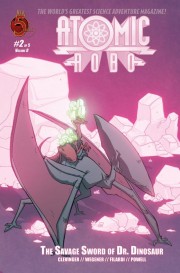
#3: Atomic Robo: The Savage Sword of Dr. Dinosaur: There was little chance for Clevenger and Wegener to escape this list as well, with this nail-biting installment that puts Atomic Robo at the site of an impossible underground city, with shadow military agents storming his headquarters, and completely unstable velociraptor mad scientist Dr. Dinosaur sitting on a stockpile of stolen nuclear warheads. Atomic Robo remains funnier and smarter than it has a right to be.

DIG010027_2

#2: Sandman Overture: We only got one issue of Neil Gaiman’s return to his seminal Byronic Dream King, but oh boy, was it ever a doozy. Filled with all of the gothic-horror elements that made Sandman great, and with exceptional art by G H Williams III, This comic is a rare treat for Morpheus fans. Hopefully, we’ll get to see it a bit more frequently in 2014.

DIG013410_1

#1: Young Avengers: Sadly ending in early 2014, Young Avengers is a comic that knows exactly what it wants and goes right for it. Under the direction of comics super-team Keiran Gillen and Jamie McKelvie, the Young Avengers bring a little bit of their indie hit “Phonogram” into the Marvel Universe. “Young Avengers” pits focuses less on what it means or takes to be a superhero than it does the trials and tribulations of modern teenagers. After a poorly planned bit of magic use, a group of teens find themselves fighting against an magical parasite that draws power from how parents don’t understand teenagers. It is a fantastic high-concept very well executed. Unfortunately, for a teen book, there is a lot of backstory for these characters that just isn’t given. I’ve felt in over my head a few times, but I’ve loved the ride. Another plus in this comic’s favor is that it has possibly the highest collection of LGBTQ characters anywhere in ‘the big two,’ and handles them with then same excellent touch as earlier Young Avengers installments.

2013 No-Prize: Dan Didio continues to be comics’ greatest super-villain. He spent the year making sure no DC Comics characters have any fun on his watch. After denying the upcoming marriage of Batwoman Kate Kane, he went on to say that none of DC’s heroes should have a stable home life, and seems to be making certain of it. His crowning achievement this year: Creating an art contest for Harley Quinn #0 which included drawing the beloved children’s TV character naked, despairing, and about to commit suicide. After much outcry, the panel did not appear in the final version.

Honorable mentions:

X-Men: Teenage Mom Jubilee, enough time-travelers to stage a production of “Les Mis” and other crazy nonsense. Marvel seemed to focus on their movie-friendly characters like the Avengers in 2013, but there was still a ton of mutants out there, including an all-female team!

Edison Rex: Artist Dennis Culver gets the nod for designing not just a new set of comics characters, but an entire major publisher’s line-up of heroes and villains. My personal favorite: ROFL, an omnipotent extra-dimensional being using the form of a muppet Grant Morrison.

Subatomic Party Girls: Simms and Bowers had the stones to use the line ‘Do you realize we’re floating in space’ unironically. Props.


Megaman I: Elegance in Design

Leave a comment

System: Nintendo NES/Famicom

Release Date: 1987

Megaman’s creator, Keiji Inafune recently funded a kickstarter for his new independent project, Mighty Number 9. Inspired by the buzz surrounding the new project, I went back and looked at the Blue Bomber’s original adventure with new eyes.

I didn’t have “Megaman” for my NES, but lots of my friends did, and I remember the games fondly from the early nineties. I also recall them being controller-threateningly difficult. I was curious to see how the first outing would stack up to my memories.

First of all, it is worth noting that the first game lacks the graphical and musical polish of the sequels. There are only six stages, and once the player determines the proper order for playing them, they fall rather quickly. Especially if you use the well-known ‘pause trick.’ Likewise, there’s not much of a story besides ‘You’re a good robot, they’re evil robots, go fight them.’ It’s the sort of fare from the era that is simple, but has been expanded upon greatly in the years since. For example, in the much-praised Megaman comic, put out by Archie Comics.

While I will agree that Megaman is hard, it was not quite so bad as I remember. Aside from a few of the end stage bosses, (and I am looking squarely at you, one-eyed rock monster) the deaths don’t feel cheap. Unlike other 8-bit era platformers, there is no countdown clock. The game gives you plenty of time to observe and experiment. Megaman really is the start of what later-generation indie developers would call ‘puzzle platformers.’ Most of the game can be best progressed by observing the challenge and discovering the pattern, or choosing the best Robot Master’s subweapon for the situation. For example, the flying torpedo enemies can often knock you into a pit when they explode, but freezing them rather than shooting them with your regular gun solves the dilemma. Most of the jumping puzzles can likewise be bypassed with the Magnet Beam.

This creates an odd challenge curve as the game actually gets EASIER as you gain new powers. The game’s non-linear nature lets you play the stages in any order, but the real challenge is figuring out an optimal path. each Robot Master has a weakness, and some levels, such as Fire Man’s stage, are practically impassable without the right weapon.

All in all, Megaman I is a solid entry in the NES’s roster of games. While its sprites and textures are a little less eye-popping than its successors, it is at the very least noteworthy for being the progenitor of something great, and a whole lot of fun. You don’t need to play it to get into the series, as there isn’t much of a story aside from the window-dressing standard to that generation, but it is certainly worth your time. Just watch out for those disappearing block puzzles.

Hugh Likes Comics: Wolverine and the X-Men # 19

Leave a comment

Wolverine and the X-Men #19, Written by Jason Aaron, Penciled by Nick Bradshaw. Available from Comixology or YOUR LOCAL COMICS SHOP!

After tearing “Avengers vs. X-Men” a new one in the last entry, I’m glad to be able to recommend something from the House of Ideas, and if there is anything this comic is full of, it is wonderful, crazy, hilarious ideas. The issue opens with an assault by a second rate super-villain made of ‘nazi bees’ and ends with a reveal so great that I’m not going to spoil it here, although I may have already spilled the beans on my twitter feed.

Wolverine and the X-Men is the story of the Jean Grey School for Gifted Youngsters, and it is just fantastic. This issue is a wrap-up point after the big crossover, and the start of a new semester. This may or may not be the best place for new readers to jump on, but it gives a good cross section of the kinds of stories that this book has at its heart.

In a previous issue, one of the students was shot, and is at death’s door. While the rest of his classmates are on another world volunteering at a shelter for aliens displaced by the Phoenix, Wolverine is out looking for the assailants. Meanwhile, Beast has shrunk himself down “Fantastic Voyage” style and conducts hands-on brain surgery. He grows back to normal size and consults with a panel of Marvel’s smartest scientists: Mr. Fantastic, Iron Man, and Spider-man, all of whom have Skyped in to lend assistance. The rest of the issue is some comic relief: Shadowcat is interviewing replacement teachers, and a host of unlikely but hilarious candidates, including Blade and Ghost Rider, have turned up to apply.

The issue is by turns goofy, chilling, and heart-wrenching. But most importantly, it is fun and authentic. With a huge cast and divergent storylines, Aaron does an amazing job keeping all the plates he has going spinning, and giving us a ride that is enjoyable and surprising. And in spite of all the big ideas, the super-hero schools and the size-changing brain surgery, it is the characters that shine through. These aren’t simply mannequins equipped with wish-fulfillment powers and one-liners. His students feel like teenagers. Moreover, he gets what it is to be a mutant teenager better than any x-writer I’ve seen in a long time: Not merely the terror of being different in a world where being different is BAD, but also the swagger of having power, but not the wisdom to restrain it. He frames the adults perfectly as well: They are there to protect these kids, not simply train them. I can’t recommend this comic highly enough. Go check it out.

Hugh Likes Comics: Edison Rex #1

Leave a comment

Written by Chris Roberson, Art by Dennis Culvur, Colored by Stephen Downer, Lettered by John J. Hill, Edited by Allison Baker. Published by Monkeybrain Comics. Available from Comixology.

“Edison Rex” is a thinking person’s goofy superhero comic. The flagship of the Monkeybrain line of creator-owned digital comics, it is written by publisher Chris Roberson. Like the rest of the line, it is a short, periodical comic designed to be published around other commitments.

Roberson recently worked on a short and controversial run of Superman comics. Perhaps it is unsurprising that his new work focuses on the death of a Superman-like hero at the hands of his arch nemesis, the eponymous “Edison Rex.” What is surprising is that the climax of their relationship isn’t a titanic brawl. It is a conversation, and it is handled with subtlety and craft.

The hero Valiant arrives at the hideout of the criminal Rex, ready to bring him to justice. Rex doesn’t want to fight, he wants to talk. Roberson and Culvur guide us through the villain’s lair, the two characters’ personal history, and a few interesting science fiction ideas along the way. The dialog feels natural, without getting too deep into ‘as you know’ information dumps, and Culvur’s art prevents the issue from feeling like a talking head sequence. I especially liked the evolving design of Valiant’s costumes, and the expressiveness of his faces. It becomes clear that Rex is seeing the culmination of a plan he didn’t really think would work. These characters really feel like they might be ending decades of comic-book confrontations, rather than appearing in their first issue.

The comic ends with an implied question, which is going to be the backbone for the series: What do you do once you’ve reached your life’s goal? And if that goal is the destruction of the world’s mightiest defender, there might be some problems. It falls to our criminal genius to take up the cause of saving the world.

Edison Rex is a comic that perfectly balances the crafts that have gone into it. The writing, art, and design all compliment each other in a way that would fall flat otherwise. This is the kind of comic that shows just how and why comics work as their own medium, rather than the lesser sibling of film or prose. Rex is a standout comic, with a flawed protagonist that is thought-provoking while still being loads of fun. This is a series to watch.

edisonrex1-lg

Review-Free Will and Other Compulsions by J. Daniel Sawyer

Leave a comment

Free Will on Goodreads

J. Daniel Sawyer’s “Free Will” is a smart, sexy cyberpunk novel worthy to be placed on the shelves next to Gibson, Varley, and Heinlein.  It has a very unique voice, a wonderfully diverse cast of characters, and plenty of thrills, but it isn’t without its flaws.
Free Will and Other Compulsions is the second novel in the “Antithesis Progression.”  The story follows geopolitical events and personal stories as the American space colony Luna City prepares to start a revolt against its earthbound controllers.  While this isn’t exactly unbroken ground, Sawyer establishes a very rich history for the different space colonies.   Not all of them are working towards the same goal.  Luna City, while full of clever hat tips to the Masters of Science Fiction, is established as a haven for groups outcast on Earth for their beliefs, politics, or sexual identity.  Parts of it read like “The Moon is a Harsh Mistress” with big gay dock workers, which is awesome.
The rest of the story follows scheming Senator Bill Shelly, who is manipulating the situation to his own ends, and the personal and political fallout as all the people he’s burned over the years, including poker playing anti-hero and former national security advisor Joss Kyle, and even his own daughter, come back to haunt him.
There are a few flaws, however.  This is the second book in the series, and Sawyer assumes that readers are familiar with all of the details from the first book, Predestination and Other Games of Chance.  The world is very detailed, and it is well researched, especially where the author extrapolates technology out another century, but there are so many factions, characters, places and technologies, that a glossary would have been helpful.  He also assumes the reader has a good grasp of science, politics, and theology, rarely holding the readers hand.  This is a challenging thrill ride that isn’t afraid to take chances.  Like it’s characters, “Free Will” lays its cards on the table and bets that the reader will be able to keep up.  It doesn’t always pay off, but when it does, it works beautifully.
The novel follows a huge cast and sweeps them into a vast tumble of world events.  We follow these characters in chapters that follow dramatically, but don’t quite sync up chronologically, and the results can be disorienting, but Sawyer manages the human element well enough that even if the events get lost, the characters shine through, and keep us invested.  Plot threads weave sinuously and cleverly together, and reinforce one another in surprising ways.  These diverse plot threads come together so well that by the end it becomes difficult to find the seams between them.  In the end, it is difficult to say what the main plot of the novel is.
“Predestination” is a novel about running from, and ultimately facing, difficult decisions.  “Free Will” is a novel about facing consequences.  The “Progression” is still under construction, with at least three more novels in the works.  I think fans of the first book will still be on board after “Free Will.”  Personally, I can’t wait to see where the Lunar Revolution goes next.
Note:  This article is based on an earlier draft of the novel.  Some differences likely exist between the reviewed copy and the final release, including edits of grammar and spelling.

Newer Entries