Home

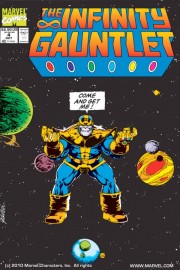
Hugh Likes Comics: The Infinity Gauntlet

Leave a comment

Infinity gauntlet

Written by:  Jim Starlin
Drawn by: George Perez
Published by Marvel Comics

As a rule, I really don’t like crossovers.  They’re messy, over-crowded affairs where heroes act out of character to fit the story, and their endings tend to be unsatisfying piles of continuity.  Event full of sound and fury where “everything changes” but at the end of the story, everything is pretty much back where they were.  Oh, she might be in a different costume and he might have been replaced with his sidekick, who looks the same except for the cybernetic arm.  The status quo remains king.
And then there’s “The Infinity Gauntlet.”  This is the one that got it right.  It’s a threat that is based off of years of continuity, but clear enough that one doesn’t need to invest a college savings in back issues to know who’s who.  It’s a threat that is credible, active, and present, not only for the heroes, but for the entire fictional universe.  A threat that is credible enough to not only bring the Marvel Universe together, but also put their backs against the wall.
It also manages to balance character study and knock-down, drag-out, cosmic-level fighting.  In the first issue, Thanos, elevated to genuine omnipotence thanks to the eponymous gauntlet, snuffs out half the life in the universe.  He does this because it turns out that he’d like to hook up with the Universe’s personification of Death.  Death is, naturally, a hot lady, because Comics.  Unfortunately, all of his god-like power fails to catch her eye.  Having gained unmatched power, and being unable to effectively use it is the core of Thanos’s character, and it is an interesting contrast to the surviving heroes and villains, who are left with the task of fighting a hopeless battle against the Mad Titan.
The climax of the series is a fight where he faces of and wins against first every hero in the Marvel Universe, and then the super powerful Cosmic Forces.  It gets a bit metaphysical, but the thread of the story never gets lost, and Perez’s expressionistic art captures it all perfectly.
The Infinity Gauntlet isn’t just a cheap cash in.  It is the basis for twenty years of comics storytelling, and possibly the endgame Marvel’s cinematic universe is heading towards.  Even if you have no interest in those things, it is the Platonic Ideal of a Marvel comic.  A story of superhuman power filtered by the lens of the most human emotions.
The Infinity Gauntlet is available from Comixology, Amazon, or Your Local Comics Shop.
Hugh Likes Comics: Dragon Ball

Leave a comment

Hugh Likes Comics:  Dragon Ball
Written and Drawn by Akira Toriyama
Published by Viz/Shonen Jump

Although it is a big part of my own path through comics, I haven’t talked about manga in this space.  Manga, broadly speaking, refers to Japanese comics, or occasionally comics drawn in a Japanese style.  These comics have a visual language all their own, enjoy vast popularity the world over, and one of the best loved of these is “Dragon Ball.”
Spanning over forty volumes, spawning four long-running animated TV shows, a vast collection of movies, and enough merchandize to sink a container ship, Akira Toriyama’s “Dragon Ball” is a full-fledged cultural phenomenon.  Originally a goofy, cartoonish Sci-Fi retelling of the Monkey King legend, this is the story of Son Goku, an incredibly strong, perfectly innocent child as he travels with teenage prodigy Bulma to gather the Dragon Balls, seven mystical stones which, when brought together, will grant any one wish.  Along the way, he becomes the greatest martial artist in the universe, and saves the world a few times, to boot.
With its beyond epic length, the thing I find really interesting about Dragon Ball is that it so completely documents the evolution of Toriyama as an artist.  His style is very round and iconic, and at the beginning of the comic, much more rooted in sophomoric humor.  It certainly isn’t what you’d expect from the martial-arts action story it becomes.  While Toriyama never completely lets go of his comedic side, the series becomes more and more of an action comic as the tale unfolds, until we reach halfway through and it becomes “Dragon Ball Z.”
With its focus on space adventure and over the top martial arts, DBZ is what got translated first.  It appeared in incomplete forms on American and Canadian TV in the 90’s.  And I fell in love with it.  But now I think I prefer the original stories about Goku’s childhood.  The adventures are more fun, more playful, and less reliant on gimmicks and ‘power levels’ to keep the tension high.  “Dragon Ball,” by contrast, remains delightful and ridiculous throughout, including a cameo crossover with his earlier work “Dr. Slump,” in which just about every character tries to squeeze into a panel for a fourth-wall breaking cameo.
“Dragon Ball” comic is particularly a comic of its time and place, but like its protagonist, it mixes goofball humor, iconic visual style, and thrilling action in perfect amounts with a perfect garnish of child-like whimsy.  Go pick up a copy, and be a kid again for a few hours.

Dragon Ball on Amazon.com (Affiliate Link)

Dragon Ball on Comixology.com


Newer Entries